Executive Summary
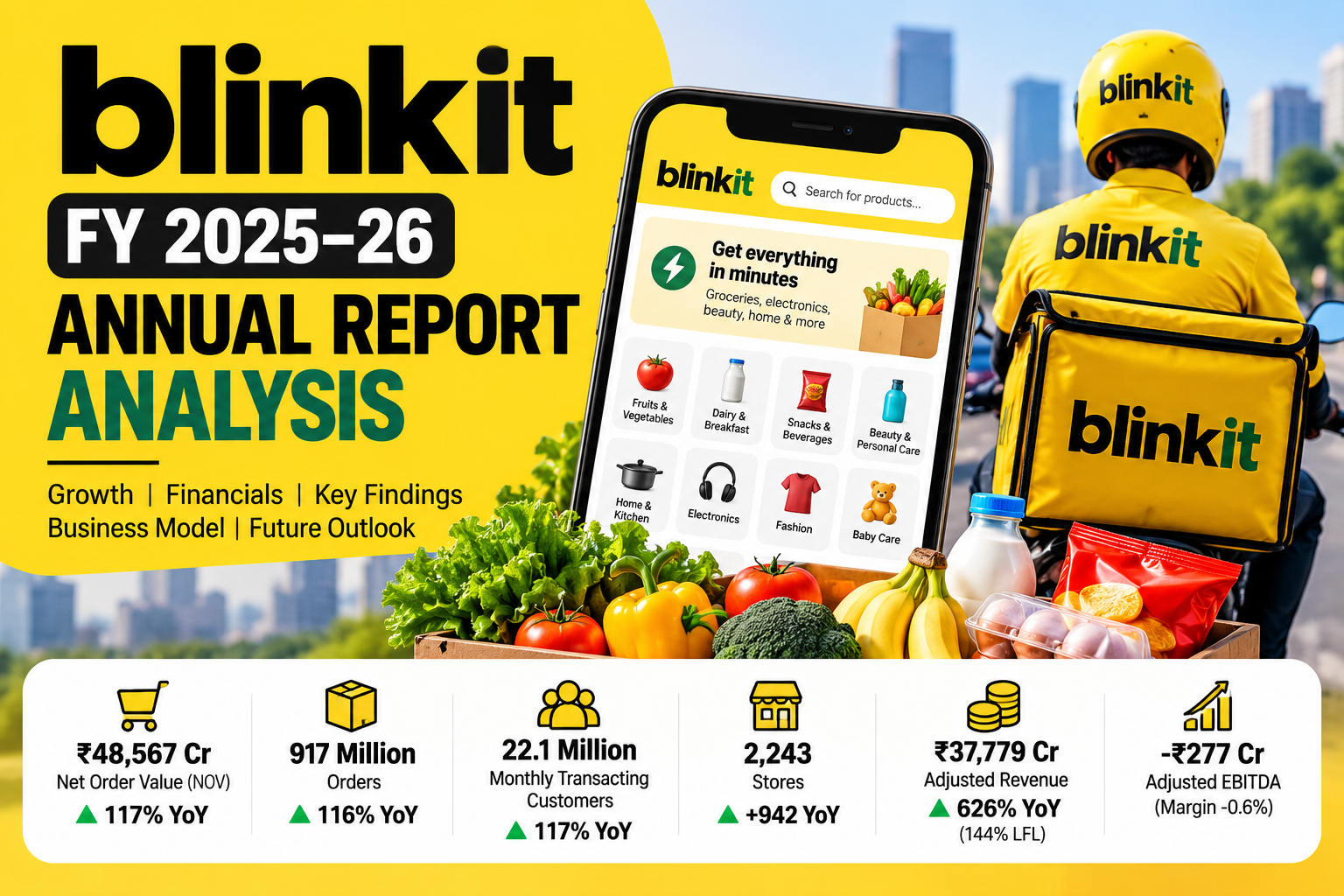
Blinkit was the defining growth engine of Eternal in FY26. Quick commerce became the company's largest B2C business by annual NOV, reaching ₹48,567 crore, ahead of food delivery.
The business combined extraordinary scale expansion with a strategic shift toward inventory ownership. By March 2026, approximately 90% of quick-commerce NOV was on owned inventory.
FY26 Snapshot
Metric | FY26 / Finding |
NOV | ₹48,567 crore; +117% YoY |
Orders | 917 million; +116% YoY |
Monthly transacting customers | 22.1 million; +117% YoY |
Net AOV | ₹530; +0.3% YoY |
Stores | 2,243 across 250+ cities |
Net new stores | 942 |
Warehousing | 8.5 million sq ft |
Adjusted Revenue | ₹37,779 crore |
Adjusted EBITDA | -₹277 crore |
Adjusted EBITDA margin | -0.6%; Q4 FY26 reached 0.3% |
Why Blinkit Became the Largest B2C Business
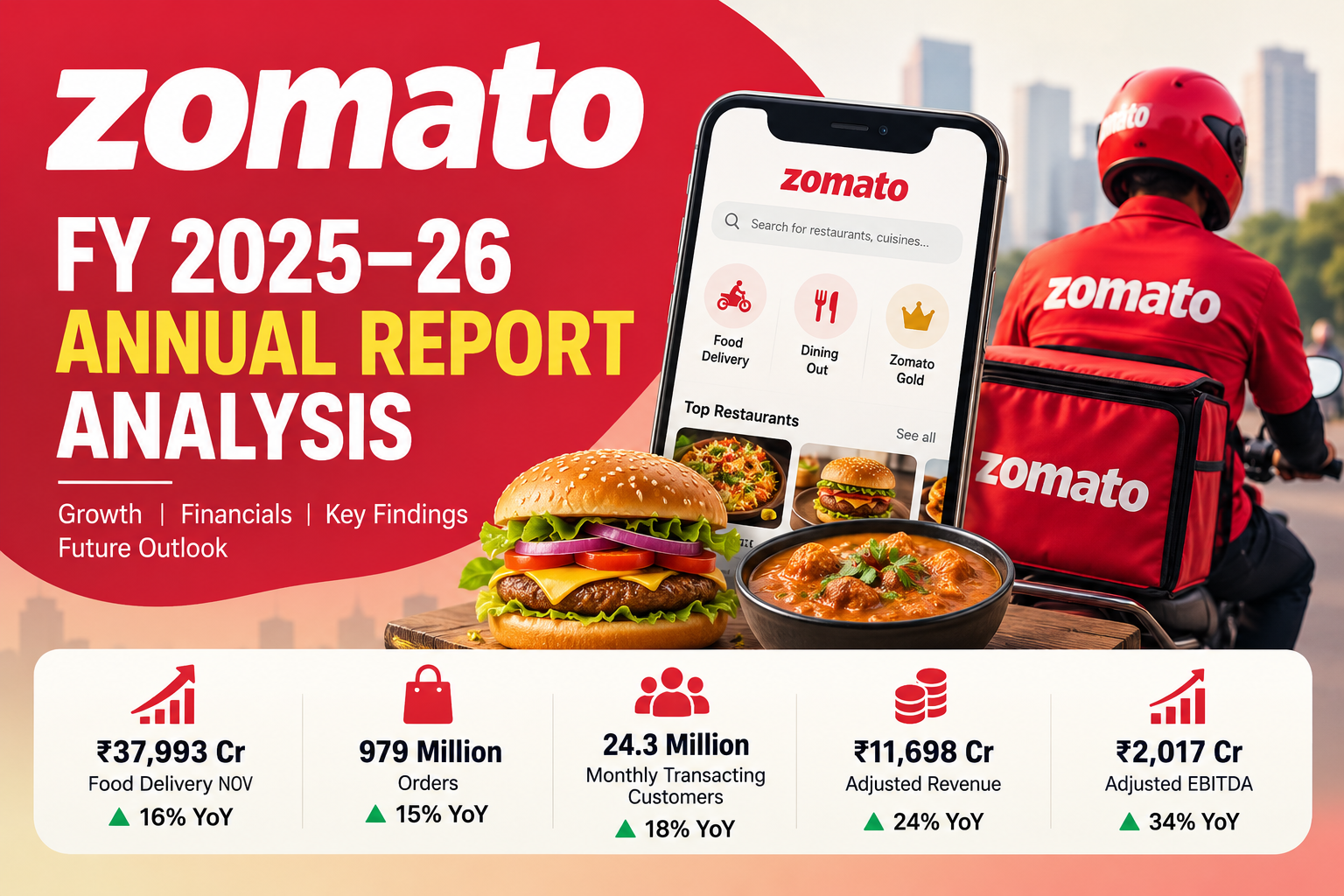
Blinkit's NOV reached ₹48,567 crore, surpassing food-delivery NOV of ₹37,993 crore. The growth was driven by a 116% increase in orders and a 117% increase in average monthly transacting customers, while NAOV remained broadly stable.
Inventory Ownership Transition
FY26 marked a major business-model transition from a marketplace model toward inventory ownership. The company states that owning inventory gives it greater control over assortment depth, margins, product availability and speed of assortment expansion.
Approximately 90% of quick-commerce NOV was on own inventory by March 2026. This transition is also important when interpreting revenue growth: reported quick-commerce revenue increased 626% to ₹37,779 crore, while like-for-like growth was 144% after excluding the cost of goods sold effect associated with own-inventory sales.
Store and Infrastructure Expansion
Blinkit added 942 net new stores during FY26, taking the network to 2,243 stores across 250+ cities. It added approximately 3.3 million sq ft of backend warehousing during the year, taking the total warehousing footprint to 8.5 million sq ft.
The company remained on track for approximately 3,000 stores by March 2027. Average NOV per day per store remained broadly stable at about ₹756,000 despite rapid network expansion.
Assortment Expansion
Blinkit expanded beyond traditional grocery and daily essentials into electronics, beauty and personal care, home products, toys and games, sports accessories, general merchandise and other categories. The report highlights a very broad assortment, supporting the transition from emergency grocery delivery toward general-purpose instant commerce.
Profitability
Adjusted EBITDA loss reduced from ₹292 crore in FY25 to ₹277 crore in FY26. Adjusted EBITDA margin improved from -1.3% to -0.6%. The business reached Adjusted EBITDA break-even in Q3 FY26 and reported a positive 0.3% Adjusted EBITDA margin in Q4 FY26.
Growth Outlook
Eternal expects Blinkit NOV to grow at 60%+ CAGR over the next three years. The stated growth drivers are assortment expansion, geographic coverage, demand densification and improvements in service quality and reliability.
The company expects the business to reach a steady-state Adjusted EBITDA margin of approximately 5–6%, with some mature cities already approaching steady-state margins.
Key Findings
1. Blinkit became Eternal's largest B2C business by NOV in FY26.
2. Growth is primarily volume-led, with customers and orders more than doubling while NAOV remained broadly stable.
3. The inventory model is a fundamental strategic change, not simply a reporting change.
4. Store density and warehousing infrastructure are becoming important competitive assets.
5. Profitability is moving closer: Q4 FY26 achieved positive Adjusted EBITDA margin.
6. The principal strategic challenge is balancing very high growth and infrastructure investment with sustainable unit economics.
Conclusion
Blinkit has moved from being Eternal's emerging growth business to becoming its central growth engine. The next phase will be defined by the ability to convert scale, inventory control and network density into durable margins while maintaining customer experience and competitiveness.