Introduction
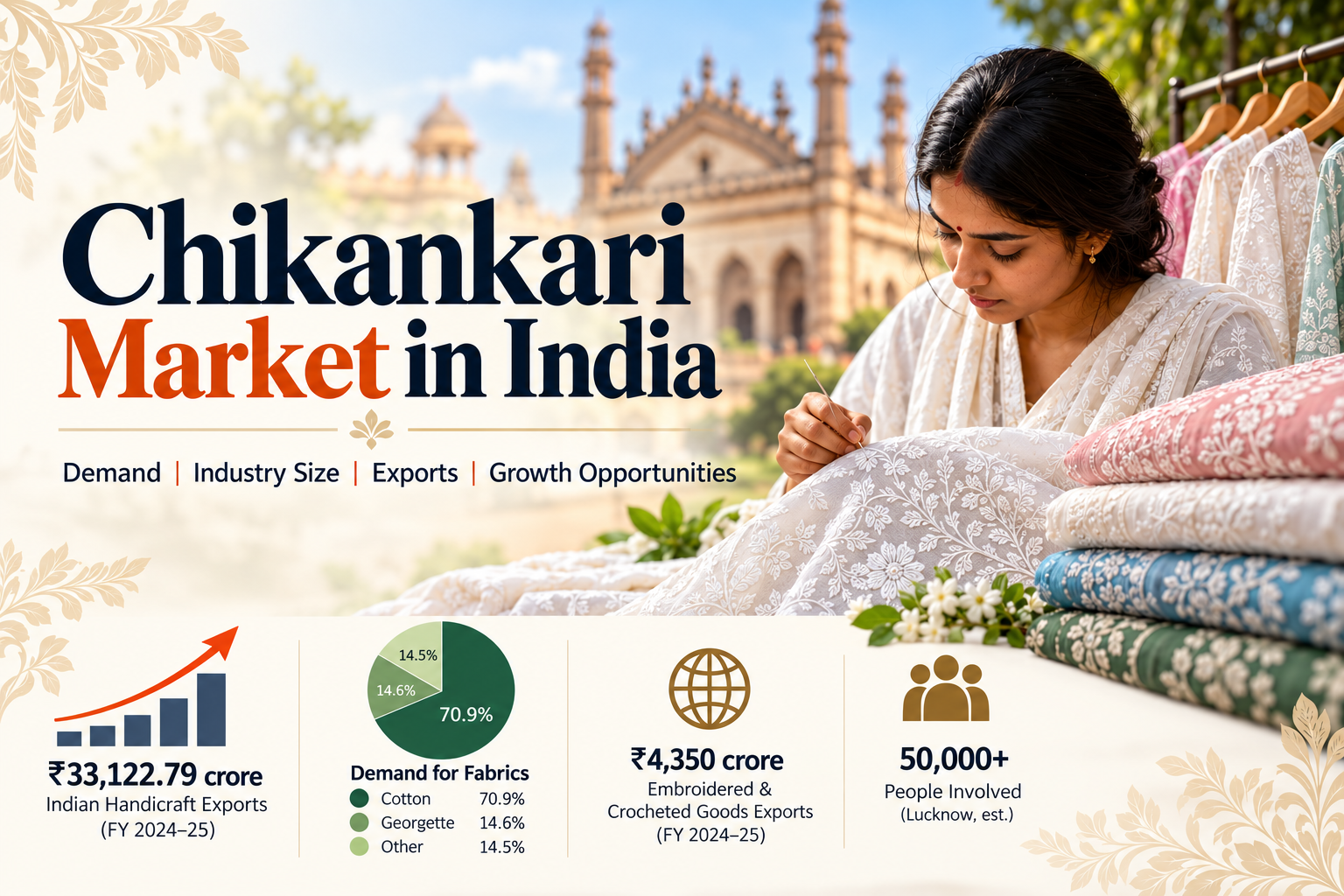
India’s Chikankari industry sits at the intersection of traditional craftsmanship, women’s livelihoods, contemporary fashion and the wider handicrafts economy. Originating in Lucknow, Uttar Pradesh, Chikankari has moved beyond traditional ethnic wear into modern clothing, designer collections and online retail.
For entrepreneurs, clothing brands, manufacturers, wholesalers and exporters, the opportunity is not simply to sell embroidered garments. It is to build businesses around authentic craftsmanship, dependable artisan sourcing, product innovation and access to wider markets.
A key limitation must be made clear: the sources reviewed for this article do not establish a current, independently verified standalone national market-size figure for Chikankari. The figures below therefore distinguish broader handicraft statistics, local research findings and individual artisan examples.
1. Chikankari market in India: Key statistics
Indicator |
Reported figure |
Interpretation |
Cotton in a Lucknow-focused study |
70.9% |
Leading fabric in that study’s reported preferences |
Georgette in the same study |
14.6% |
Smaller reported fabric segment |
Embroidered and crocheted goods exports, FY 2024–25 |
₹4,350 crore |
Broader Indian export category; not Chikankari-only |
Total handicraft exports, excluding hand-knotted carpets, FY 2024–25 |
₹33,122.79 crore |
Wider handicraft export ecosystem |
Women trained by one documented master artisan |
500+ |
A local example of artisan training |
Women regularly receiving work at that centre |
Around 10 |
A local example, not an industry-wide count |
Earnings reported per finished product |
₹1,200–₹1,500 |
Specific artisan case; not a national average |
Sources: Press Information Bureau (PIB), Government of India; a Lucknow-focused Chikankari consumer study. The export figures refer to broader trade categories, not to Chikankari alone.
2. India’s handicraft exports: A wider market opportunity
India’s handicraft exports, excluding hand-knotted carpets, increased from ₹20,082.53 crore in FY 2014–15 to ₹33,122.79 crore in FY 2024–25, according to the Press Information Bureau. This is an increase of about 64.9% over ten years, equivalent to approximately 5.1% annualized growth.
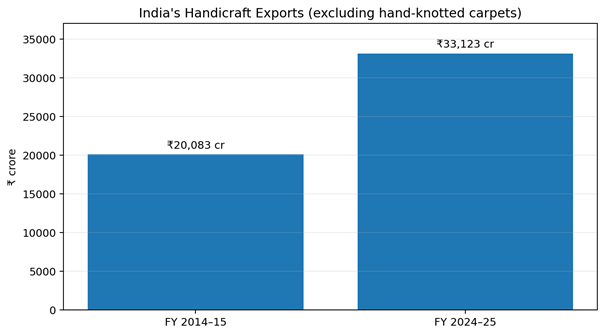
Figure 1. India’s handicraft exports excluding hand-knotted carpets. These figures cover the wider handicrafts sector and should not be interpreted as Chikankari exports.
The government also reported ₹4,350 crore in exports for the broader category of embroidered and crocheted goods in FY 2024–25. This is approximately 13.1% of the reported total handicraft exports figure above. It is a category-level comparison only; it does not represent Chikankari’s share.
3. Chikankari industry size: What do we actually know?
A Lucknow-focused research paper, “Evaluation of Growing Opportunities of Chikankari Product: With Special Reference to Lucknow City,” cites historical estimates of approximately ₹2,000 crore in annual turnover, 50,000 people involved in the sector and 5,000 shops. These figures are attributed secondarily to an older source and should not be treated as verified 2026 statistics.
Three different measures should be kept separate:
·Market revenue: the total value of Chikankari products sold during a defined period.
·Industry participation: artisans, traders, manufacturers, retailers and other workers in the supply chain.
·Export value: products shipped internationally under defined customs and trade classifications.
A reliable current market estimate would require product-level domestic sales, wholesale turnover, export data, business counts and checks for overlap between retail and wholesale sales.
4. What fabric preferences tell us
The Lucknow-focused study reports cotton at 70.9% and georgette at 14.6% of recorded fabric preferences. The remaining 14.5% is calculated as the difference from 100%; it was not separately identified as one specific fabric category. The study’s sample is local, so these percentages should not be presented as national market shares.
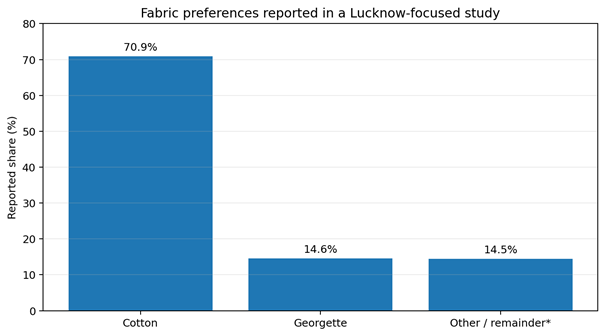
Figure 2. Fabric preferences reported in a Lucknow-focused study. “Other / remainder” is calculated, not a separately reported category.
For product development, cotton garments such as kurtis and everyday suits are a reasonable segment to test first, based on the study’s finding. Georgette can be tested for festive and occasion wear. Businesses should validate demand through actual sell-through, customer feedback, returns and contribution margin rather than assuming that study percentages equal sales shares.
5. Artisan employment and earnings
A March 2026 PIB report documented the work of Bimla Rathore, a master artisan in Badi Garhi village, Malihabad, Lucknow district. According to the report, she had trained more than 500 women and provided regular work to around 10 women at her centre. The report stated that women artisans earned ₹1,200–₹1,500 per finished product and spent around four hours daily on embroidery alongside domestic or farm work.
These figures are a documented local example, not an industry-wide average. The reported earnings are per finished product, not per day or month, and the source does not provide enough detail to standardize the rate across all garment types.
For brands and manufacturers, transparent embroidery rates, clear product specifications, realistic lead times, quality checks and repeat orders can support a more dependable supply chain. Fair and predictable artisan relationships may also help preserve the skills on which authentic handmade products depend.
6. Government support and ODOP
Chikankari is recognized under Uttar Pradesh’s One District One Product (ODOP) initiative. The PIB’s March 2026 report describes toolkit and training support, as well as assistance through government programmes. Artisans and entrepreneurs can investigate current ODOP support, skill-development opportunities, eligible microenterprise finance and handicraft marketing programmes.
Benefits, eligibility criteria, funding limits and application processes can change. Confirm current terms with the relevant government department before including any subsidy or loan benefit in a business plan.
7. Growth opportunities for entrepreneurs
Everyday cotton Chikankari clothing: Test kurtis, everyday suits and lightweight summer collections with consistent sizing and repeatable designs.
Premium and occasion wear: Test intricate embroidery and premium designs with pricing based on production costs and customer willingness to pay.
B2B wholesale and private-label supply: Serve boutiques, resellers and clothing brands that need reliable quality, repeatable designs and predictable delivery.
Direct-to-consumer online brands: Use digital storefronts, strong product photography, accurate descriptions, sizing information and a clear returns process.
Export-oriented supply: Research product-specific customs classifications, buyer requirements, destination markets and realistic shipping costs before forecasting export revenue.
These are opportunities to validate, not proven market-share rankings. Before selecting a segment, calculate fabric, stitching and embroidery costs; packaging and shipping; marketplace commissions; acquisition costs; returns and defects; discounts; and the contribution margin per order.
8. Challenges that could limit growth
Challenge |
Business impact |
Possible response |
Inconsistent handmade quality |
Returns, rework and complaints |
Document specifications and use quality checks |
Long production lead times |
Stockouts and missed seasonal demand |
Plan production and set realistic delivery dates |
Price competition |
Pressure on margins and artisan pay |
Differentiate through design, provenance and quality |
Limited market access |
Dependence on intermediaries |
Build B2B relationships and direct online channels |
Unverified handmade claims |
Customer distrust |
Document sourcing and describe production accurately |
9. What the data supports—and what remains uncertain
What the evidence supports:
·India’s broader handicraft exports reached ₹33,122.79 crore in FY 2024–25, excluding hand-knotted carpets.
·The broader embroidered and crocheted goods export category reached ₹4,350 crore in FY 2024–25.
·A Lucknow-focused study reported cotton as the leading fabric preference in its sample.
·A government-documented case illustrates artisan training and work provision in a local Chikankari centre.
What remains uncertain:
·The current total value of the Chikankari market across India.
·National market shares for cotton, georgette and other fabrics.
·Chikankari-specific exports and destination-wise demand.
·A representative national average for artisan earnings.
·Current industry-wide growth rates, profit margins and active business counts.
Conclusion
Chikankari offers a promising area for entrepreneurs interested in ethnic wear, traditional craftsmanship, clothing manufacturing and handicraft commerce. The broader handicraft export sector has expanded over the past decade, and documented artisan initiatives show that the craft continues to support livelihoods in and around Lucknow.
However, the available figures do not establish a current national Chikankari market valuation or prove that every product segment is growing. Businesses should treat the published statistics as a starting point and validate opportunities through supplier quotations, buyer interviews, competitor research and real sales tests.
For a new brand, a small cotton collection may be a reasonable starting hypothesis given the local study’s fabric-preference findings. For an established manufacturer, reliable artisan sourcing and B2B relationships may be more relevant. Exporters should investigate product-specific trade data and buyer demand before forecasting international revenue. Sustainable growth will depend on combining craftsmanship with stronger product development, dependable supply chains, fair artisan relationships and access to wider markets.
Sources and research notes
1.Press Information Bureau — Handicrafts at the Heart of India’s Rural Economy: https://www.pib.gov.in/PressNoteDetails.aspx?ModuleId=3&NoteId=156396&lang=2®=48
2.Press Information Bureau — Chikankari artisan profile, March 2026: https://www.pib.gov.in/PressReleasePage.aspx?PRID=2245837®=48&lang=2
3.Crafting Resilience: Sustainability Initiatives for Chikankari Artisans in Uttar Pradesh: https://www.ignited.in/index.php/jasrae/article/view/15169/30000
4.The Times of India — How Chikankari expanded beyond Lucknow: https://timesofindia.indiatimes.com/life-style/fashion/buzz/how-chikankari-sneaked-out-of-lucknow-and-proved-its-global-supremacy/articleshow/112252841.cms
5.Evaluation of Growing Opportunities of Chikankari Product: With Special Reference to Lucknow City (2025), local research paper.
Editorial note: Broader handicraft/export categories are not Chikankari-only. Historical Lucknow turnover and employment estimates are not verified current national figures. Fabric preference percentages come from a local study and should not be generalized to all of India.