Introduction
Diwali is one of India's biggest consumption opportunities, but high sales do not automatically mean high profits. A product can generate substantial revenue while producing little contribution profit because of discounts, marketplace fees, shipping, advertising, returns and price competition.
The better question for an entrepreneur is: Which Diwali products combine strong demand, attractive margin potential, manageable fulfilment, low return risk and the ability to differentiate through bundles or branding?
Diwali 2025 Market Baseline
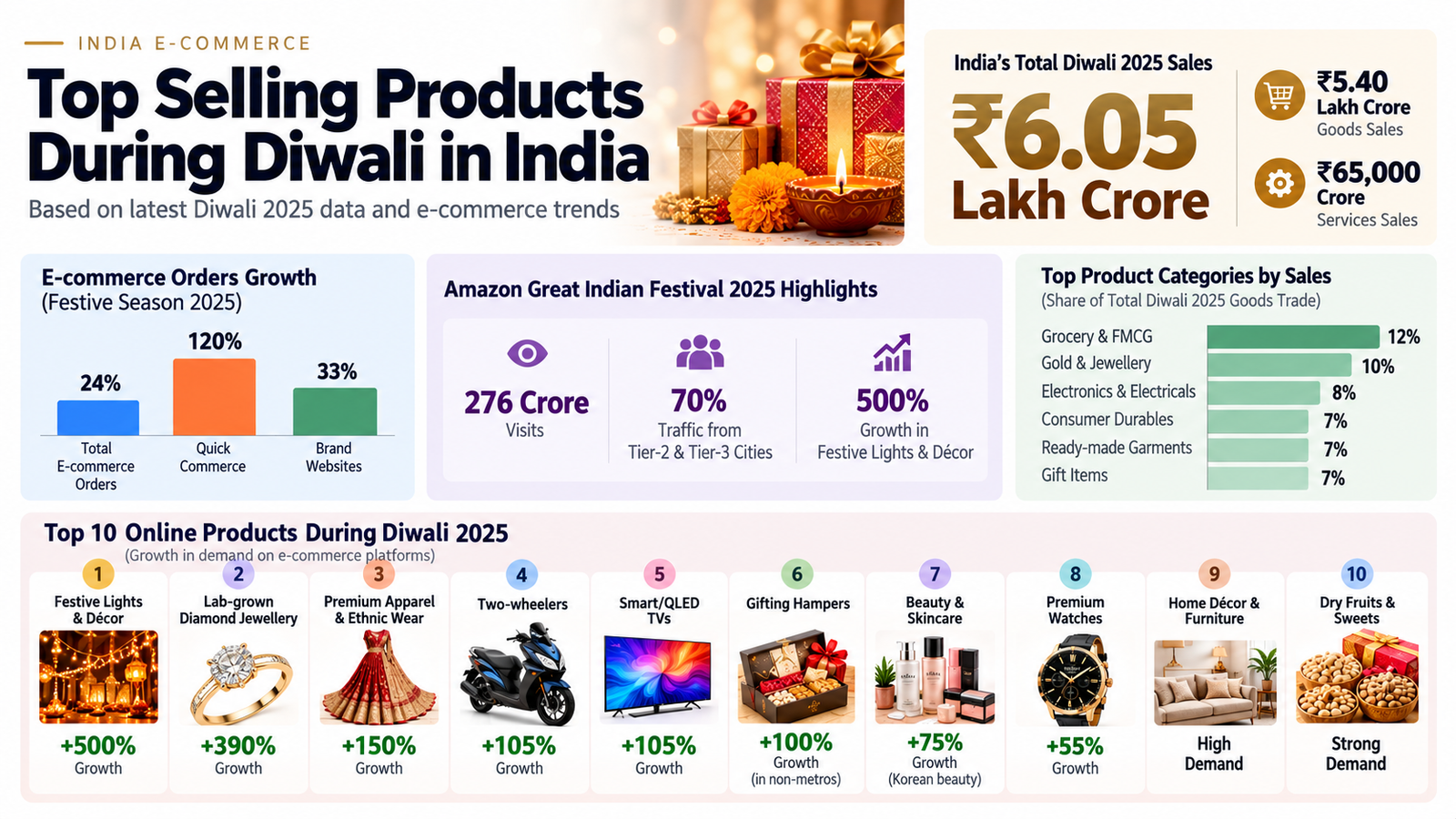
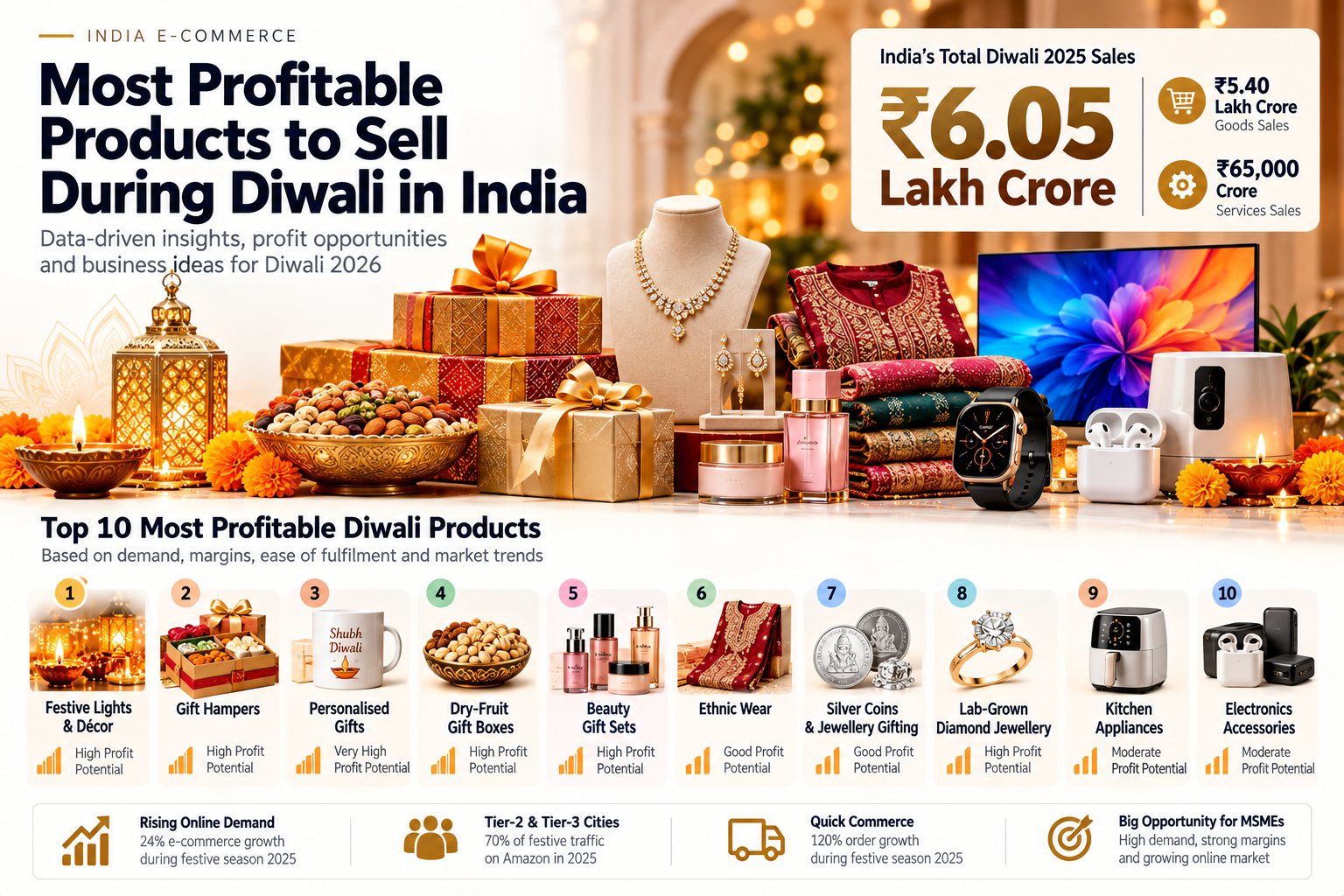
CAIT reported ₹6.05 lakh crore of total Diwali 2025 business, including ₹5.40 lakh crore in goods and ₹65,000 crore in services. Within goods, Grocery & FMCG accounted for 12%, Gold & Jewellery 10%, Electronics & Electricals 8%, Consumer Durables 7%, Ready-made Garments 7% and Gift Items 7%.
Category |
CAIT 2025 share |
Grocery & FMCG |
12% |
Gold & Jewellery |
10% |
Electronics & Electricals |
8% |
Consumer Durables |
7% |
Ready-made Garments |
7% |
Gift Items |
7% |
Home Décor |
5% |
Furnishing & Furniture |
5% |
Sweets & Namkeen |
5% |
Textiles & Fabrics |
4% |
Pooja Articles |
3% |
Fruits & Dry Fruits |
3% |
Bakery & Confectionery |
3% |
Footwear |
2% |
Other |
19% |
How to Measure Profitability
A practical Diwali profitability calculation should use contribution profit rather than gross sales alone.
Contribution Profit = Selling Price − Product Cost − Marketplace Fees − Payment Fees − Shipping − Packaging − Discount − Advertising − Expected Return/Replacement Cost
Example economics |
Amount |
Selling price |
₹1,499 |
Product cost |
₹550 |
Packaging |
₹50 |
Shipping |
₹100 |
Marketplace/payment costs |
₹150 |
Advertising |
₹150 |
Discount |
₹100 |
Expected return/replacement cost |
₹50 |
Contribution profit |
₹349 |
Contribution margin |
23.3% |
Top 10 Profit Opportunities
Rank |
Product |
Demand |
Margin potential |
Logistics |
Return risk |
Opportunity |
1 |
Diwali lights & décor |
Very High |
High |
Easy |
Low |
Excellent |
2 |
Diwali gift hampers |
Very High |
High |
Easy–Medium |
Low |
Excellent |
3 |
Personalised gifts |
High |
Very High |
Easy |
Low |
Excellent |
4 |
Dry-fruit gift boxes |
High |
Medium–High |
Easy |
Low |
Excellent |
5 |
Premium beauty gift sets |
High |
High |
Easy |
Medium |
Very Good |
6 |
Festive ethnic wear |
High |
High |
Easy–Medium |
High |
Good–Very Good |
7 |
Silver coins / jewellery gifting |
High |
Medium |
Easy |
Low–Medium |
Very Good |
8 |
Lab-grown diamond jewellery |
Very High |
High |
Easy |
Medium |
Very Good |
9 |
Small kitchen appliances |
High |
Medium |
Medium |
Medium |
Good |
10 |
Electronics accessories |
High |
Medium–High |
Easy |
Medium |
Good |
Diwali Lights & Décor
Amazon reported a 500% increase in festive lights and décor during its 2025 Great Indian Festival. Potential products include LED string lights, curtain lights, diyas, lanterns, rangoli kits, pooja décor, candles and balcony décor.
Best strategy: sell complete decoration bundles such as a ₹499 Basic Décor Kit, ₹999 Balcony Décor Kit and ₹1,999 Complete Home Diwali Kit.
Diwali Gift Hampers
Gift Items represented 7% of CAIT's Diwali 2025 goods mix. Amazon also reported 100% growth in premium gifting selection in non-metro markets.
Build ₹499, ₹999, ₹1,499, ₹2,499 and ₹4,999+ hampers combining dry fruits, chocolates, candles, diyas, premium snacks and personalised cards.
Personalised Diwali Gifts
Personalisation can support higher perceived value because customers pay for customisation and gifting experience rather than only the physical product.
Examples: name-engraved gifts, personalised mugs, custom boxes, corporate logo gifts, candles, photo gifts and personalised hampers.
Dry-Fruit Gift Boxes
Dry fruits combine food, gifting and premiumisation. They can be offered at multiple price points and are comparatively easy to store and ship.
Possible tiers: ₹499 Mini Box, ₹999 Premium Box, ₹1,499 Executive Box and ₹2,499 Corporate Box.
Premium Beauty Gift Sets
Amazon reported 75% growth in Korean beauty products during the 2025 festive period. Beauty serves both gifting and self-purchase demand.
Potential products include skincare kits, makeup sets, grooming kits, hair-care kits, fragrance sets and beauty tools.
Festive Ethnic Wear
Premium apparel grew 150% on Amazon during the 2025 festive period. The uploaded historical Diwali study also reported a fivefold increase in ethnic-wear sales in its Amazon case.
Potential products: sarees, kurta sets, anarkalis, lehenga sets, men's ethnic wear, kidswear and matching family outfits. Main risk: size and fit returns.
Silver Coins & Jewellery Gifting
Gold & Jewellery accounted for 10% of CAIT's Diwali 2025 goods trade. Amazon reported 200% growth in precious jewellery and silver coins during its 2025 festive event.
Potential products: silver coins, auspicious designs, premium gift packaging and corporate silver gifting.
Lab-Grown Diamond Jewellery
Amazon reported 390% growth in lab-grown diamond jewellery during its 2025 festive event. This is a platform-specific signal but indicates strong premiumisation.
The category offers high AOV and easy physical shipping, but sourcing, certification, inventory capital, trust and acquisition cost must be managed carefully.
Kitchen Appliances
The historical Diwali study highlighted deep fryers, mixer grinders and microwave ovens among Amazon's festive products. Smaller appliances can be more manageable than large appliances.
Potential products: air fryers, mixers, coffee machines, electric kettles, OTGs and blenders.
Electronics Accessories
Accessories can sometimes provide better unit economics than headline electronics because they are easier to ship and can be bundled.
Potential products: TWS earbuds, chargers, cables, power banks, laptop accessories, phone cases and smartwatch straps.
High Demand Does Not Always Mean High Profit
Smartphones, TVs and laptops can generate huge festive volumes, but they can also face aggressive price competition, discounting, marketplace fees, advertising costs and warranty or return requirements.
Category |
Demand |
Main business challenge |
Smartphones |
Very High |
Price competition and low differentiation |
Smart TVs |
Very High |
Shipping, installation and discounting |
Laptops |
High |
Price transparency and advertising |
Premium gifting |
High |
Sourcing and packaging execution |
Décor |
High |
Seasonality and inventory risk |
Tier-2 and Tier-3 Cities
Amazon reported that 70% of Great Indian Festival 2025 customer visits came from Tier-2 and Tier-3 cities. Unicommerce reported that approximately 58% of festive transactions came from Tier-II and Tier-III cities in its first-week 2025 analysis.
This creates opportunities for regional-language content, local influencers, city-specific landing pages, fast regional fulfilment and WhatsApp-based selling.
Quick-Commerce Opportunity
Unicommerce reported an 85% year-on-year increase in quick-commerce order volumes during the first week of the 2025 festive season, compared with 21% growth in overall e-commerce orders in its comparison.
Product type |
Suitability |
Diyas, candles and décor |
High |
Sweets and namkeen |
High |
Dry fruits |
High |
Flowers and fruits |
High |
Last-minute gifts |
High |
Beauty essentials |
Medium–High |
Electronics accessories |
Medium–High |
Investment-Based Opportunities
Investment |
Potential products |
Under ₹50,000 |
Décor, lights, diyas, rangoli, personalised gifts, small hampers |
₹50,000–₹2 lakh |
Premium hampers, dry fruits, beauty kits, ethnic wear, home décor, small appliances |
₹2–₹10 lakh |
Premium gifting, jewellery, ethnic fashion, electronics, D2C festive brand |
₹10 lakh+ |
Electronics distribution, appliance dealership, jewellery, two-wheeler dealership/lead generation, large corporate gifting |
Best Strategy for Diwali
1.Choose a narrow product category rather than launching hundreds of SKUs.
2.Validate demand using marketplace data, Google search demand, social trends and competitor pricing.
3.Calculate contribution margin before buying inventory.
4.Create bundles and gift-ready packaging.
5.Build separate offers for consumers and corporate buyers.
6.Target Tier-2 and Tier-3 cities with localised creatives and fulfilment.
7.Use marketplaces for discovery and your own website or WhatsApp for retention.
8.Track CAC, AOV, conversion rate, contribution margin, return rate and inventory sell-through.
9.Plan the post-Diwali use of leftover inventory before purchasing stock.
Conclusion
The biggest mistake when entering the Diwali market is asking only what sells the most. The better question is what produces the best contribution profit per customer while solving a real Diwali need.
For small and medium businesses, festive décor, personalised gifts, premium hampers and dry-fruit gifting can provide attractive risk-adjusted opportunities. Premium beauty, ethnic wear, jewellery and lab-grown jewellery can offer higher AOV but require stronger execution. Smartphones, TVs and laptops can generate high volumes but face greater price competition.
The strongest Diwali business model is therefore not simply Product → Discount → Sale. It is Demand → Product → Bundle → Positioning → Distribution → Contribution Margin → Repeat Customer.
Data & Methodology Notes
·CAIT category percentages represent shares of total Diwali 2025 goods trade, not online-only market share.
·Amazon growth percentages are platform-specific signals and should not be interpreted as total Indian category growth.
·Unicommerce figures represent channel and transaction signals from its analysed transaction base.
·Historical 2014 evidence is contextual and should not be presented as 2026 sales data.
·Profitability ratings are analytical business judgements, not published industry margin benchmarks.
·Full-season 2026 actual sales and profit data were not available at the 7 October 2026 research cut-off.