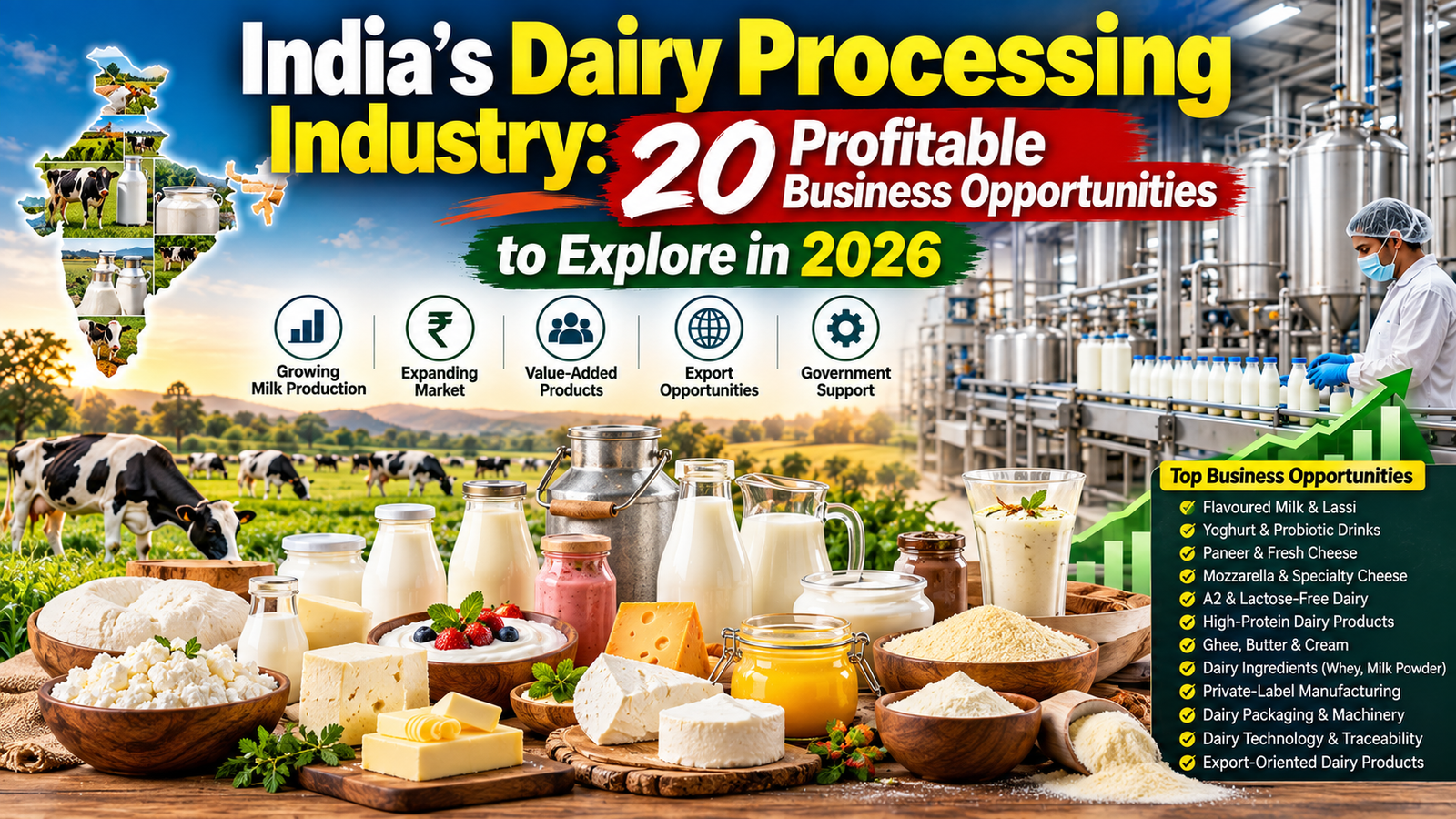
Business opportunity guide based primarily on the supplied MoFPI Dairy Sector Profile, with opportunity interpretation clearly identified.
1. Executive Summary
India's dairy sector offers opportunities beyond commodity milk. The strongest business opportunities come from converting milk into higher-value products, supplying dairy businesses, building private-label manufacturing capacity, and providing technology, packaging and infrastructure to the dairy value chain.
The supplied MoFPI sector profile reports 239.3 million metric tonnes of milk production in 2023-24, per-capita availability of 471 grams/day and about 24% of global output. It also estimates India's packaged dairy products market at around ₹3 lakh crore with strong double-digit growth. The report identifies cheese, yoghurt, flavoured milk, probiotic drinks, lactose-free products, fortified milk, A2 milk, whey, milk powder and related value-added categories as opportunity areas.
2. Why Dairy Processing Is a Business Opportunity
A new entrepreneur does not necessarily need to compete with large companies in plain milk. A more defensible strategy is to move up the value chain:
Value Chain Level |
Examples |
Business Character |
Commodity |
Milk, basic curd, butter |
High volume; price competition |
Value Added |
Yoghurt, flavoured milk, cheese, probiotic drinks |
Higher differentiation and margin potential |
Specialised |
Lactose-free, fortified, A2, high-protein products |
Premium/niche positioning |
B2B |
Whey, milk powder, dairy ingredients, mozzarella |
Recurring institutional demand |
Infrastructure |
Packaging, machinery, cold chain, testing |
Sell to multiple dairy businesses |
Technology |
Traceability, IoT, quality and batch management |
Asset-light/scalable software opportunity |
3. Market Foundation
Metric |
Reported Figure |
Source / Note |
Milk production, 2023-24 |
239.3 MMT |
MoFPI Dairy Sector Profile |
Per-capita milk availability |
471 g/day |
MoFPI Dairy Sector Profile |
Share of global milk output |
About 24% |
MoFPI Dairy Sector Profile |
Packaged dairy products market |
About ₹3 lakh crore |
MoFPI Dairy Sector Profile |
Dairy industry market size, 2024 |
₹18,975 billion |
Market estimate reproduced in MoFPI profile |
Forecast market size, 2033 |
₹57,001.81 billion |
IMARC estimate reproduced in MoFPI profile |
Forecast CAGR, 2025-33 |
12.35% |
Estimate reproduced in MoFPI profile |
4. Top 20 Dairy Business Opportunities
Opportunity |
Investment Level |
Primary Customers |
Core Opportunity |
Premium yoghurt / Greek yoghurt |
Low–Medium |
Retail, D2C, gyms, modern trade |
Premium, high-value positioning |
Flavoured milk |
Low–Medium |
Retail, schools, offices, gyms |
Convenience and flavour-led consumption |
Lassi and buttermilk |
Low–Medium |
Retail, QSRs, local distribution |
Strong local/regional opportunity |
Paneer manufacturing |
Low–Medium |
Retail, restaurants, hotels |
Everyday food-service demand |
Mozzarella cheese |
Medium–High |
Pizza chains, QSRs, hotels, cloud kitchens |
Strong B2B model |
Speciality cheese |
Medium–High |
Premium retail, hotels, restaurants |
Gouda, Parmesan and artisanal positioning |
Probiotic dairy drinks |
Medium |
Health-conscious consumers |
Functional-health positioning |
Lactose-free dairy |
Medium |
Premium/health consumers |
Niche value-added segment |
Fortified milk |
Medium |
Families, nutrition market |
Nutrition-led positioning |
A2 milk products |
Medium |
Premium consumers |
Premium dairy proposition |
High-protein dairy |
Medium |
Gyms, athletes, young professionals |
Fitness/health positioning |
Whey products |
Medium–High |
Fitness brands, food manufacturers |
B2B and consumer potential |
Milk powder / SMP |
High |
Food manufacturers, institutional buyers |
Ingredient/B2B model |
Condensed milk |
Medium–High |
Bakeries, F&B, food manufacturers |
B2B recurring demand |
Dairy ingredients distribution |
Medium |
Bakeries, ice cream, food manufacturers |
Asset-light B2B opportunity |
Private-label dairy manufacturing |
Medium |
Retailers, D2C brands |
Manufacturing-as-a-service |
Dairy packaging |
Medium |
Dairies and food brands |
B2B repeat orders |
Dairy machinery/services |
High |
Dairy processors |
Equipment + maintenance model |
Cold-chain services |
High |
Dairy/F&B businesses |
Infrastructure opportunity |
Dairy technology SaaS |
Low–Medium |
Dairies, plants, collection centres |
Digital recurring-revenue model |
5. Opportunity 1 — Premium Yoghurt Business
Business model
Milk procurement → standardisation → pasteurisation → fermentation → flavouring → packaging → distribution.
Possible products
Greek yoghurt
High-protein yoghurt
Fruit yoghurt
Probiotic yoghurt
Low-sugar yoghurt
Premium curd
Target customers
Urban consumers, gyms, fitness customers, families, cafés, premium grocery and quick-commerce.
6. Opportunity 2 — Flavoured Milk, Lassi & Buttermilk
A regional beverage-led dairy business can begin with a focused product portfolio and expand after proving local demand. Potential products include chocolate milk, badam milk, kesar milk, elaichi milk, mango lassi, sweet/salted lassi and buttermilk.
Suggested route to market
Plant → distributor → kirana / café / gym / institution → consumer.
The supplied report identifies flavoured milk as a key processed dairy product and highlights convenience-driven demand.
7. Opportunity 3 — B2B Mozzarella Cheese
Instead of building a mass consumer cheese brand immediately, a processor can supply mozzarella to pizza restaurants, QSRs, hotels, caterers, cloud kitchens and food manufacturers.
B2B value proposition
Consistent quality
Reliable supply
Competitive landed price
Standard pack sizes
Cold-chain reliability
Technical support
8. Opportunity 4 — Lactose-Free Dairy
Products can include lactose-free milk, curd and dairy beverages. The supplied sector profile specifically lists lactose-free milk and drinks among domestic-market opportunities.
9. Opportunity 5 — High-Protein Dairy
A fitness-oriented dairy line could combine dairy processing with a protein-focused proposition.
Product |
Potential Customer |
High-protein milk |
Fitness and health consumers |
High-protein yoghurt |
Gyms, D2C, premium retail |
Protein lassi |
Young professionals and athletes |
High-protein paneer |
Fitness consumers |
Whey-based drinks |
Fitness and nutrition market |
10. Opportunity 6 — Dairy Ingredients B2B
Instead of selling directly to consumers, an entrepreneur can supply ingredients to food manufacturers.
Skimmed milk powder
Whey
Milk solids
Butter
Cream
Condensed milk
Dairy blends
Cheese ingredients
Potential customers include bakeries, ice-cream manufacturers, chocolate companies, protein brands, sweet manufacturers and restaurants.
11. Opportunity 7 — Private-Label Dairy Manufacturing
The manufacturer operates the processing and packaging facility while the customer sells products under its own brand.
Model |
Revenue Source |
Private-label manufacturing |
Manufacturing fee + product margin |
Contract manufacturing |
Processing/packing charge + agreed margin |
Own brand |
Product margin + brand value |
Hybrid model |
Own brand + private-label customers |
12. Opportunity 8 — Dairy Packaging
The supplied report highlights sustainable dairy packaging as an opportunity, particularly recyclable, biodegradable and eco-friendly solutions.
Yoghurt cups
Lassi bottles
Cheese packaging
Butter containers
Ice-cream packaging
Tamper-evident packaging
Sustainable packaging
13. Opportunity 9 — Dairy Technology & SaaS
A technology company can build software for milk collection, quality, batch traceability, inventory and distribution.
Module |
Function |
Milk collection |
Farmer and collection-centre records |
Quality testing |
Fat, SNF and test-result records |
Batch management |
Track production batches |
Temperature |
Monitor cold-chain conditions |
Inventory |
Raw material and finished goods |
Dispatch |
Distributor/order management |
Traceability |
QR/batch-level product history |
Payments |
Supplier/farmer settlement records |
Analytics |
Production, wastage and sales dashboards |
14. Investment-Based Business Selection
Indicative Budget Band |
Businesses to Evaluate |
Recommended Strategy |
₹5–10 lakh |
Lassi, buttermilk, paneer, basic yoghurt, distribution |
One city + limited SKUs |
₹10–25 lakh |
Yoghurt, flavoured milk, paneer/curd plant, private label |
Local B2B + retail |
₹25–50 lakh |
Premium yoghurt, beverages, mozzarella, institutional supply |
B2B + D2C |
₹50 lakh–₹2 crore+ |
Automated dairy processing, cheese, contract manufacturing |
Regional scale |
Higher / project scale |
Milk powder, ingredients, cold chain, larger plants |
Multi-state/B2B/export strategy |
These are strategic planning bands, not quotations or guaranteed project costs. Actual capex depends on capacity, land, utilities, machinery, cold chain, compliance and product specification.
15. B2B vs B2C Strategy
Factor |
B2B |
B2C |
Branding requirement |
Lower initially |
High |
Customer acquisition |
Direct sales |
Digital + retail + distribution |
Order size |
Large |
Small |
Repeat purchase |
Potentially high |
Depends on product |
Margin structure |
Volume + relationship |
Brand + product margin |
Best starting point |
Mozzarella, ingredients, private label |
Yoghurt, beverages, lassi |
16. Government Support & Financing Opportunities
The supplied profile describes PMKSY, PMFME, PLI for food processing and AHIDF as relevant government interventions. PMFME is described as supporting micro food-processing enterprises, while AHIDF provides eligible dairy-related entities with financing support including interest subvention. Eligibility, application windows and scheme guidelines should be verified from current government notifications before making an investment decision.
Scheme / Intervention |
Source-Reported Relevance |
PMKSY |
Food processing and preservation infrastructure; multiple components |
PMFME |
Micro food-processing formalisation, credit-linked support, branding and common facilities |
PLISFPI |
Food processing manufacturing, capacity expansion and branding abroad for eligible entities |
AHIDF |
Dairy/animal husbandry infrastructure; eligible entities and cooperatives |
17. Supply Chain Model
Farmer → Milk Collection Centre → Chilling → Processing → Packaging → Cold Storage → Distributor → Retail / Foodservice → Consumer
The business should be designed around procurement reliability, quality control, cold-chain discipline, working capital and predictable distribution rather than only production capacity.
18. How to Start a Dairy Processing Business
1. Choose one product rather than launching a large portfolio.
2. Define the target customer: consumer, restaurant, hotel, retailer or food manufacturer.
3. Validate local demand through pilot sales and customer interviews.
4. Map milk/raw-material supply and backup suppliers.
5. Prepare product specifications, packaging and shelf-life requirements.
6. Identify premises, utilities, cold chain and processing equipment.
7. Complete applicable business, food-safety and local regulatory requirements.
8. Run pilot production and quality testing.
9. Secure 5–20 anchor customers before aggressively expanding capacity.
10. Build distribution and repeat-order systems.
11. Track contribution margin per SKU and customer.
12. Scale only after product-market fit and supply consistency are demonstrated.
19. Unit Economics Framework
Before investing, calculate:
Milk/raw-material cost per litre or kg
Yield loss
Packaging cost
Labour
Power/fuel
Cold storage
Transport
Testing
Sales/distribution commission
Marketing
Rent/interest
Wastage/returns
Working-capital cost
Contribution Margin = Selling Price − Variable Cost.
Break-even volume = Fixed Costs ÷ Contribution per unit.
These formulas should be used with actual quotations and pilot production data; no profitability percentage is guaranteed by the source.
20. Recommended Business Models by Entrepreneur Type
Entrepreneur Profile |
Best-Fit Model |
Low-budget entrepreneur |
Lassi/buttermilk/paneer/local dairy distribution |
Marketing-led entrepreneur |
Premium yoghurt or high-protein dairy brand |
B2B sales entrepreneur |
Mozzarella / dairy ingredients |
Manufacturing entrepreneur |
Private-label dairy processing |
Technology entrepreneur |
Dairy traceability and plant-management SaaS |
Infrastructure entrepreneur |
Packaging / cold-chain / machinery services |
Export-oriented entrepreneur |
Shelf-stable/value-added dairy products, subject to market and regulatory validation |
21. 90-Day Launch Plan
Period |
Action |
Days 1–15 |
Select product, customer segment and city/region |
Days 16–30 |
Customer interviews, competitor mapping and supplier discovery |
Days 31–45 |
Product trials, costing, packaging and shelf-life testing |
Days 46–60 |
Compliance planning, equipment and production setup |
Days 61–75 |
Pilot production and first B2B/retail customers |
Days 76–90 |
Repeat-order tracking, distribution expansion and SKU optimisation |
22. Biggest Risks
Milk-price volatility
Cold-chain failure
Short shelf life
Quality/adulteration risk
High working-capital requirements
Retailer/distributor credit periods
Product returns and wastage
Low utilisation of processing capacity
Price competition
Regulatory and food-safety non-compliance
Over-expansion before product-market fit
23. Final Opportunity Ranking
Rank |
Opportunity |
Why It Stands Out |
1 |
B2B mozzarella |
Recurring institutional demand and clear customer segment |
2 |
High-protein dairy |
Premium health/fitness positioning |
3 |
Private-label dairy |
Can manufacture for multiple brands |
4 |
Dairy ingredients B2B |
Recurring downstream food-manufacturer demand |
5 |
Dairy technology SaaS |
Scalable technology model |
6 |
Premium yoghurt |
Value-added consumer product |
7 |
Lactose-free dairy |
Specialised premium niche |
8 |
Dairy packaging |
Sells to multiple dairy businesses |
9 |
Flavoured milk/lassi |
Accessible regional launch model |
10 |
Cold-chain services |
Infrastructure play across dairy/F&B |
24. Source-Based Opportunity Notes
The MoFPI Dairy Sector Profile identifies dairy processing technology and machinery, sustainable packaging, value-added dairy products, domestic expansion and export expansion as investment-opportunity areas. It specifically lists lactose-free milk/drinks, recombined/fortified/flavoured milk, A2 milk, mozzarella/Gouda/Parmesan, yoghurt and fermented dairy products, skimmed milk powder, whey proteins and baby/maternity food among domestic opportunities.
The profile also describes demand drivers including demographics, rising disposable income, structural consumption shifts, demand for healthy food supplements and next-generation urban consumers.
25. Editorial Note
This document is an opportunity-planning guide, not an investment guarantee. Market figures and opportunity categories are based primarily on the supplied MoFPI Dairy Sector Profile. Investment bands and business-model recommendations are strategic estimates created for planning and should be validated with current equipment quotations, local milk prices, product yields, customer interviews, FSSAI requirements, tax treatment, financing terms and current government scheme guidelines before capital i