Why Fresh Fruits and Vegetables Processing Is a Major Business Opportunity
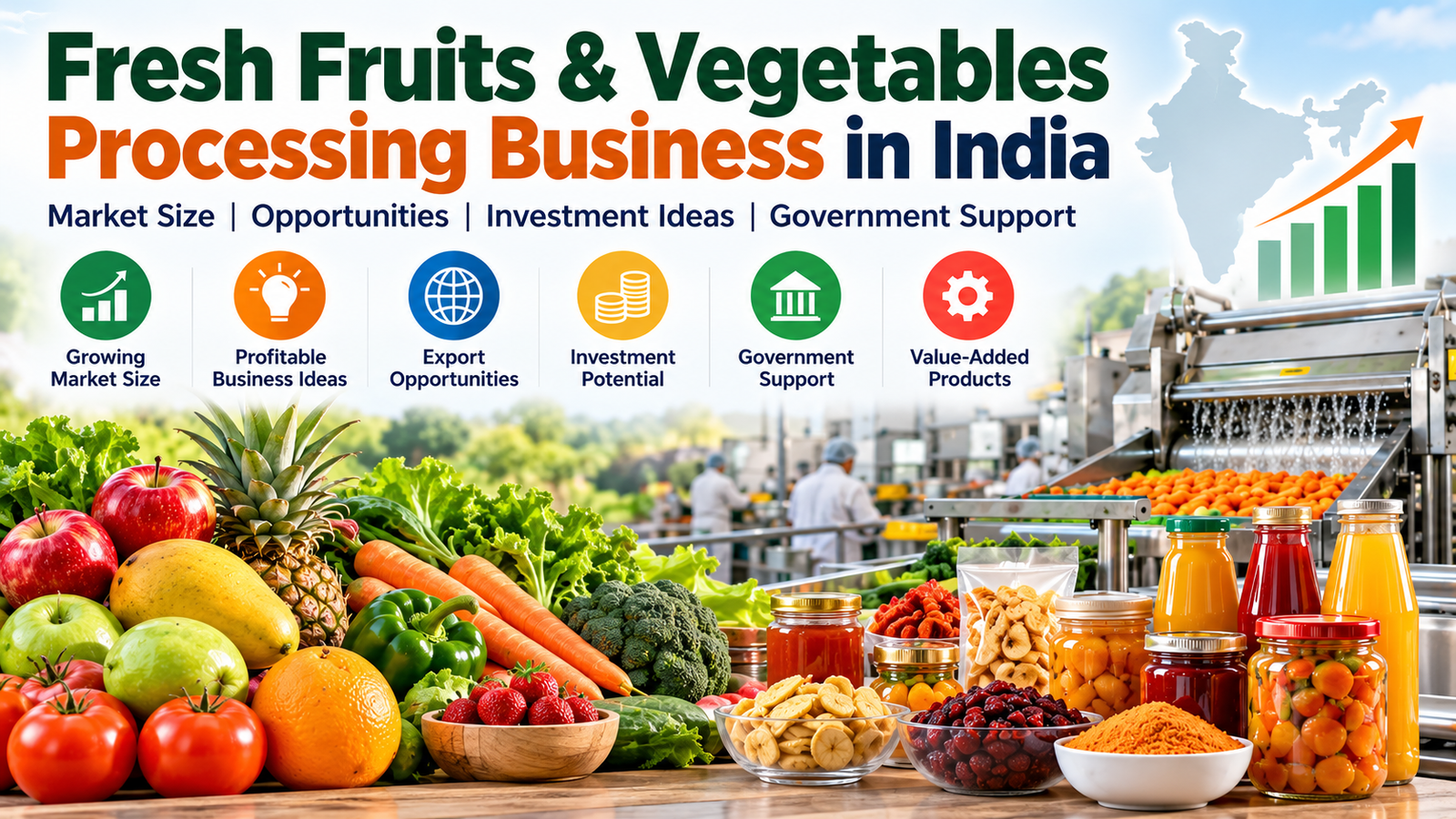
India's fruits and vegetables processing opportunity spans procurement, sorting, grading, washing, cutting, packaging, cold storage, freezing, dehydration, pulp and puree production, juices, pickles, canned products and ready-to-eat/ready-to-cook foods. The APEDA profile highlights processing as an important route to reduce post-harvest losses and increase value addition.
India's Food Processing Industry: The Bigger Picture
The supplied APEDA profile reports around 6.55% average annual growth in India's food-processing sector during the nine years ending 2023–24, a 7.93% share in manufacturing, and 12.91% employment in registered/organised manufacturing. It reports processed food exports of USD 10.09 billion in 2024–25 and USD 7.21 billion FDI inflow over the decade ending 2024–25.
Global Fruits and Vegetables Opportunity
Global fruit production grew 63% from 2000 to 2022 to 933 million tonnes, while global vegetable production grew 71% to 1.17 billion tonnes. The APEDA profile also cites 2025 revenue of USD 284.55 billion for processed and frozen vegetables and USD 75.34 billion for processed and frozen fruits.
India Fruits and Vegetables Processing Market Size
The APEDA profile cites IMARC's estimate of USD 876.6 million for India's fruits and vegetables processing market in 2024, projected to reach USD 1,387.5 million by 2033 at a 4.7% CAGR during 2025–2033.
India's Fruits and Vegetables Production
Category | Production |
Fruits | 112.98 million tonnes |
Vegetables | 207.21 million tonnes |
Fruits + Vegetables | 320.19 million tonnes |
Total horticulture | 354.74 million tonnes |
India's Horticulture Production Trend
Year | Production (MMT) |
2018–19 | 311.05 |
2019–20 | 320.47 |
2020–21 | 334.60 |
2021–22 | 347.17 |
2022–23 | 355.48 |
2023–24 | 354.74 |
Global Processed Vegetable Export Trend
Year | Exports (USD billion) |
2019 | 3.43 |
2020 | 3.51 |
2021 | 4.02 |
2022 | 4.21 |
2023 | 4.49 |
2024 | 4.56 |
Major Fruit-Producing States
Rank | State | Production ('000 MT) |
1 | Andhra Pradesh | 17,780.85 |
2 | Maharashtra | 15,453.97 |
3 | Uttar Pradesh | 13,460.29 |
4 | Madhya Pradesh | 9,863.80 |
5 | Gujarat | 8,383.32 |
Major Vegetable-Producing States
Rank | State | Production ('000 MT) |
1 | Uttar Pradesh | 34,430.38 |
2 | West Bengal | 29,200.96 |
3 | Madhya Pradesh | 24,350.12 |
4 | Bihar | 17,150.06 |
5 | Gujarat | 15,264.55 |
Top Fruits & Vegetables Processing Business Ideas
# | Business idea | Target opportunity |
1 | Fruit pulp and puree | Mango, guava, pineapple and other purees for beverage and food manufacturers. |
2 | Dehydrated fruits | Dried mango, pineapple, jackfruit, banana chips, fruit leather and powders. |
3 | Vegetable dehydration | Onion flakes/powder, garlic flakes/powder, dried potatoes and other vegetables. |
4 | Frozen fruits and vegetables | Frozen peas, corn, mixed vegetables, fruit chunks and smoothie packs. |
5 | Fresh-cut produce | Cut fruits, salad mixes, chopped and diced vegetables for food service and retail. |
6 | Fruit juices and beverages | Juices, concentrates and ready-to-serve beverages. |
7 | Pickles and preserved vegetables | Regional pickles, preserved cucumber/gherkins, chutneys and sauces. |
8 | Jams, jellies and spreads | Fruit jams, jellies, marmalades and fruit spreads. |
9 | Fruit and vegetable powders | Mango, tomato, spinach, beetroot, carrot, banana and functional blends. |
10 | Cold storage and post-harvest services | Cold storage, pre-cooling, sorting, grading, packing and cold-chain services. |
India's Processed Food Export Opportunity
The APEDA profile reports India's processed food exports at USD 7,701.66 million in 2023–24 and lists major categories including processed vegetables and processed fruits, juices and nuts.
Product | Export value |
Mango pulp | USD 75.32 million |
Processed vegetables | USD 787.28 million |
Prepared/preserved cucumber & gherkins | USD 256.58 million |
Processed fruits, juices & nuts | USD 682.58 million |
Guar gum | USD 541.65 million |
Top Export Destinations
Processed vegetables
Rank | Country | Exports (USD thousand) |
1 | USA | 63,811 |
2 | Germany | 37,108 |
3 | UK | 32,844 |
4 | Canada | 23,519 |
5 | Australia | 20,424 |
Processed fruits
Rank | Country | Exports (USD thousand) |
1 | USA | 185,943 |
2 | Netherlands | 85,400 |
3 | UAE | 73,084 |
4 | UK | 72,191 |
5 | Saudi Arabia | 69,541 |
Government Schemes Supporting the Sector
Scheme | Relevant support |
PMKSY | Modern food-processing infrastructure, cold chains, clusters and preservation/supply-chain infrastructure. |
PMFME | ₹10,000 crore scheme supporting micro food-processing enterprises, branding, marketing and institutional strengthening. |
PLISFPI | ₹10,900 crore scheme; processed fruits and vegetables are among supported segments. |
MIDH | Horticulture development including post-harvest management, processing and marketing infrastructure. |
Agriculture Infrastructure Fund | ₹1 lakh crore financing framework for farm-gate, aggregation and post-harvest infrastructure. |
R&D and Technical Support Ecosystem
The APEDA profile identifies ICAR, CIPHET, CFTRI, NIFTEM Kundli, NIFTEM-Thanjavur, IIHR, DFRL, NHB and agricultural universities as part of India's R&D and skill-development ecosystem.
NIFTEM Kundli
The profile notes that NIFTEM Kundli has a fruit and vegetable pilot plant with sorting, grading, packaging, IQF, controlled-atmosphere storage, ripening and processing infrastructure for beverages, pulp, paste and concentrates.
Fresh Produce vs Processed Produce
Factor | Fresh produce | Processed produce |
Shelf life | Generally shorter | Longer, depending on process |
Geographic market | More limited | Wider |
Value addition | Lower | Higher |
Branding | Limited | Significant |
Export potential | Product dependent | Strong for many categories |
E-commerce potential | Limited by perishability | Higher for shelf-stable products |
Key Risks
Raw-material price volatility
Crop seasonality
Cold-chain reliability
Food-safety and quality failures
Packaging and shelf-life issues
Working-capital requirements
Demand and competition risk
Export compliance
Conclusion
India's fresh fruits and vegetables processing industry offers opportunities across small-scale, medium-scale and export-oriented businesses. The strongest opportunity is in converting India's large agricultural output into longer-shelf-life, branded, convenient and higher-value products. Cold-chain infrastructure, processing technology, farmer linkages, food safety, sustainable packaging and export-market development can all increase value addition.
Source Note
Primary source: APEDA, Food Processing – Towards Sustainable Growth Opportunities, Sector Profile: Fruits and Vegetables, supplied with this request. The document cites FAO, ITC Trade Map, IMARC, Department of Agriculture & Farmers Welfare, MoFPI and other sources for individual datasets. Figures are reproduced from the supplied source and are not independently reconciled in this document.