1. Executive Summary
India has a large and established cashew processing ecosystem, but the business is structurally dependent on imported raw cashew nuts (RCN). That creates both an opportunity and a major risk: processors can build value through grading, processing, quality control, packaging, exports and domestic distribution, but margins are highly sensitive to raw-material prices, kernel recovery, working capital and selling prices.
·India produced about 802 thousand tonnes of cashew in 2024-25, up from 794 thousand tonnes in 2023-24.
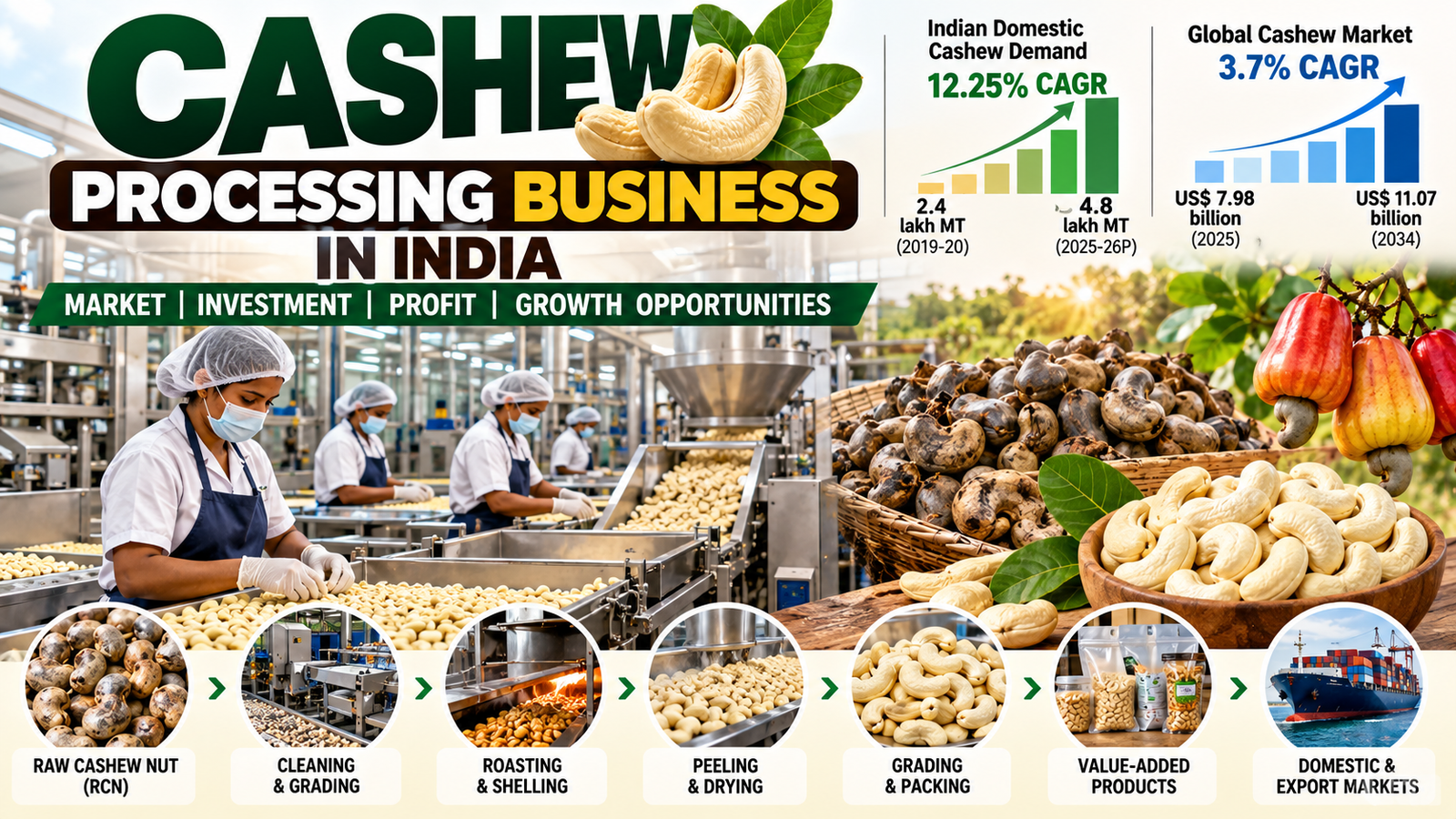
·APEDA/Crisil data shows domestic kernel demand rising from 2.4 lakh MT in 2019-20 to a projected 4.8 lakh MT in 2025-26, an illustrative CAGR of about 12.25%.
·IMARC estimates the global cashew market at US$7.98 billion in 2025 and US$11.07 billion by 2034, implying a 3.7% CAGR.
·Government cost norms from MoFPI list ₹72 lakh for a 5 TPD RCN-capacity cashew processing machinery package (2021 benchmark); this is not a 2026 installed-project quotation.
·For practical 2026 planning, a 5 TPD unit should be evaluated as a multi-crore working-capital and processing business rather than only a machinery purchase.
·A 5 TPD plant processing 300 days/year would handle about 1,500 tonnes of RCN/year. At a 23% kernel recovery assumption, that is about 345 tonnes of kernels/year.
·Illustrative revenue at ₹900–₹1,100/kg blended kernel realization is approximately ₹31.05–₹37.95 crore/year. These are scenario calculations, not forecasts.
·A prudent investment underwriting range for a well-managed small/medium plant is roughly 3–5 years payback, but actual results can vary materially.
·PMFME and APEDA support may reduce eligible capital burden for qualifying applicants, subject to current scheme rules and eligibility.
2. Market Snapshot
Metric |
Latest / planning figure |
Interpretation |
India cashew production |
802.35k MT, FY2024-25 |
Large domestic raw-material base |
Domestic kernel demand |
4.8 lakh MT, 2025-26P |
Strong consumption growth |
Domestic demand CAGR |
~12.25% (2019-20 to 2025-26P) |
Demand has grown faster than global market |
Global cashew market |
US$7.98bn, 2025 |
IMARC estimate |
Global market CAGR |
3.7%, 2026-34 |
Steady long-term growth |
India shelled-cashew export rank |
4th globally, 2024 |
APEDA |
India kernel export value |
US$338.18m, FY2024-25 |
APEDA product-line figure |
Indicative RCN recovery |
23% |
APEDA/Crisil planning assumption |
3. Why Cashew Processing Is a Business Opportunity
·Recurring food demand: cashew is consumed as a snack, ingredient, confectionery input and premium dry-fruit product.
·Value addition: raw cashew is transformed into graded kernels, roasted products, broken kernels and other saleable/by-product streams.
·Multiple customer channels: wholesalers, dry-fruit distributors, food manufacturers, bakeries, hotels, retailers, private labels and exporters.
·India already has processing know-how and a mature ecosystem, reducing the learning curve compared with creating a completely new food-processing category.
·Domestic demand is growing while India remains an important processor and exporter.
·By-products such as cashew nut shell liquid (CNSL), cardanol and de-oiled shell/cake can add monetization opportunities when scale permits.
4. India Production & Supply Structure
APEDA reports major growing states including Maharashtra, Karnataka, Kerala, Goa, Andhra Pradesh, Odisha, Tamil Nadu and West Bengal, with smaller cultivation in Chhattisgarh and the North-East. FY2024-25 production from a DCCD compilation was approximately 802.35 thousand tonnes.
State |
FY2024-25 production (000 MT) |
Maharashtra |
192.374 |
Andhra Pradesh |
139.821 |
Odisha |
131.802 |
Tamil Nadu |
86.196 |
Karnataka |
81.929 |
Kerala |
74.658 |
Goa |
25.337 |
Other states / balance |
~70.890 |
India total |
802.349 |
Business implication: a processor does not need to be located only in the largest production state. Location should balance RCN sourcing, labour, utilities, logistics, customer access, export access and incentives.
5. India’s RCN Import Dependence
APEDA/Crisil market data shows India’s processing ecosystem depends heavily on imported RCN. In 2024-25E, production was about 7.9 lakh MT while imports were about 11.4 lakh MT. For 2025-26P, imports were projected at about 14.0 lakh MT.
Marketing year |
Domestic RCN production (lakh MT) |
RCN imports (lakh MT) |
Total RCN supply (lakh MT) |
Kernel recovery |
Domestic kernel demand (lakh MT) |
2019-20 |
7.0 |
9.4 |
23.3 |
23% |
2.4 |
2020-21 |
7.4 |
8.3 |
24.7 |
23% |
2.2 |
2021-22 |
7.5 |
9.3 |
28.8 |
23% |
3.3 |
2022-23 |
7.8 |
13.2 |
32.2 |
23% |
3.7 |
2023-24 |
7.9 |
12.5 |
33.2 |
23% |
4.3 |
2024-25E |
7.9 |
11.4 |
30.7 |
23% |
4.6 |
2025-26P |
7.9 |
14.0 |
30.4 |
23% |
4.8 |
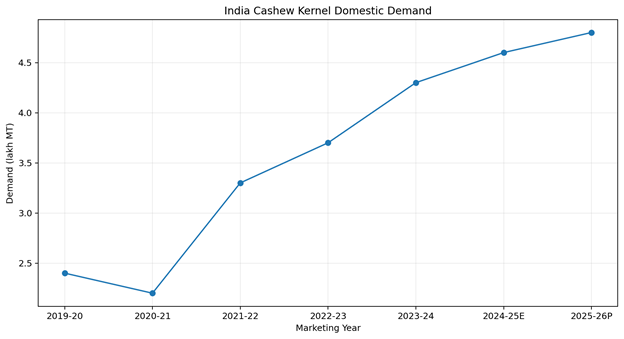
Chart: APEDA/Crisil domestic kernel demand series. CAGR from 2.4 to 4.8 lakh MT is approximately 12.25%.
6. Global Market Opportunity
IMARC estimates the global cashew market at US$7.98 billion in 2025 and projects it to reach US$11.07 billion by 2034, a 3.7% CAGR over 2026–2034.
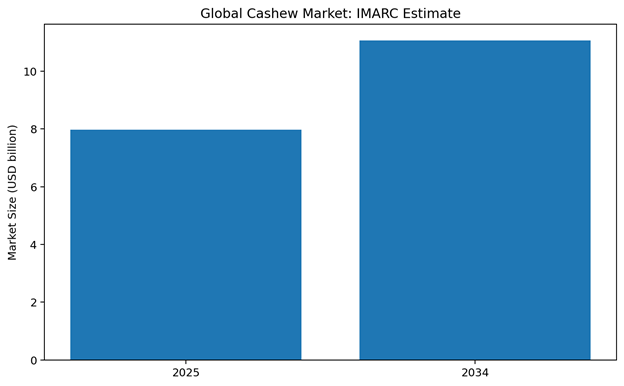
Source: IMARC public project-report summary. The chart is a simplified visualization of the cited market endpoints.
7. Export Opportunity
APEDA reports India ranked fourth globally in shelled-cashew exports in 2024 with a 6.60% market share. FY2024-25 exports reported by APEDA included 65,243.93 MT of cashew kernels valued at US$338.18 million. Major kernel destinations included the UAE, Vietnam, Japan, Netherlands and Saudi Arabia.
·Export economics must be modeled after freight, insurance, packaging, finance costs, quality claims, rejection risk and buyer payment terms—not simply on the FOB selling price.
·India competes with lower-cost processing hubs, especially Vietnam, so automation, quality consistency, procurement and buyer relationships matter.
8. Cashew Processing: End-to-End Process
1.Raw cashew nut procurement and incoming quality inspection
2.Cleaning and sizing
3.Steam cooking / conditioning
4.Shelling and scooping
5.Drying
6.Peeling
7.Grading and colour/quality sorting
8.Packing in suitable formats
9.Finished-goods storage
10.Domestic distribution or export dispatch
By-products can include CNSL, cardanol, shell/cake and cashew apple-derived products depending on the operation and recovery system.
9. Processing Plant Capacity Options
Capacity |
Annual RCN input @ 300 days |
Kernel output @ 23% recovery |
Typical positioning |
1 TPD |
300 MT |
69 MT |
Pilot / micro-industrial |
5 TPD |
1,500 MT |
345 MT |
Small commercial plant |
10 TPD |
3,000 MT |
690 MT |
Medium-scale operation |
20 TPD |
6,000 MT |
1,380 MT |
Larger regional/export operation |
TPD here means tonnes of raw cashew nut input per operating day. Actual kernel output depends on raw-material quality, variety, processing losses, moisture and operator/plant performance.
10. Plant Cost: Government Benchmark vs Practical Budget
MoFPI's 2021 cost norms list a 1 TPD RCN cashew processing plant at ₹15 lakh and a 5 TPD RCN plant at ₹72 lakh for specified machinery. The document states that such cost norms are generally basic machinery costs and generally exclude taxes, freight, installation and commissioning unless specified.
Capacity |
MoFPI machinery benchmark (2021) |
Practical 2026 planning range* |
Comment |
1 TPD |
₹15 lakh |
₹0.70–1.25 crore |
Land/building + utilities + working capital can dominate |
5 TPD |
₹72 lakh |
₹3.7–6.0 crore |
Commercial operation requires substantial working capital |
10 TPD |
— |
₹7.25–11.75 crore |
Indicative planning range |
20 TPD |
— |
₹14.5–23.5 crore |
Indicative planning range |
*Planning ranges are model estimates for feasibility discussion, not official quotations or guaranteed project costs. Actual cost depends on land, civil works, automation, boiler/utilities, packaging, laboratory, cold/controlled storage where applicable, installation, pre-operative expenses and working capital.
11. Current Machinery Market Check
Current vendor listings show wide price dispersion: individual fully automatic machines and processing lines can run from tens of lakhs to more than ₹1 crore depending on capacity and configuration. Therefore, a single marketplace quote should never be used as the complete project cost.
·Obtain at least three OEM quotations with identical capacity definitions.
·Ask vendors to specify RCN input capacity separately from finished-kernel output.
·Request power load, steam requirement, manpower, recovery assumptions, warranty, spares and installation scope.
·Separate machinery price from GST, freight, civil work, utilities, electricals and commissioning.
12. 5 TPD Plant: Detailed Financial Model
Illustrative model: 5 tonnes RCN/day × 300 operating days = 1,500 tonnes RCN/year. At 23% kernel recovery, annual kernel output is approximately 345 tonnes or 345,000 kg.
Scenario |
Blended kernel realization |
Kernel revenue |
Conservative |
₹900/kg |
₹31.05 crore |
Base illustration |
₹1,000/kg |
₹34.50 crore |
Higher realization |
₹1,100/kg |
₹37.95 crore |
These revenue scenarios are mathematical illustrations. They should not be interpreted as a forecast because selling price varies by grade, market, season, buyer, contract, packaging and export/domestic mix.
13. Margin & Profitability Framework
IMARC's public summary cites gross profit margins of about 15–25% and net profit margins of about 5–10% for the project economics it models. Use these only as an external benchmark, not as a guaranteed result.
Illustrative sales |
5% net margin |
10% net margin |
₹31.05 crore |
₹1.55 crore |
₹3.11 crore |
₹34.50 crore |
₹1.73 crore |
₹3.45 crore |
₹37.95 crore |
₹1.90 crore |
₹3.80 crore |
A real P&L must separately model RCN cost, yield, labour, utilities, packaging, finance cost, depreciation, freight, selling expenses, wastage, quality claims and taxes.
14. Working Capital: The Often-Missed Issue
Cashew processing is working-capital intensive because raw material can represent a very large share of operating cost. IMARC's public summary indicates raw materials can account for around 80–85% of OpEx.
Illustration: at 5 TPD, 45 days of RCN inventory equals 225 tonnes. If the planning RCN cost is ₹125/kg, 45 days of raw-material inventory alone would be about ₹2.81 crore. This excludes finished stock, receivables, packing material and cash buffers.
This is why financing capacity can be as important as plant capacity.
15. Break-even Analysis
Operational break-even depends on contribution margin, fixed costs, financing, utilization, recovery and selling price. For a well-managed small plant, an illustrative planning range of roughly 25–40% utilization can be used as a starting scenario, but it must be recalculated using actual quotations and procurement terms.
Basic formula:
Break-even volume = Fixed costs ÷ Contribution per unit
For a 5 TPD plant, management should calculate break-even in three ways: tonnes of RCN, tonnes of kernels, and monthly sales value.
16. Payback / Break-even Time
A practical underwriting range for a properly financed and efficiently utilized cashew processing unit is approximately 3–5 years payback. This is a planning range, not a promise. A poor procurement cycle, low recovery, high finance cost or weak utilization can push payback materially beyond five years; strong buyer contracts and high utilization can improve it.
Variable |
Improves payback when… |
Hurts payback when… |
RCN procurement |
Purchased at competitive prices with quality consistency |
Raw material is expensive or inconsistent |
Recovery |
Actual recovery beats the model |
Breakage/loss lowers saleable output |
Utilization |
Plant runs close to planned capacity |
Plant remains underutilized |
Selling price |
Higher-grade mix and better buyer realization |
Commodity selling with weak negotiation |
Working capital |
Adequate, low-cost financing |
Cash shortages force expensive borrowing |
Quality |
Low rejection and claims |
Frequent buyer rejection/discounts |
Product mix |
More value-added/graded/private-label sales |
Only low-value commodity sales |
17. Government Support & Schemes
PMFME provides credit-linked capital subsidy of 35% of eligible project cost up to ₹10 lakh per unit for eligible individual/upgraded micro food-processing units. Common infrastructure categories can have higher ceilings subject to scheme conditions. APEDA also provides financial assistance for eligible infrastructure activities under its schemes.
·Treat subsidy as conditional and eligibility-dependent; do not subtract it from the project cost until sanction/eligibility is established.
·Check the latest PMFME, APEDA and state-government rules before financial closure.
·For export-oriented projects, evaluate APEDA registration, food-safety compliance, packaging and buyer-specific standards.
18. Best Business Models
Model |
Capital |
Margin potential |
Complexity |
Best for |
B2B raw kernel trading |
Low–medium |
Low–medium |
Low |
Trading/distribution |
Small processing plant |
Medium |
Medium |
Medium |
Regional B2B |
Processing + grading + private label |
Medium–high |
Medium–high |
Medium–high |
Brand + B2B |
Export-focused processor |
High working capital |
Medium–high |
High |
Experienced operator |
Integrated processing + by-products |
High |
High |
High |
Larger scale |
Consumer cashew brand |
Medium–high |
High potential |
High |
Marketing-led business |
A sensible progression is: secure buyers → secure RCN supply → start processing → optimize yield → add grading/value-added products → add private label/export → monetize by-products.
19. Location Strategy
·Near reliable RCN sourcing clusters to reduce procurement and inbound freight.
·Access to skilled/semi-skilled labour.
·Reliable electricity, water and boiler fuel/steam infrastructure.
·Road/rail access to major B2B markets and ports where exports are planned.
·Availability of food-grade warehousing and packaging suppliers.
·State-level incentives, power tariffs and local compliance costs.
20. Key Risks
·RCN price volatility
·Currency and import exposure
·Low kernel recovery or high breakage
·Working-capital shortages
·Buyer concentration
·Quality rejection and food-safety failures
·Competition from Vietnam and other processing hubs
·Inventory price risk
·Export freight and payment risk
·Over-investment in machinery before securing raw material and buyers
21. Due-Diligence Checklist Before Investing
11.Obtain three comparable machinery quotations.
12.Run a 12-month RCN price sensitivity analysis.
13.Validate recovery using actual raw-material samples.
14.Get buyer LOIs / indicative purchase terms before final capex.
15.Confirm power, boiler, water and civil requirements.
16.Model 30/45/60/90-day working-capital scenarios.
17.Calculate contribution margin separately by kernel grade.
18.Check subsidy eligibility in writing with the relevant implementing agency.
19.Build a food-safety and quality-control plan.
20.Stress-test the project at lower selling prices and lower recovery.
22. Recommended 5 TPD Launch Blueprint
Phase |
Timeline |
Priority actions |
1. Market validation |
0–2 months |
Buyer mapping, sample sales, RCN sourcing, grade economics |
2. Feasibility |
1–3 months |
OEM quotes, land, utilities, financing, subsidy eligibility |
3. Setup |
3–6 months |
Civil, machinery, utilities, hiring, SOPs |
4. Trial production |
6–7 months |
Yield validation, grading, QC, packaging |
5. Commercial launch |
7–9 months |
B2B contracts, distributors, institutional buyers |
6. Optimization |
9–18 months |
Recovery, procurement, product mix, exports/private label |
Conclusion
Cashew processing is a compelling Indian food-processing opportunity when approached as an integrated supply-chain business. The strongest opportunity is not simply buying a machine and selling kernels. The advantage comes from controlling procurement, improving recovery, maintaining quality, grading intelligently, managing working capital, developing repeat B2B buyers and progressively moving into value-added products, private labels and exports.
For a first commercial project, a 5 TPD RCN-input model is a useful feasibility benchmark. The key investment question is not 'How much is the machine?' but 'Can the business consistently source quality RCN, convert it at the modeled recovery, sell each grade at a profitable realization, and finance the inventory cycle?'
Important disclaimer: This report is a business-planning document, not an investment guarantee. Market prices, RCN costs, exchange rates, machinery prices, government schemes and buyer realizations change over time. All illustrative financial calculations should be replaced with current quotations, verified procurement offers, buyer contracts and project-specific financing assumptions before committing capital.