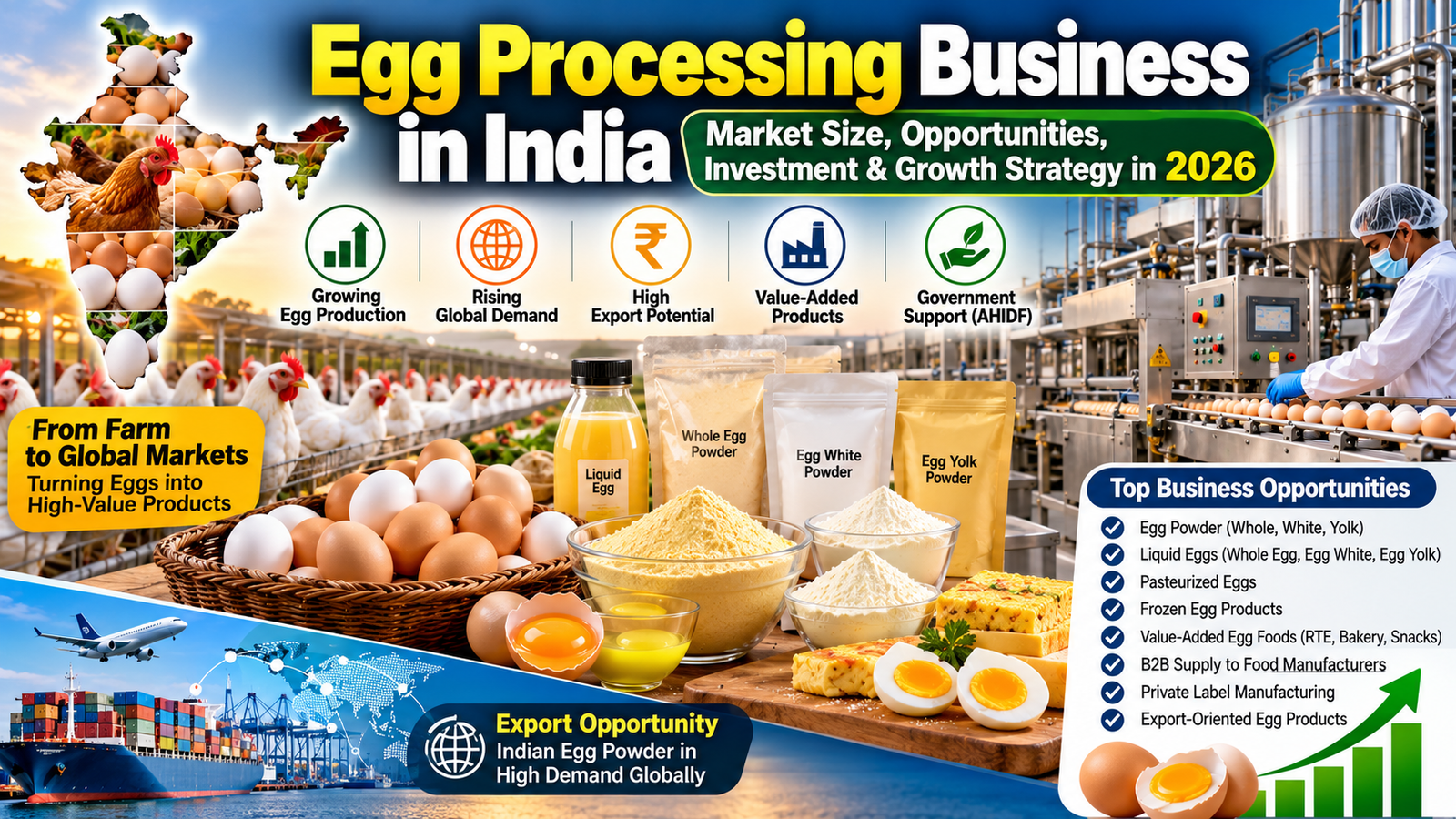
Egg Processing Business in India: Market Size, Investment, Opportunities & Growth Strategy
India has a large egg production base and a growing opportunity to convert fresh eggs into higher-value products such as liquid whole egg, egg white, egg yolk, dried egg powder and frozen egg products. These formats can serve bakeries, confectionery manufacturers, food processors, hotels, QSRs, institutional kitchens, nutrition companies and export markets.
1. Executive Summary
Indicator | Data | Business Meaning |
Egg production | 78.48 bn in 2014-15 → 129.60 bn in 2021-22 | Large raw-material base |
Egg production CAGR | 7.4% | Strong long-term supply growth |
Per-capita availability | 95 eggs/year in 2021-22 | Demand headroom |
India egg processing market | US$1,426.5M in 2024 | Large processed-egg opportunity |
Forecast | US$1,887.6M in 2029 | 5.8% CAGR |
Formats | Dried, liquid, frozen | Multiple business models |
Applications | Bakery, confectionery, dairy/desserts, RTE, supplements | Recurring B2B demand |
2. India Egg Production Market
PIB reported that India's egg production increased from 78.48 billion eggs in 2014-15 to 129.60 billion in 2021-22, with a reported CAGR of 7.4%. Per-capita availability reached 95 eggs per year in 2021-22. PIB also stated that India ranked third in egg production globally using FAO 2020 data.
Year | Production |
2014-15 | 78.48 billion eggs |
2021-22 | 129.60 billion eggs |
Increase | 65.15% |
3. India Egg Processing Market Size
MarketsandMarkets' August 2026 India market page estimates the egg processing market at US$1,426.5 million in 2024 and US$1,887.6 million by 2029, a 5.8% CAGR. The source highlights protein consumption, urbanisation, disposable income and organised food channels as drivers.
Year | Market Size | Metric |
2024 | US$1,426.5M | Base |
2029 | US$1,887.6M | 5.8% CAGR |
Increase | US$461.1M | ~32.3% |
Market research estimates vary by scope and methodology; this figure should be presented as a commercial market-research estimate rather than an official government market-size statistic.
4. Global Market Context
The 2026 Business Research Company report estimates the global egg processing market at US$31.09 billion in 2026 and US$36.49 billion in 2030, implying a 4.1% CAGR. The market is segmented by whole egg, yolk and white; and by dried, liquid and frozen formats.
Global Metric | 2026 | 2030 |
Market size | US$31.09B | US$36.49B |
CAGR | 4.1% | 2026-30 |
5. Egg Processing Product Opportunities
Product | Main Buyers | Opportunity |
Liquid whole egg | Bakeries, hotels, QSRs | Recurring B2B supply |
Liquid egg white | Nutrition, bakery | Specialised protein ingredient |
Liquid egg yolk | Mayonnaise, sauces | Ingredient supply |
Dried whole egg powder | Food manufacturers, exporters | Shelf-stable B2B/export |
Egg yolk powder | Sauces, bakery | Higher-value ingredient |
Egg albumin/white powder | Nutrition, bakery | Premium ingredient |
Frozen egg | Foodservice, processors | Longer storage |
Ready-to-use boiled eggs | Retail, foodservice | Convenience product |
6. India's Dried Egg Export Opportunity
A December 2023 Rajya Sabha answer stated that exports of Indian egg powder were showing an increasing trend. The attached government annexure reports DGCIS data for dried egg yolks, dried birds' eggs not in shell and dried egg albumin.
Year | Quantity MT | Rs crore | US$ million |
2020-21 | 7,495.01 | 289.66 | 38.99 |
2021-22 | 6,973.03 | 293.08 | 39.31 |
2022-23 | 12,085.01 | 710.82 | 88.29 |
2023-24 Apr-Sep | 5,689.12 | 368.93 | 44.78 |
Important: 2023-24 is April-September only and should not be compared directly with full-year figures.
2022-23 export mix
Product | Quantity MT | US$ million |
Dried egg yolks | 5,611.18 | 29.07 |
Dried birds' eggs, not in shell | 4,383.76 | 26.98 |
Dried egg albumin | 2,090.07 | 32.24 |
Total | 12,085.01 | 88.29 |
7. Why Egg Powder Is a Strong Business Opportunity
Shelf life and logistics
Dried egg products are more convenient to store and transport than fresh eggs, making them suitable for ingredient manufacturers, institutional buyers and export markets.
B2B repeat demand
The strongest model is generally recurring B2B demand from bakeries, confectionery, sauces, prepared foods, foodservice and nutrition companies.
Export potential
Government data demonstrates a meaningful export channel for dried egg products. Export-oriented processors must build traceability, food safety, documentation and destination-country compliance into the plant design.
8. Egg Processing Business Models
Model | Indicative Investment* | Customer | Complexity |
Egg collection + B2B distribution | ₹5–15 lakh | Hotels, bakeries, retailers | Low |
Egg grading & packing | ₹10–30 lakh | Retail, foodservice | Low-Medium |
Liquid egg processing | ₹25–75 lakh | Bakeries, QSRs, factories | Medium-High |
Frozen egg products | ₹50 lakh–₹1.5 crore | Foodservice, processors | High |
Egg powder plant | ₹1.5–4 crore | Manufacturers, exporters | High |
Integrated plant | ₹3–10+ crore | Domestic + export | Very high |
*Illustrative planning ranges only. Actual project cost depends on capacity, land/building, automation, dryer technology, utilities, cold chain, laboratory, effluent treatment and working capital.
9. Liquid Egg Business
Customer | Value Proposition |
Large bakeries | Consistent ingredient and lower handling |
Hotels/QSRs | Less cracking and preparation |
Mayonnaise/sauce makers | Standardised yolk supply |
RTE manufacturers | Controlled ingredient input |
Institutional kitchens | Convenience and predictable usage |
Foodservice distributors | Recurring bulk demand |
10. Egg Processing Plant Process
Stage | Activity |
1 | Egg procurement and supplier verification |
2 | Receiving, inspection and grading |
3 | Washing/sanitisation |
4 | Breaking and separation |
5 | Filtration |
6 | Pasteurisation |
7A | Liquid filling and cold storage |
7B | Drying and powder handling |
8 | Packaging and lot coding |
9 | Storage |
10 | Dispatch and traceability |
11. Machinery Required
Business | Core Machinery |
Grading/packing | Grader, conveyor, inspection, weighing, packing |
Liquid egg | Breaker, separator, filtration, pasteuriser, tanks, filler, cold room |
Egg powder | Breaker, separator, pasteuriser, spray dryer, powder handling and packaging |
Frozen products | Processing line, freezer, cold room and packing |
Export plant | Processing line + laboratory, traceability and food-safety systems |
12. Export & Regulatory Requirements
Egg and egg products intended for export are subject to mandatory export certification/approval requirements under India's export-control framework. The EIC instructions require export establishments to implement HACCP-based controls and maintain records. Application documentation can include a HACCP manual, SSOPs, process-flow information, site/layout plans, identified layer-farm suppliers, pollution-control consent where applicable, IEC and FSSAI licence.
The EIC framework also describes assessment of infrastructure, equipment and GHP/GMP/GVP/HACCP implementation. Export approvals and destination-country requirements should be verified for the exact product and market before investment.
13. Government Support
Support | Relevance |
AHIDF | Eligible animal-husbandry/poultry infrastructure; PIB cites 3% interest subvention for specified borrowers |
Export promotion | Trade fairs and buyer-seller meets |
FSSAI | Food-safety licensing/compliance |
EIC/EIA | Export approval and inspection framework |
APEDA/trade ecosystem | Relevant for agricultural/processed-food export development |
14. Location Strategy
Prioritise proximity to egg-producing clusters, road connectivity, reliable electricity and water, effluent-management capability, food-manufacturing customers and export logistics. The best location is not necessarily the cheapest land; it is the location that minimises total delivered cost while protecting raw-material freshness and customer service.
15. Go-to-Market Strategy
Phase | Action | KPI |
1 | Secure 5–10 anchor buyers | Committed monthly volume |
2 | Run pilot batches | Repeat orders |
3 | Add distributors | Active accounts |
4 | Add private-label/contract processing | Capacity utilisation |
5 | Develop export buyers | Qualified export leads |
6 | Add premium SKUs | Gross margin/kg |
16. Illustrative Unit Economics
Metric | Example |
Raw eggs processed/day | 10,000 kg |
Raw material cost | ₹70/kg |
Raw material/day | ₹7,00,000 |
Processing + labour + utilities | ₹1,00,000/day |
Packaging + logistics + overhead | ₹75,000/day |
Total daily cost | ₹8,75,000 |
Illustrative sales | ₹10,00,000/day |
Illustrative contribution | ₹1,25,000/day |
This is only a planning illustration, not a promised margin. Replace assumptions with actual procurement price, yield, utilities, packaging, freight, finance cost and selling price.
17. Growth Strategy
Start B2B first
Target bakeries, food factories, hotels, QSRs and distributors before investing heavily in mass retail.
Use multiple product streams
Whole egg, yolk and white products can diversify revenue and improve raw-material utilisation.
Build export readiness early
Design traceability, hygiene zoning, testing and documentation from the beginning.
Sell on specifications
Consistency, microbiological quality, functionality, moisture, protein, colour and shelf life can differentiate the business.
Scale only after utilisation
Capacity expansion should follow repeat orders and proven unit economics.
18. Key Risks and Mitigation
Risk | Mitigation |
Egg price volatility | Supplier diversification, contracts and dynamic pricing |
Avian disease | Biosecurity and diversified sourcing |
Food-safety failure | HACCP, GMP/GHP, testing and traceability |
Cold-chain failure | Temperature monitoring and backup |
Low plant utilisation | Anchor buyers before expansion |
Export rejection | Destination-country compliance and testing |
Working-capital pressure | Credit controls and buyer contracts |
19. 90-Day Launch Plan
Period | Priority |
Days 1-15 | Select product, capacity and target customer |
Days 16-30 | Supplier mapping, buyer interviews, regulatory checklist |
Days 31-45 | Machinery specification and project economics |
Days 46-60 | Pilot production, packaging and samples |
Days 61-75 | Commercial contracts and compliance implementation |
Days 76-90 | Launch with anchor accounts and track yield/margin |