Executive Summary
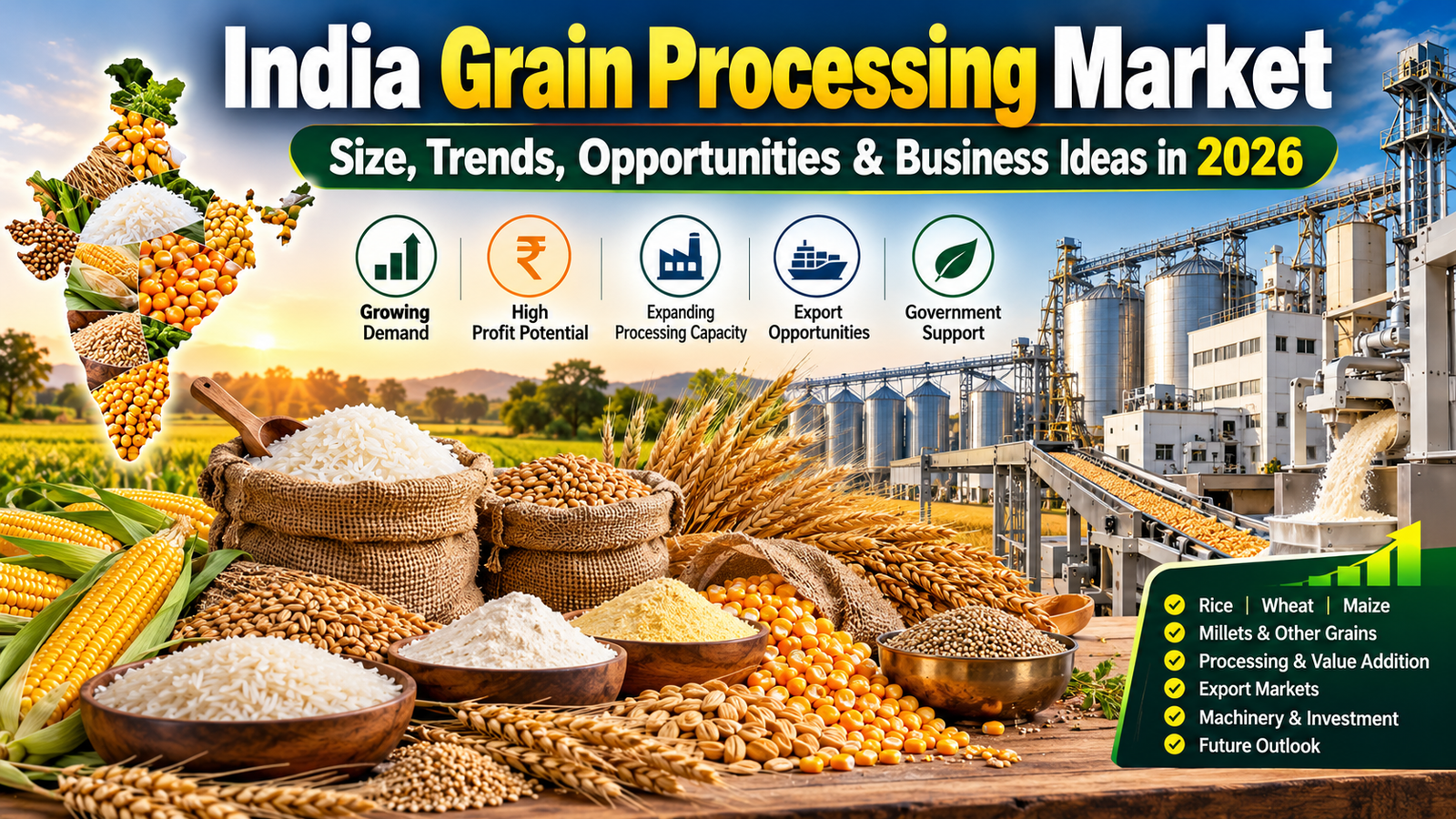
India’s grain processing industry sits at the intersection of one of the country’s largest agricultural production bases and a growing market for processed, packaged and value-added foods. Rice, wheat and maize provide the core volume, while millets, sorghum and barley create additional opportunities in health foods, feed, malting, starch, ethanol and specialty ingredients.
The data reviewed for this article does not provide a single, reliable headline figure for the entire Indian grain-processing market. That distinction matters: the TechSci/Research and Markets report previously reviewed is a grain analysis/testing market report, not the complete grain processing market. Instead of presenting that smaller testing-market number as the size of the processing industry, this article uses production, consumption, milling capacity and trade indicators to describe the processing opportunity.
USDA FAS New Delhi’s 2024 Grain and Feed Annual forecast India’s MY 2024/25 wheat production at 112.5 million metric tons (MMT), rice production at 135 MMT and corn production at 37 MMT. The same source forecasts wheat food, seed and industrial consumption at 107.5 MMT, rice consumption and residual at 120 MMT, and coarse-grain consumption at 55.9 MMT.
For investors and entrepreneurs, the opportunity is not limited to conventional flour mills or rice mills. Value can be created through cleaning, grading, sorting, milling, polishing, packaging, specialty flours, fortified products, ready-to-cook ingredients, grain-based snacks, starches, feed ingredients, by-product utilization and export-oriented processing.
1. What Is Grain Processing?
Grain processing converts harvested cereals into cleaner, safer, more usable and higher-value products. Depending on the crop and end market, the process can include receiving, cleaning, drying, storage, grading, destoning, dehusking, milling, polishing, grinding, blending, fortification, packaging and quality testing.
A modern grain-processing business can therefore operate at several levels: primary processing, secondary processing, ingredient production or branded consumer products. The right model depends on raw-material availability, local demand, equipment investment, working capital and access to buyers.
2. India’s Grain Production Base
Grain |
MY 2024/25 production forecast |
Key processing / demand angle |
Rice |
135 MMT milled production forecast |
Milling, grading, polishing, parboiling, branded rice, broken rice and bran utilization |
Wheat |
112.5 MMT |
Atta, maida, suji, bakery ingredients, pasta-grade wheat and bran |
Corn / Maize |
37 MMT |
Animal feed, starch, ethanol, food ingredients and specialty corn |
Coarse grains |
55.9 MMT consumption forecast |
Feed, starch, ethanol, malting and millet-based foods |
Barley |
Approx. 1.4–2.2 MMT historical range in source |
Malting, food and feed; premium malt demand |
Source basis: USDA FAS New Delhi, Grain and Feed Annual – India, published March 29, 2024. Forecast figures refer to the report’s specified marketing years.
3. Rice Processing: The Largest Volume Opportunity
Rice is one of India’s most important grain-processing opportunities because the crop already moves through a large milling ecosystem before reaching consumers or export markets. The USDA FAS source forecasts MY 2024/25 milled rice production at 135 MMT, with consumption and residual at 120 MMT and exports around 18 MMT.
The report notes that rice is the leading staple food crop and contributes more than 41% of India’s food-grain production. It also describes more than 4,000 rice varieties grown across India, reflecting significant regional preferences and opportunities for differentiated processing and packaging.
Rice processing opportunities extend from basic milling to specialty and export products. Basmati and fragrant varieties can command different economics from commodity rice, while broken rice and rice bran create downstream opportunities. The source also notes increasing use of broken rice and de-oiled rice bran in commercial feed, and some use of damaged rice for alcohol and ethanol applications.
For an entrepreneur, the strategic question is therefore not simply 'Should I start a rice mill?' but 'Which rice-processing layer can I compete in?' A commodity mill competes primarily on procurement, recovery, throughput and operating efficiency. A specialty processor can compete on variety, quality, traceability, packaging, branding or export relationships.
4. Wheat Processing: A Huge Domestic Consumption Base
Wheat offers a particularly strong processing opportunity because the crop feeds several large end markets: household flour, restaurants, bakery products, biscuits, pasta and other processed foods.
The USDA FAS report forecasts MY 2024/25 wheat production at 112.5 MMT and food, seed and industrial consumption at 107.5 MMT. It states that households, local restaurants and eateries account for roughly 75–80% of wheat consumed domestically as atta and maida. Around 12–15% goes into processed products such as bread, biscuits and other bakery items, while approximately 5–7 MMT serves higher-quality wheat demand for pasta, baking and confectionery applications.
The organized milling sector is described as approximately 1,300–1,400 medium-to-large flour mills with total milling capacity of around 28–30 MMT per year. Market sources in the report indicate utilization of roughly 55–60%, corresponding to about 16–18 MMT of annual processing. A large amount of household flour is still produced by the unorganized neighborhood atta-chakki sector.
This creates room for differentiated products: premium chakki atta, multigrain flour, millet-wheat blends, bakery flour, institutional flour, private-label flour and ingredient-grade wheat products. The strongest business model depends on whether the entrepreneur wants to serve consumers, retailers, restaurants, bakeries or industrial buyers.
5. Maize Processing: More Than Just Animal Feed
Corn is increasingly important as an industrial raw material. The USDA FAS forecast puts India’s MY 2024/25 corn production at 37 MMT. Total consumption is forecast at 36.8 MMT, including 22 MMT of feed and residual use and 14.8 MMT of food, seed and industrial consumption.
The report highlights demand from poultry and aquaculture feed, starch and ethanol. It also notes that the starch industry’s corn demand is growing and that policy support for corn-based ethanol is another demand driver.
For processors, this means maize can support several business models: dry milling, corn meal, grits, feed ingredients, starch manufacturing, specialty food ingredients and industrial supply. The economics differ sharply across these models, so entrepreneurs should select the downstream buyer before selecting machinery.
6. Millets, Sorghum and Barley: Smaller Volumes, Interesting Niches
Coarse grains are smaller than rice and wheat in mainstream staple consumption but can be attractive for value-added processing. The USDA FAS report forecasts MY 2024/25 coarse-grain consumption at 55.9 MMT, driven by corn feed and industrial demand and an expected recovery in millet, sorghum and barley consumption.
Government promotion of millets has increased their visibility around nutrition and sustainable agriculture. However, the source cautions that converting nutritional awareness into higher farm-level prices and large-scale demand takes time. This makes product positioning and distribution especially important for millet processors.
Barley is a more specialized opportunity. The source describes production in the approximate 1.4–2.2 MMT range depending on weather and market demand and notes rising demand for high-quality malting barley from local breweries. This creates a niche for cleaning, grading and malt-oriented supply chains.
7. Grain Processing Market: How to Think About Market Size
A common SEO mistake is to take a grain-testing or grain-analysis market report and call it the Indian grain-processing market. The previously reviewed TechSci report titled 'India Grain Analysis Market, By Region, Competition, Forecast and Opportunities, 2020-2030F' estimates the grain analysis market at US$20.21 million in 2024 and US$32.14 million by 2030, at an 8.04% CAGR. That is a testing/analysis market, not the complete grain-processing industry.
For the broader processing opportunity, production and utilization are better anchors. India is processing hundreds of millions of tonnes of major grains across rice, wheat and maize ecosystems, with additional volumes of other cereals. The commercial opportunity is therefore better understood through throughput, milling capacity, value addition, recovery rates, product mix, utilization, domestic demand and exports rather than a single market-size number from a testing report.
This distinction makes the article more credible and avoids overstating the market with a number that represents only one supporting segment.
8. Grain Processing Value Chain
Stage |
Typical activities |
Business opportunity |
Farm / procurement |
Aggregation, sourcing, contracts |
Procurement networks and aggregators |
Primary processing |
Cleaning, drying, destoning, grading |
Local processing centres |
Milling |
Dehusking, grinding, polishing |
Rice mills, flour mills, dal/grain mills |
Secondary processing |
Blending, fortification, specialty products |
Higher-margin ingredient products |
Packaging |
Consumer, institutional and bulk packs |
Private label and branded products |
Distribution |
Wholesale, modern trade, foodservice, export |
B2B distribution and export |
By-products |
Bran, broken grain, husk, germ |
Feed, oil, biomass and ingredient markets |
9. Where the Business Opportunity Is in 2026
·1. Rice milling and grading — Best suited to regions with reliable paddy procurement and established buyers.
·2. Premium basmati processing — Differentiation through quality, aging, grading, packaging and export positioning.
·3. Chakki atta / premium flour — Consumer-facing opportunity with strong local and regional distribution.
·4. Institutional flour supply — B2B supply to bakeries, restaurants, caterers and food manufacturers.
·5. Specialty wheat flour — Multigrain, high-fibre and application-specific blends.
·6. Maize dry milling — Food, feed and ingredient markets.
·7. Corn grits and meal — Food manufacturing and institutional customers.
·8. Grain cleaning and grading centre — Lower-complexity service model near production clusters.
·9. Millet processing — Cleaning, dehulling, flour, mixes and ready-to-cook products.
·10. Grain-based ready-to-cook ingredients — Convenience products for modern consumers and foodservice.
·11. Rice bran / by-product utilization — Value recovery from milling streams.
·12. Private-label grain products — Manufacture and pack for retailers and emerging brands.
10. Machinery Required for Grain Processing
Machinery should be selected around the crop, product and target throughput—not the other way around. A basic grain-processing line can include receiving equipment, pre-cleaners, magnetic separators, destoners, graders, dehusking or milling equipment, polishing equipment where required, conveyors, dust-control systems, weighing and packaging equipment, and quality-control instruments.
Processing activity |
Typical equipment |
Cleaning |
Pre-cleaner, aspirator, magnetic separator |
Stone removal |
Destoner |
Grading |
Vibro grader / sieve grader |
Rice processing |
Dehusker, paddy separator, whitener/polisher, color sorter |
Wheat processing |
Cleaning line, roller mill or chakki system, plansifter, purifier where applicable |
Maize |
Dry mill, degerminator, roller/hammer mill depending on product |
Packaging |
Weighing, filling, sealing and coding systems |
Quality control |
Moisture, foreign matter and other product-specific testing equipment |
11. Why Machinery Utilization Matters
Processing profitability is strongly influenced by plant utilization. A mill with excellent equipment but poor procurement or low order volumes can underperform, while a modest facility with dependable raw material and repeat B2B buyers can generate better returns.
The wheat example illustrates this clearly: the source reports organized flour mills operating at roughly 55–60% capacity. For a new project, the business plan should therefore model conservative utilization in the first year and show how procurement, sales contracts and distribution will raise throughput over time.
12. Exports: India’s Grain Processing Advantage
India has a major export position in rice, giving grain processors an opportunity to build export-oriented products. The reviewed data shows India forecast to export around 18 MMT of rice in MY 2024/25. Earlier APEDA data reviewed for this project showed rice exports of approximately US$12.47 billion in FY2024/25, including about US$6.53 billion in non-Basmati rice and US$5.94 billion in Basmati rice.
APEDA data reviewed earlier also showed processed and value-added product exports rising from about US$6.014 billion in 2021/22 to US$8.222 billion in 2024/25. These figures indicate a wider shift toward value-added agri-food exports, although the APEDA category is broader than grain processing alone.
Export-oriented processors should focus on specifications, traceability, food safety, buyer requirements, packaging, documentation, residue compliance and consistent quality rather than treating export as simply an extension of domestic wholesale sales.
13. Government Support and Investment Environment
The wider food-processing sector has received significant policy support through programs administered by the Ministry of Food Processing Industries (MoFPI). In the machinery and sector study reviewed earlier, PMKSY, PMFME and PLI were identified as important support mechanisms. As of March 2025, the study reported 170 PLI applications from 132 companies approved, with investment of ₹8,910 crore and employment of about 3.4 lakh.
The same study reported 1,646 projects approved under PMKSY and an estimated benefit to around 5.1 million farmers and more than 0.74 million jobs. PMFME had a ₹10,000 crore outlay, with more than ₹2,793 crore released by March 2025 according to the study reviewed.
Scheme eligibility, subsidy percentages, application windows and project conditions can change. Any investment decision should therefore verify the current official scheme guidelines before financial commitments are made.
14. Small vs Medium vs Large Grain Processing Businesses
Business level |
Typical model |
Main advantage |
Main challenge |
Small |
Atta, millet flour, cleaning/grading, local packing |
Lower entry barrier and local distribution |
Limited scale and procurement power |
Medium |
Flour mill, rice mill, maize processing, B2B supply |
Better throughput and institutional buyers |
Working capital and utilization |
Large |
Integrated milling, specialty ingredients, exports |
Scale, automation and broader markets |
High capex, quality systems and market risk |
These are business-model categories, not fixed investment limits. Actual project cost varies substantially by capacity, automation, land, utilities, product mix and location.
15. Key Profitability Drivers
·Raw-material procurement price and seasonal buying discipline
·Milling recovery and product yield
·Plant utilization and downtime
·Energy and manpower cost
·Product mix and degree of value addition
·Packaging cost and pack-size strategy
·B2B contract stability
·By-product monetization
·Inventory turnover and working-capital cost
·Quality consistency and rejection rate
·Freight and proximity to raw-material and customer clusters
16. Major Risks in Grain Processing
·Raw material volatility: Grain prices can change with weather, procurement policies, inventories and trade rules.
·Under-utilization: Fixed costs become difficult to absorb when plant throughput remains low.
·Commodity competition: Undifferentiated products can lead to price-based competition.
·Quality inconsistency: Moisture, foreign matter, infestation and grading problems can reduce realizations.
·Working capital: Seasonal procurement can require substantial inventory funding.
·Policy and export changes: Grain trade policies can change in response to domestic food inflation and supply conditions.
·Customer concentration: Dependence on one large buyer can increase commercial risk.
17. How to Choose the Right Grain Processing Business
A practical selection framework is to score each opportunity on six factors: raw-material availability, buyer demand, product differentiation, capex, working capital and regulatory complexity. An entrepreneur should identify the buyer first, estimate monthly demand, work backward to required throughput and then select machinery.
Question |
What to check before investing |
Can I source raw material? |
Farmer networks, mandis, aggregators, traders and seasonal availability |
Who will buy my output? |
Retailers, wholesalers, food manufacturers, bakeries, feed mills, exporters |
What is my differentiation? |
Quality, variety, processing, packaging, price, traceability or service |
What throughput is required? |
Daily and annual tonnage based on confirmed demand |
Can I fund working capital? |
Raw material inventory, receivables, packaging and operating expenses |
Can I sell by-products? |
Bran, husk, broken grain, germ and other recoverable streams |
18. Future Trends in India’s Grain Processing Industry
·Higher demand for convenience and ready-to-cook grain products
·Growth of specialty and premium flours
·Greater interest in millets and nutrient-dense grains
·Automation in sorting, grading and quality control
·Color sorting and digital quality systems
·More private-label manufacturing
·Growth of B2B ingredient supply
·Better utilization of milling by-products
·Export-oriented specialty rice and grain products
·Greater emphasis on traceability, food safety and consistent specifications
19. Is Grain Processing a Good Business in India in 2026?
Yes—but the attractive opportunities are not necessarily the businesses with the largest machines. Grain processing works best when a processor has a clear raw-material advantage, a defined buyer, disciplined working capital and a product that earns more than a commodity-grade realization.
The strongest long-term opportunities are likely to be in the layers where processing creates measurable value: better cleaning and grading, consistent milling, specialty varieties, consumer packaging, industrial ingredients, export specifications, convenience products and by-product recovery.
India’s production scale provides the foundation. The business opportunity comes from converting that agricultural volume into reliable, standardized and higher-value products.