Starting a bakery business in India can be an opportunity for entrepreneurs who understand local demand, control ingredient costs and build reliable distribution. A bakery can operate as a neighbourhood shop, a customised cake studio, a cloud bakery, a wholesale manufacturing unit or a specialised producer of packaged bakery products.
However, a large market does not automatically guarantee a profitable bakery. Profitability depends on product selection, selling prices, production capacity, wastage, employee costs, rent, distribution commissions and the ability to generate repeat orders.
This guide explains how to start a bakery business in India in 2026, with market data, investment estimates, a reference commercial bakery project, financial calculations, profit-margin examples and applicable compliance requirements.
1. Bakery Industry in India: Market Size and Growth Opportunities
India's bakery sector benefits from demand for bread, biscuits, rusks, cakes, pastries, cookies and other convenience foods. Urbanisation, changing food preferences, organised retail and demand for convenient snacks create opportunities for different bakery business models.
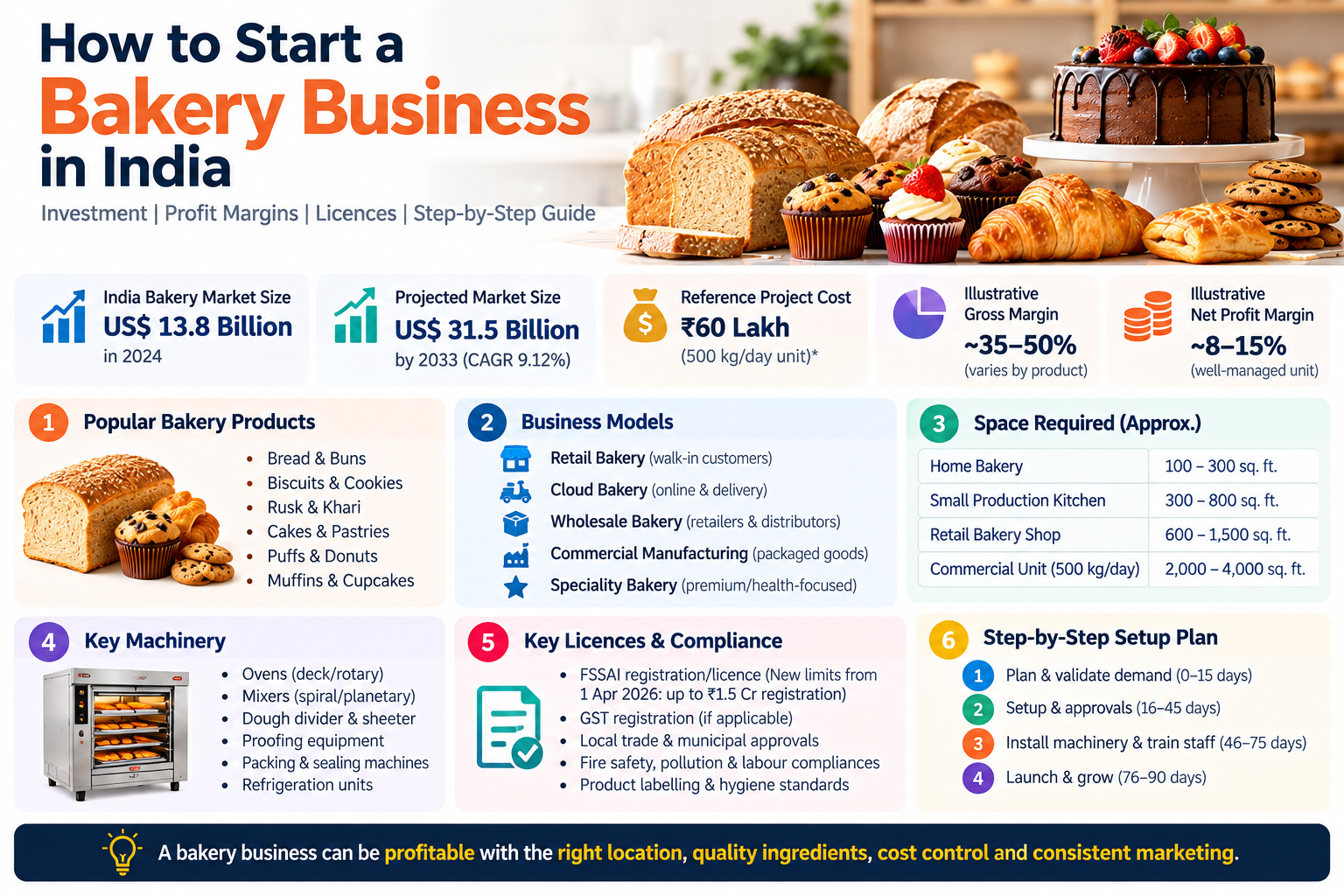
According to the Ministry of Food Processing Industries' bakery sector profile, India's bakery market was valued at approximately US$13.8 billion in 2024 and was projected to reach US$31.5 billion by 2033, representing a forecast CAGR of approximately 9.12%. These figures describe the overall market, not the revenue potential of an individual bakery. Source: MoFPI Bakery Sector Profile
What does this market opportunity mean for entrepreneurs?
| Opportunity | Potential customer segment | Business approach |
|---|---|---|
| Fresh bread and buns | Households, retailers and restaurants | Daily production and local distribution |
| Biscuits and cookies | Retailers, distributors and online buyers | Packaged products and repeat sales |
| Cakes and pastries | Individual customers and celebrations | Pre-orders, customisation and retail sales |
| Rusk and khari | Tea shops, retailers and wholesalers | High-volume production and distribution |
| Premium bakery products | Cafés, premium stores and urban consumers | Differentiated products and premium pricing |
| Institutional bakery supply | Hotels, cafés, caterers and canteens | Contract-based B2B supply |
The most suitable opportunity depends on the target market. A cake studio may succeed through customisation and direct orders, while a commercial biscuit or rusk unit may depend more heavily on production efficiency, distribution and repeat wholesale purchases.
2. Choose the Right Bakery Business Model
Before renting a property or purchasing machinery, decide what you want to manufacture, whom you want to sell to and how customers will purchase your products.
| Business model | Main revenue source | Key consideration |
|---|---|---|
| Home-based bakery | Custom cakes, cookies and pre-orders | Local rules, permitted activities and production capacity |
| Retail bakery shop | Walk-in customers and takeaway orders | Location, rent, display and daily footfall |
| Cloud bakery | Online and direct orders | Delivery costs, digital acquisition and repeat purchases |
| Wholesale bakery | Retailers, distributors and food-service businesses | Volume, credit periods and delivery efficiency |
| Commercial manufacturing unit | Packaged bread, biscuits, rusk and similar products | Machinery, quality control and distribution |
| Speciality bakery | Premium, customised or niche products | Product differentiation and customer willingness to pay |
Which model should you choose?
Choose a retail bakery if customer-facing sales and a suitable location are your strengths. Consider a cloud bakery if you can generate online orders without investing heavily in a storefront. A manufacturing unit is more appropriate when you have identified repeat buyers and can justify the investment in machinery and production infrastructure.
For first-time entrepreneurs, validating demand before committing to a large production facility can reduce financial risk.
3. How Much Investment Is Required to Start a Bakery?
Bakery investment varies according to location, production capacity, equipment specifications, premises and product range. The following amounts are illustrative planning estimates, not verified market quotations or guaranteed project costs.
| Bakery model | Indicative initial investment |
|---|---|
| Small home-based operation | ₹1 lakh–₹5 lakh |
| Small retail bakery | ₹5 lakh–₹15 lakh |
| Cloud bakery | ₹3 lakh–₹10 lakh |
| Small commercial production unit | ₹15 lakh–₹35 lakh |
| Larger commercial bakery | ₹40 lakh–₹1 crore or more |
These ranges may exclude land purchases and can vary substantially with the fit-out, equipment capacity and working capital required. Obtain local quotations before preparing a final project report.
Reference project: 500 kg/day commercial bakery
Report describes a bakery with an installed capacity of 500 kg per day. Its reference project cost is ₹60 lakh, assuming the land and building are already owned.
| Project component | Reference amount |
|---|---|
| Machinery and equipment | ₹40 lakh |
| Contingency provision | ₹8 lakh |
| Other capital investment | ₹12 lakh |
| Total reference project cost | ₹60 lakh |
Important: This is the source report cost structure, not a current quotation. The ₹12 lakh category for other capital investment should be checked against the underlying project schedule to determine precisely which items it covers. The project cost may change considerably if land, building construction, a lease deposit or additional working capital is required.
The Report also shows a proposed financing structure of ₹30 lakh promoter capital, ₹20 lakh term loan and ₹10 lakh subsidy. Treat this strictly as a source-model assumption. Subsidies are not automatic; eligibility, the applicable scheme, funding availability and approval must be independently verified before including subsidy money in a bankable financial plan.
4. Machinery Required for a Bakery Business
Machinery selection should follow the product plan and production target. Buying equipment before finalising the recipes, batch sizes and expected orders can result in unnecessary capital expenditure.
Typical equipment includes:
Commercial oven or rotary rack oven
Spiral or planetary mixer, depending on the products
Dough divider, sheeter or moulding equipment where required
Fermentation or proofing equipment for yeast-based products
Baking trays, racks and cooling systems
Weighing scales and food-grade worktables
Refrigeration and storage equipment
Sealing, packaging and date-coding equipment
Exhaust, ventilation and fire-safety equipment as applicable
A commercial unit may also require electrical upgrades, suitable water supply, drainage, washable surfaces and appropriate storage areas.
Request quotations from multiple suppliers. Compare installed capacity, power consumption, warranty, service availability, spare parts, installation, training and expected maintenance—not just the purchase price.
5. Select Products Based on Demand and Unit Economics
The best product range is not necessarily the largest one. A focused range can simplify purchasing, production planning, inventory management and quality control.
500 kg/day report uses the following product mix:
| Product | Production mix | Reference selling price |
|---|---|---|
| Khari | 20% | ₹100/kg |
| Rusk | 40% | ₹120/kg |
| Atta biscuits | 40% | ₹150/kg |
These prices are assumptions in the sample report, not verified current wholesale or retail prices.
The reference model assumes 500 kg/day installed capacity, 300 operating days per year and 80% effective production efficiency at full planned operating capacity.
At 80% efficiency, expected output is:
500 kg × 80% = 400 kg/day
Annual output is:
400 kg × 300 days = 120,000 kg
Using the sample product mix and selling prices:
| Product | Annual volume | Assumed price | Annual sales |
|---|---|---|---|
| Khari | 24,000 kg | ₹100/kg | ₹24 lakh |
| Rusk | 48,000 kg | ₹120/kg | ₹57.60 lakh |
| Atta biscuits | 48,000 kg | ₹150/kg | ₹72 lakh |
| Total | 120,000 kg | — | ₹153.60 lakh |
This is a capacity-based revenue calculation. It assumes the planned output is produced and sold at the stated prices. It does not demonstrate that the unit will earn a profit of ₹153.60 lakh, because ingredient costs, labour, packaging, distribution, wastage, overheads, financing and taxes must still be accounted for.
6. How to Calculate Bakery Gross Profit and Gross Margin Correctly
This is one of the most important parts of a bakery business plan. Gross margin must not be confused with net profit margin.
Gross profit formula
Gross Profit = Net Sales − Cost of Goods Sold (COGS)
Gross margin formula
Gross Margin (%) = (Gross Profit ÷ Net Sales) × 100
COGS generally includes the direct costs of producing the goods sold. Depending on the accounting policy, these can include ingredients, direct production labour, production-related packaging and allocated manufacturing overheads.
The treatment of costs such as factory rent, utilities, depreciation and indirect production labour should follow a consistent accounting policy. They should not be omitted from product costing simply because they are not ingredients.
Example: Monthly bakery sales of ₹5 lakh
The following is an illustrative financial example designed to demonstrate the calculations. It is not an industry-average margin or a verified forecast for a particular bakery.
| Particulars | Monthly amount |
|---|---|
| Net sales | ₹5,00,000 |
| Ingredients and direct materials | ₹1,80,000 |
| Direct production labour | ₹50,000 |
| Production packaging | ₹20,000 |
| Other direct production costs | ₹25,000 |
| Total COGS | ₹2,75,000 |
| Gross profit | ₹2,25,000 |
| Gross margin | 45% |
Calculation:
Gross profit = ₹5,00,000 − ₹2,75,000 = ₹2,25,000
Gross margin = (₹2,25,000 ÷ ₹5,00,000) × 100 = 45%
The 45% gross margin means that ₹45 of every ₹100 in net sales remains after the direct costs included in this example's COGS. It does not mean the owner takes home ₹45 in profit. The business must still pay its operating expenses and financing costs.
Calculate operating profit and net profit separately
Continue with the same hypothetical bakery:
| Particulars | Monthly amount |
|---|---|
| Gross profit | ₹2,25,000 |
| Rent | ₹50,000 |
| Utilities and maintenance | ₹20,000 |
| Marketing, administration and delivery overheads | ₹35,000 |
| Depreciation | ₹15,000 |
| Operating profit | ₹1,05,000 |
| Interest expense | ₹10,000 |
| Profit before tax | ₹95,000 |
| Illustrative tax provision at 25% | ₹23,750 |
| Illustrative net profit | ₹71,250 |
| Illustrative net profit margin | 14.25% |
The 25% tax provision is used only to illustrate the arithmetic. Actual tax depends on the business structure, applicable tax rules, deductions and other circumstances. This example also assumes that the listed expenses are complete and that there are no other adjustments.
Net margin = (₹71,250 ÷ ₹5,00,000) × 100 = 14.25%
The key lesson is that the same bakery can show a 45% gross margin and a 14.25% net margin in an illustrative month. Neither figure should be advertised as the expected margin of every bakery.
Important distinction for bakery owners
| Metric | Formula | Purpose |
|---|---|---|
| Gross margin | Gross profit ÷ net sales × 100 | Measures production-level profitability |
| Operating profit margin | Operating profit ÷ net sales × 100 | Measures profitability after operating expenses |
| Net profit margin | Net profit ÷ net sales × 100 | Measures profit remaining after applicable costs, interest and tax |
When comparing bakeries, check whether they classify manufacturing labour, packaging, rent, depreciation and delivery costs consistently. A margin comparison is unreliable when the underlying cost classifications differ.
7. Six-Year Financial Projection From the Sample Bakery DPR
The sample DPR projects sales at different capacity-utilisation levels. The table below preserves its reported sales and net-profit figures and calculates the corresponding reported-profit margin.
| Financial year | Capacity utilisation | Sales | Source-reported net profit | Reported-profit margin |
|---|---|---|---|---|
| Year 1 | 70% | ₹107.52 lakh | ₹2.8932 lakh | 2.69% |
| Year 2 | 75% | ₹115.20 lakh | ₹2.8590 lakh | 2.48% |
| Year 3 | 80% | ₹122.88 lakh | ₹2.8248 lakh | 2.30% |
| Year 4 | 85% | ₹130.56 lakh | ₹9.3786 lakh | 7.18% |
| Year 5 | 90% | ₹138.24 lakh | ₹15.9324 lakh | 11.52% |
| Year 6 | 90% | ₹138.24 lakh | ₹16.2654 lakh | 11.77% |
Calculation: Reported-profit margin = Source-reported net profit ÷ sales × 100.
For example, Year 1 margin = (₹2.8932 lakh ÷ ₹107.52 lakh) × 100 = approximately 2.69%.
Can these figures be treated as verified bakery profit forecasts?
No. These are the figures reported in the supplied sample DPR report, not independently validated forecasts.
Two issues need to be reconciled before using them to assess investment viability:
The source's expense presentation appears to include loan-related amounts in a way that requires checking. Loan principal repayment is generally a financing cash-flow item, not an expense in the profit and loss statement. Interest expense is treated separately.
The source's raw-material cost schedule does not increase consistently with sales in the later years. The underlying cost assumptions need to be reviewed before relying on the resulting profit figures.
The source-reported profit margins above are therefore not gross margins and should not be presented as validated net margins until the profit-and-loss classification and cost assumptions are reconciled.
The sample's reported DSCR and IRR should also be independently recalculated from a consistent cash-flow model before they are used in a loan application or investment decision.
8. How to Estimate Your Bakery's Break-Even Point
Break-even analysis shows the level of sales at which contribution covers fixed costs.
Contribution = Sales − Variable Costs
Break-Even Sales = Fixed Costs ÷ Contribution Margin Ratio
Suppose a bakery has the following illustrative monthly assumptions:
Monthly fixed costs: ₹1,50,000
Variable costs: 60% of sales
Contribution margin ratio: 40%
Break-even sales:
₹1,50,000 ÷ 40% = ₹3,75,000 per month
Under these assumptions, the bakery needs ₹3.75 lakh in monthly sales to cover the specified fixed and variable costs before any expenses omitted from the model.
This is a simplified illustration. For a realistic bakery, calculate contribution by product, account for sales-channel commissions and wastage, and distinguish fixed costs from variable costs. If products have different contribution margins, a weighted average should reflect the expected sales mix.
9. Working Capital: A Critical Part of Bakery Investment
Purchasing machinery is only one part of funding a bakery. The business also needs enough cash to buy ingredients, pay employees, manage utilities, maintain inventory and cover the gap between supplying customers and receiving payment.
Working-capital requirements depend on:
Supplier payment terms
Inventory levels and ingredient shelf life
Daily production and sales volumes
Retailer and distributor credit periods
Customer advance payments
Unsold products and wastage
Seasonal demand fluctuations
A wholesale bakery that supplies retailers on credit may need more working capital than a business collecting advance payments for customised cakes.
Before starting, prepare a monthly cash-flow forecast for at least the first year. Do not assume that accounting profit automatically means cash is available to repay a loan.
10. Licences and Compliance Required to Start a Bakery in India
Compliance requirements depend on the nature of the activity, the premises, the products and the location. Confirm the requirements with the relevant authorities before commencing operations.
FSSAI registration or licence
Food businesses must identify the applicable FSSAI registration or licence category. FSSAI's 2026 reforms revised the turnover thresholds effective from 1 April 2026 for new applications, with a transition process for existing businesses. The published thresholds are:
| Category | Turnover threshold |
|---|---|
| Registration | Up to ₹1.5 crore |
| State licence | Above ₹1.5 crore and up to ₹50 crore |
| Central licence | Above ₹50 crore |
Important: Turnover alone may not determine the applicable category for every food activity. Manufacturing, e-commerce, importing and other activities can have specific eligibility requirements. Confirm the exact kind of business and licence category on the official FoSCoS portal.
The 2026 reforms also introduced perpetual validity subject to suspension, cancellation or surrender, while ongoing food-safety and statutory obligations remain applicable. Check the current official guidance for your business category.
Other compliance checks
Depending on your business model and location, you may need to review:
Business constitution and PAN, and GST registration where applicable
State Shops and Establishments requirements for a retail outlet or workplace
Municipal trade, building-use or local permissions
Fire-safety requirements applicable to the premises and equipment
Labour, wage, workplace and employee-related requirements
Legal Metrology and packaged-commodity declarations where applicable
Product labelling, ingredient and allergen declarations, and applicable food standards
Waste disposal, water, drainage and pollution-control requirements where applicable
Trademark protection for your brand, if appropriate
Not every requirement applies to every bakery. Confirm the applicable obligations with the relevant local authority, a qualified professional and the official regulatory portal before investing.
11. How to Select the Right Location
A retail bakery needs convenient access to its target customers. A wholesale production unit may benefit more from efficient deliveries, adequate loading space and access to retailers than from expensive high-street frontage.
Evaluate a potential location using the following factors:
Customer demand: Estimate the number and type of potential buyers in the catchment.
Competition: Review nearby bakeries, product ranges, prices, customer feedback and opening hours.
Accessibility: Check parking, pedestrian access, delivery routes and loading facilities.
Premises suitability: Confirm that the property can legally and practically support the intended food activity.
Utilities: Assess electrical load, water supply, drainage, ventilation and equipment installation.
Occupancy cost: Include rent, deposit, fit-out, maintenance and common-area charges.
Expansion potential: Determine whether the premises can support increased output without an immediate relocation.
For a retail outlet, visibility and footfall may be important. For a wholesale unit, route efficiency and distribution economics can be more important than walk-in traffic.
12. How to Market and Sell Bakery Products
A bakery needs a repeatable sales strategy rather than relying only on walk-in customers.
Direct-to-consumer sales
Build a clear product menu with prices, pack sizes and ordering information.
Use product photography that accurately represents the items.
Create a Google Business Profile for an eligible physical business.
Collect genuine customer reviews without offering prohibited incentives.
Encourage repeat purchases through appropriate customer communication.
Test local promotions and measure the cost of acquiring each order.
B2B distribution
Approach retailers, cafés, hotels, restaurants, caterers, canteens and institutional buyers with a product catalogue and sample packs.
For each potential customer, calculate the expected contribution after discounts, packaging, delivery and credit costs. A large order is not necessarily a profitable order if the selling price is too low or payment terms tie up too much cash.
Online sales
Use your own ordering channel and suitable third-party platforms where commercially appropriate. Include commissions, packaging, refunds, delivery charges and promotional costs when calculating online profitability.
For a bakery supplying packaged products, develop a clear policy for product shelf life, batch identification, returns and quality complaints.
13. Quality Control and Inventory Management
Food safety and product consistency are central to building a sustainable bakery.
Develop documented procedures for:
Approved suppliers and ingredient specifications
Ingredient receiving, storage and stock rotation
Recipe weights and production batch records
Cleaning, sanitation and pest control
Employee hygiene and food handling
Allergen management and cross-contact prevention
Product cooling, packaging and storage
Batch traceability, complaints and product recall
Monitoring wastage and unsold inventory
Track production yield and wastage by product. If ingredient costs increase or product sizes vary, contribution margins can deteriorate even when sales remain stable.
14. A Practical 90-Day Bakery Launch Plan
| Period | Key activities | Expected output |
|---|---|---|
| Days 1–15 | Research local demand, competitors, target customers and prices | Initial market assessment |
| Days 16–30 | Select products, test recipes, calculate unit costs and approach buyers | Product plan and initial sales evidence |
| Days 31–45 | Compare premises, machinery quotations, suppliers and financing options | Draft project cost and operating plan |
| Days 46–60 | Finalise the business model, confirm applicable licences and prepare the premises | Compliance and setup checklist |
| Days 61–75 | Install equipment, test production, establish quality procedures and train staff | Trial production and operating controls |
| Days 76–90 | Launch, approach repeat buyers, track sales and refine the product mix | Early sales data and revised financial forecast |
The timeline is illustrative. Regulatory approvals, premises work, equipment delivery and other dependencies can extend the launch period.
15. Common Mistakes to Avoid
Buying machinery before confirming demand: Start with a product plan and evidence of likely sales. Match equipment to the production volumes you can realistically sell.
Confusing gross margin with net profit margin: Gross margin measures profitability after the direct costs included in COGS. It does not deduct every business expense.
Using outdated or unsupported cost assumptions: Obtain current supplier quotations for machinery, ingredients, packaging, rent and utilities.
Ignoring distribution costs: Retailer discounts, distributor commissions, transport, damaged products and credit terms can materially affect contribution.
Assuming a subsidy will be approved: Verify eligibility and approval requirements before treating subsidy funding as available capital.
Ignoring working capital: A bakery can have orders and positive accounting profit yet face a cash shortage because customers pay late.
Expanding before unit economics are stable: Establish consistent product quality, repeat demand, positive contribution and adequate cash flow before committing to a larger facility.
Conclusion
Starting a bakery business in India requires more than selecting an oven and preparing a menu. Entrepreneurs need to validate demand, select products carefully, budget for equipment and working capital, comply with applicable food-safety requirements and understand the financial performance of each product.
The most important financial discipline is to calculate gross margin from properly defined production costs and calculate net profit margin separately after the relevant expenses. The supplied commercial bakery DPR offers a useful starting point for planning capacity and investment, but its financial assumptions must be reconciled before its profit, DSCR or IRR figures are used to support an investment or loan decision.