Executive Summary
A Chikankari boutique can be launched as a reseller, private-label brand, artisan-linked business or online-first store. Success depends on choosing a specific customer segment, sourcing consistent products, controlling stock and tracking contribution after variable costs. Broad apparel and handicraft data provide context, but they are not a standalone Chikankari market-size estimate.
·India's apparel retail market was estimated at ₹9.30 lakh crore (US$112 billion) in FY2025 and projected by CareEdge Ratings to reach nearly ₹16 lakh crore (US$193 billion) by FY2030.
·Handicraft exports excluding hand-knotted carpets reached ₹33,122.79 crore in FY2024–25, compared with ₹20,082.53 crore in FY2014–15.
·The broader embroidered and crocheted goods export category reached ₹4,350 crore in FY2024–25; it includes products beyond Chikankari.
·Investment budgets and profitability calculations in this article are illustrative assumptions, not market averages or guaranteed outcomes.
1. Understand the Opportunity
Chikankari is a traditional embroidery style associated with Lucknow. A boutique can sell kurtis, kurta sets, dupattas, shirts, fusion wear and occasion pieces. Its proposition can combine craftsmanship, fabric quality, contemporary styling and a curated shopping experience.
Do not use national apparel forecasts as a direct forecast for your store. They describe the wider market, not the sales a new Chikankari boutique will achieve. Validate demand through competitor visits, customer interviews, sample sales and a small opening collection.
2. Market Data and Graphs
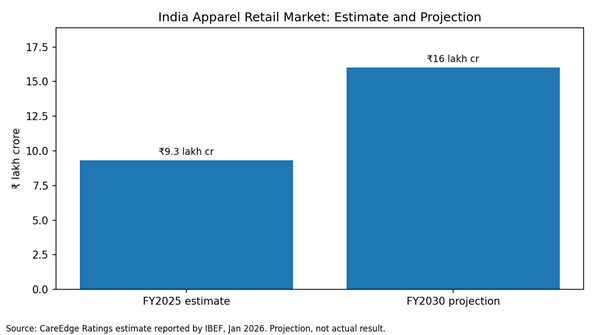
Figure 1. IBEF reported in January 2026 that CareEdge Ratings estimated India's apparel retail market at ₹9.30 lakh crore in FY2025 and projected it to approach ₹16 lakh crore by FY2030. This is a broad apparel-sector projection, not a Chikankari-specific forecast.
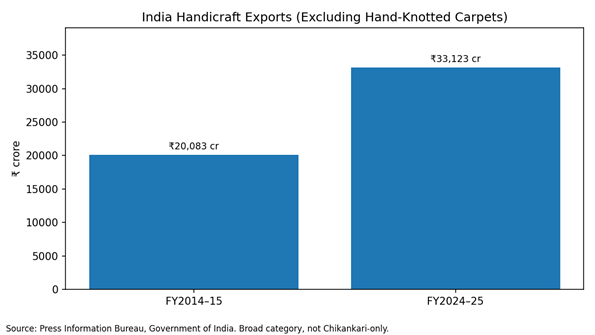
Figure 2. Government data show handicraft exports excluding hand-knotted carpets increasing from ₹20,082.53 crore in FY2014–15 to ₹33,122.79 crore in FY2024–25. This broad category includes many crafts.
Metric |
Figure |
Interpretation |
India apparel retail, FY2025 |
₹9.30 lakh crore |
Broad market estimate |
India apparel retail, FY2030 |
Nearly ₹16 lakh crore |
Projection, not actual result |
Handicraft exports, FY2024–25 |
₹33,122.79 crore |
Excludes hand-knotted carpets; broad craft category |
Embroidered and crocheted goods exports, FY2024–25 |
₹4,350 crore |
Broader category, not Chikankari-only |
3. Choose the Right Boutique Model
Reseller boutique
Buy finished garments from wholesalers and sell a curated assortment. Easy to test, but price competition can be intense.
Private-label boutique
Source garments or fabric and sell under your own brand. You control presentation and assortment, but need stronger quality control and working capital.
Artisan-linked boutique
Work with artisans or producer groups to develop selected designs. This can differentiate the brand but requires production planning and quality checks.
Online-first boutique
Start through social commerce and a simple website, then consider a physical store once repeat demand is proven.
Omnichannel boutique
Combine a physical shop with online ordering and local delivery. It improves access but adds operating complexity.
4. Investment Required to Start
There is no single standard investment amount. A home-based or online test can start with less capital than a rented boutique. These are illustrative planning budgets; replace them with supplier quotations and local rental estimates.
Lean online test: approximately ₹50,000
Cost head |
Illustrative budget |
Samples and testing |
₹8,000 |
Opening inventory |
₹20,000 |
Packaging |
₹4,000 |
Product photos/content |
₹5,000 |
Initial marketing |
₹8,000 |
Contingency |
₹5,000 |
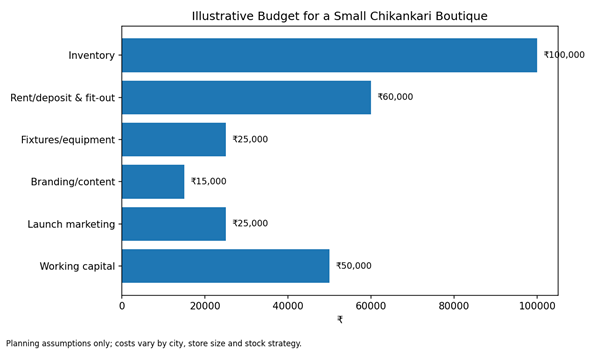
Small physical boutique: approximately ₹2,75,000
Cost head |
Illustrative budget |
Opening inventory |
₹1,00,000 |
Rent deposit and basic fit-out |
₹60,000 |
Fixtures and equipment |
₹25,000 |
Branding and content |
₹15,000 |
Launch marketing |
₹25,000 |
Working capital reserve |
₹50,000 |
The physical-boutique example excludes some possible costs such as recurring rent after the deposit, staff, utilities, licenses, taxes and major renovation. Keep a reserve for slow-moving stock and early operating losses.
5. Select Products for Your Opening Collection
·Cotton kurtis: test everyday wear, fit and fabric comfort.
·Kurta sets: can raise average order value but require coordinated stock and more sizes.
·Dupattas: test embroidery and colour preferences with less size complexity.
·Contemporary shirts and fusion wear: offer craft details in modern silhouettes.
·Premium hand-embroidered pieces: use only when craftsmanship and provenance are verified.
·Seasonal collections: test limited quantities before making large festive or wedding-season purchases.
Start with a manageable range of around 5–10 designs and a deliberate size/colour mix. Treat this as a test collection, then use sales and feedback to decide what to reorder.
6. Identify Your Target Customers
Everyday ethnic-wear buyers
Priorities: comfort, fit, durability and accessible pricing. Offer clear size charts and care information.
Office and smart-casual customers
Priorities: versatile silhouettes, subtle embroidery and dependable sizing.
Premium ethnic-fashion shoppers
Priorities: distinctive designs, finishing, fabric feel and credible craftsmanship claims.
Gift buyers
Priorities: attractive packaging, easy selection, dispatch dates and exchange policies.
Boutiques and resellers
Priorities: wholesale price lists, minimum order quantities, repeatable quality and reliable delivery.
International or diaspora buyers
Priorities: accurate descriptions, size conversions, fulfilment, shipping and return terms.
Choose one primary segment first. A store trying to serve every budget and occasion can end up with fragmented inventory and unclear positioning. Validate the segment with interviews and paid orders.
7. Supplier Sourcing and Quality Control
·Compare suppliers and order samples before bulk purchasing.
·Separate fabric, embroidery, stitching, finishing, packaging and shipping costs where possible.
·Confirm whether embroidery is hand-done, machine-done or mixed, and describe it accurately.
·Check stitch consistency, thread quality, shrinkage, colourfastness, measurements and finishing.
·Agree on lead times, defect allowances, rework, payment terms and delivery responsibilities in writing.
·Keep approved samples and batch records for future comparisons.
·Use fair, clear and timely payment terms when working directly with artisans.
8. Pricing and Profitability: An Illustrative Example
Gross margin is not net profit. Account for product cost, discounts, packaging, payment fees, shipping, marketing, rent, salaries, utilities and taxes.
Illustrative online order |
Amount |
Selling price |
₹1,499 |
Garment and embroidery |
−₹600 |
Packaging |
−₹40 |
Shipping subsidy |
−₹80 |
Payment/selling fees |
−₹45 |
Advertising cost per order |
−₹200 |
Returns/defects allowance |
−₹75 |
Contribution before fixed costs and tax |
₹459 |
Contribution is ₹459, or about 30.6% of the ₹1,499 selling price. This is an illustrative model, not a typical industry margin. If fixed monthly costs are ₹45,000, break-even is ₹45,000 ÷ ₹459 ≈ 98 retained orders per month.
9. Marketing Your Boutique
Local discovery
Keep Google Business Profile details, hours, contact information and product photos accurate. Ask for genuine, honest reviews.
Instagram and short-form video
Show embroidery close-ups, styling, fabric movement and new arrivals. Track enquiries and purchases, not only views.
Own website
Include product photos, measurements, fabric composition, care instructions, shipping timelines and return terms.
WhatsApp retention
Use consent-based messages for restocks, collections and offers, with a clear opt-out.
Local collaborations
Explore stylists, exhibitions, wedding vendors and complementary businesses that reach your target customers.
B2B outreach
Create a line sheet with wholesale prices, minimum quantities, product specs and dispatch timelines.
10. A 90-Day Launch Roadmap
Days 1–15: Research
Map competitors, interview customers, set a budget and compare suppliers.
Days 16–30: Product test
Approve samples, choose a small collection, calculate landed costs and create product content.
Days 31–45: Soft launch
Sell through one or two channels and track conversion, cancellations and feedback.
Days 46–60: Optimise
Reorder proven designs, discontinue weak products and refine pricing.
Days 61–90: Scale carefully
Test partnerships, repeat-customer campaigns or wholesale only when margins and fulfilment are healthy.
11. KPIs to Track
·Sales by product, size, colour and channel
·Gross margin and contribution per retained order
·Average order value and conversion rate
·Customer acquisition cost and marketing contribution
·Returns, exchanges, cancellations and defects
·Inventory sell-through and ageing stock
·Repeat-purchase rate and customer feedback
·Supplier lead time and on-time delivery
12. Common Mistakes to Avoid
·Buying too much inventory before testing demand.
·Choosing suppliers on price alone without checking quality.
·Using the same pricing strategy for every product.
·Ignoring rent, shipping, returns, fees and advertising in profit calculations.
·Making unverified claims about hand embroidery, origin or artisan impact.
·Treating broad apparel or handicraft statistics as the Chikankari boutique market size.
·Expanding to multiple channels before fulfilment and customer service are reliable.
Conclusion
A Chikankari boutique can begin as a small online experiment or grow into a physical and digital retail brand. The most defensible route is to choose a clear target customer, source a differentiated collection, validate product quality and price, and use actual contribution and stock-turnover data to decide when to expand.
Sources and Further Reading
·IBEF, Jan 2026 — apparel retail market projection citing CareEdge Ratings: https://www.ibef.org/news/india-s-apparel-retail-market-poised-to-reach-us-193-billion-by-fy30-careedge
·Press Information Bureau, Government of India — handicraft export performance: https://www.pib.gov.in/PressNoteDetails.aspx?ModuleId=3&NoteId=156396&lang=2®=48
·IBEF — Handicraft in India: Digital Growth & Global Demand: https://www.ibef.org/blogs/handicraft-in-india-rising-through-digital-expansion-and-global-demand
·PIB, Ministry of Textiles — Performance of Textile Sector: https://www.pib.gov.in/Pressreleaseshare.aspx?PRID=2204546&lang=2®=48
Data note: Market figures are broad apparel/handicraft statistics, not direct measurements of the Chikankari boutique segment. Budgets, margins and break-even examples are illustrative and should be replaced with current quotes and observed sales data.