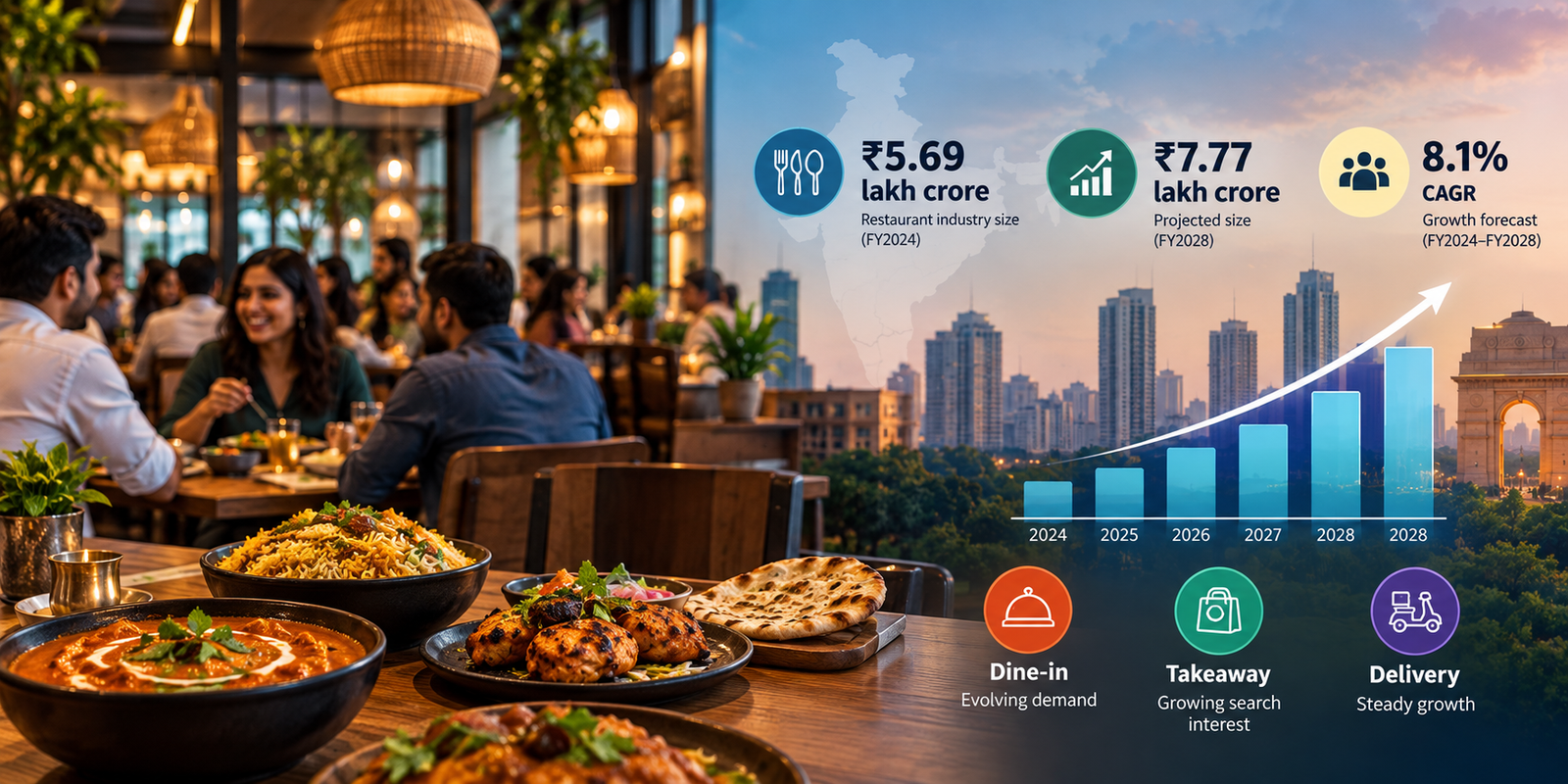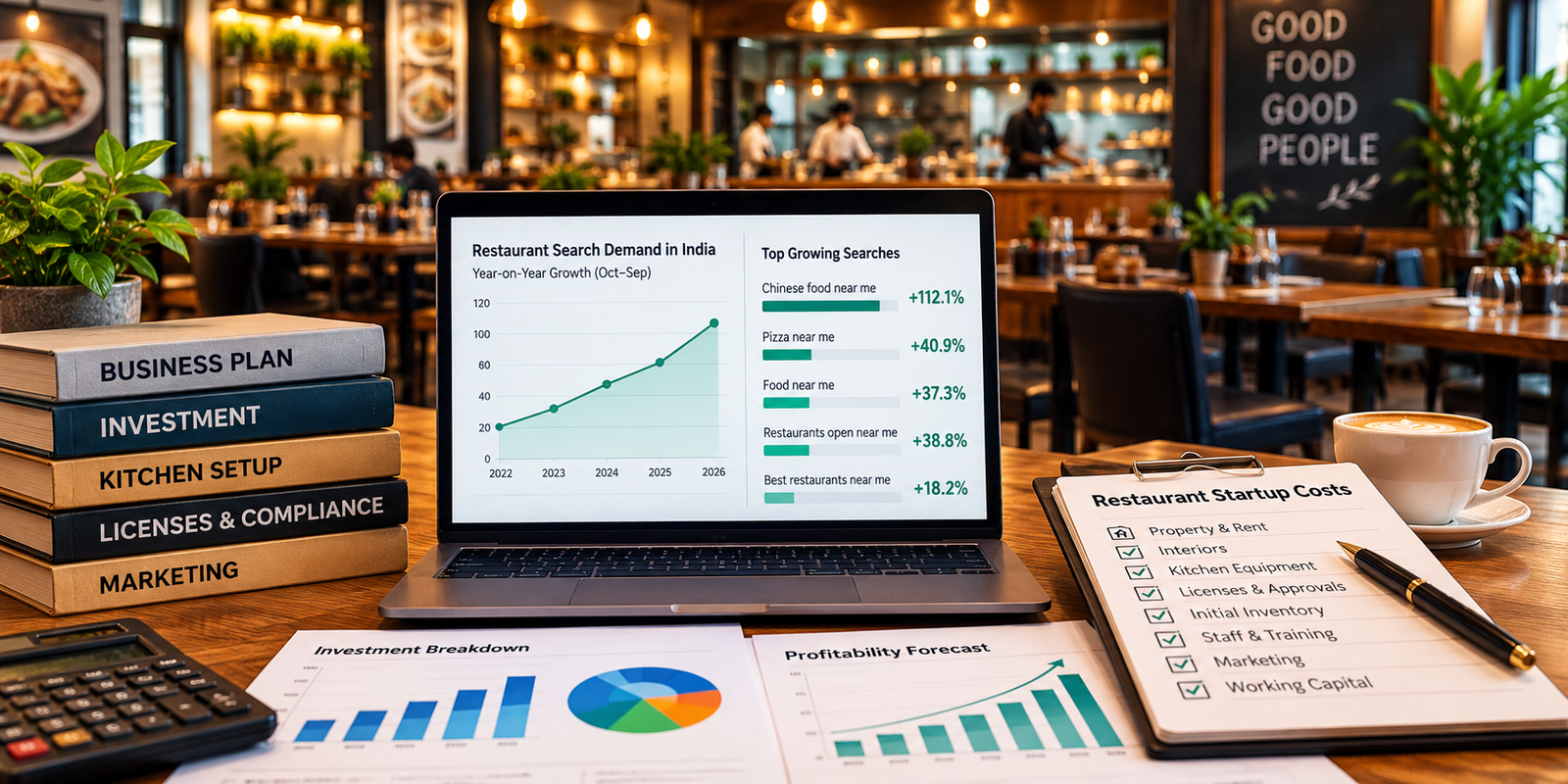
Starting a restaurant in India can be rewarding, but success depends on more than a good menu. You need to validate local demand, choose the right format, estimate costs realistically, secure the required approvals, price your menu carefully, and build a repeat-customer engine. This guide explains the main steps for planning a restaurant business in 2027.
At a glance: the steps
1.Choose a restaurant model and define your target customer.
2.Validate demand, competitors, pricing, and delivery/dine-in preferences in the catchment area.
3.Prepare a business plan, startup budget, monthly operating budget, and break-even estimate.
4.Shortlist a location based on visibility, access, rent, competition, and customer fit.
5.Check FSSAI and local approvals applicable to your premises and activities.
6.Design a focused menu, standardise recipes, and calculate contribution per order.
7.Set up operations, staff training, billing, inventory, hygiene, and customer feedback processes.
8.Launch with local marketing and measure sales, repeat orders, food cost, and profitability.
1. Choose the right restaurant business model
Your business model determines the investment, staffing, kitchen design, customer experience, and marketing required. Select a model that fits your budget, skills, and local demand rather than choosing one only because it is popular.
Model |
Typical strengths |
Key considerations |
Cloud kitchen |
Delivery-focused; can start with a smaller customer-facing space |
Platform commissions, delivery radius, packaging, and online visibility |
Takeaway / QSR |
Focused menu and potentially faster service |
Footfall, speed, standardisation, and value pricing |
Cafe |
Beverages, snacks, and a social setting |
Location, seating, ambience, and repeat visits |
Casual dining |
Broader menu and dine-in experience |
Higher fit-out, staffing, and operating costs |
Premium / fine dining |
Experience-led positioning and potentially higher average bills |
High service expectations, capital needs, and demand consistency |
2. Estimate your startup investment
The ranges below are illustrative planning estimates, not verified industry averages or quotations. Actual investment can vary significantly by city, rent deposit, size, kitchen equipment, fit-out, brand positioning, and working-capital needs. Obtain local quotations before committing.
Format |
Illustrative startup range |
Small takeaway outlet |
₹5–15 lakh |
Small cafe |
₹8–25 lakh |
Cloud kitchen |
₹5–20 lakh |
Small QSR |
₹10–30 lakh |
Casual dining restaurant |
₹25–75 lakh |
Premium / fine dining |
₹75 lakh and above |
Budget for these cost categories
·Security deposit, advance rent, brokerage, and lease-related expenses.
·Civil work, interiors, signage, electrical work, plumbing, ventilation, and fire-safety requirements.
·Kitchen equipment, refrigeration, storage, utensils, furniture, POS, and billing systems.
·Licences, registrations, professional fees, and pre-opening compliance costs.
·Initial ingredients, packaging, uniforms, cleaning supplies, and other consumables.
·Hiring, training, launch marketing, photography, menus, and listing setup.
·Working capital for rent, salaries, utilities, replenishment, and other costs during the ramp-up period.
Keep a contingency reserve. Do not spend the entire budget on interiors and equipment; the business also needs cash to operate while sales build up.
3. Validate local demand before signing a lease
Study the specific catchment area where you intend to open. A city-wide trend can hide major differences between neighbourhoods, office districts, residential clusters, and high streets.
·Map direct competitors and note cuisine, price points, ratings, opening hours, delivery coverage, and customer reviews.
·Observe footfall at different times and days, including lunch, evening, and weekends.
·Compare local menu prices and estimate the average bill that your target customer can afford.
·Use Google Trends to understand relative interest over time; its 0–100 index is not absolute search volume.
·Use Google Keyword Planner as an estimate of search demand, and check the date range, geography, and keyword groupings.
·Speak with potential customers and test a small menu or pop-up where practical before making a large commitment.
4. Choose a location carefully
A good location matches your customer and operating model. For dine-in, consider visibility, access, parking or transit, surrounding residential or office demand, and the experience customers expect. For a delivery-led kitchen, prioritise a viable delivery radius, rider access, kitchen efficiency, and platform coverage.
Before signing, review the lease terms, permitted use, power and water capacity, exhaust/ventilation feasibility, waste handling, building permissions, and any society or landlord restrictions. Confirm requirements with the relevant local authorities and qualified professionals.
5. Check licences and registrations
Requirements depend on your location, business structure, turnover, premises, and activities. Common items to investigate include:
·FSSAI registration or licence, as applicable to the food business and current eligibility criteria.
·Local municipal trade or health permissions, where applicable.
·Shop and Establishment registration, as applicable under state rules.
·GST registration if required under the applicable rules and thresholds.
·Fire-safety approvals or NOCs where applicable to the premises and local rules.
·Signage, music, liquor, outdoor seating, or other permissions if your business activities require them.
Do not rely on a generic checklist alone. Confirm current requirements with official portals and the local authority before opening. Rules, thresholds, fees, and applicability can change.
6. Build a focused menu and price it properly
Start with a manageable menu that your kitchen can deliver consistently. Standardise recipes and portion sizes, track ingredient wastage, and review dish-level contribution rather than judging items only by sales volume.
Basic food-cost percentage formula:
Food Cost % = (Ingredient Cost per Dish ÷ Selling Price) × 100
Example: if ingredients cost ₹80 and the selling price is ₹240, food cost is 33.3% before considering packaging, platform fees, discounts, labour, rent, utilities, taxes, and other overheads. The right target depends on your menu, format, and business economics.
7. Calculate break-even sales
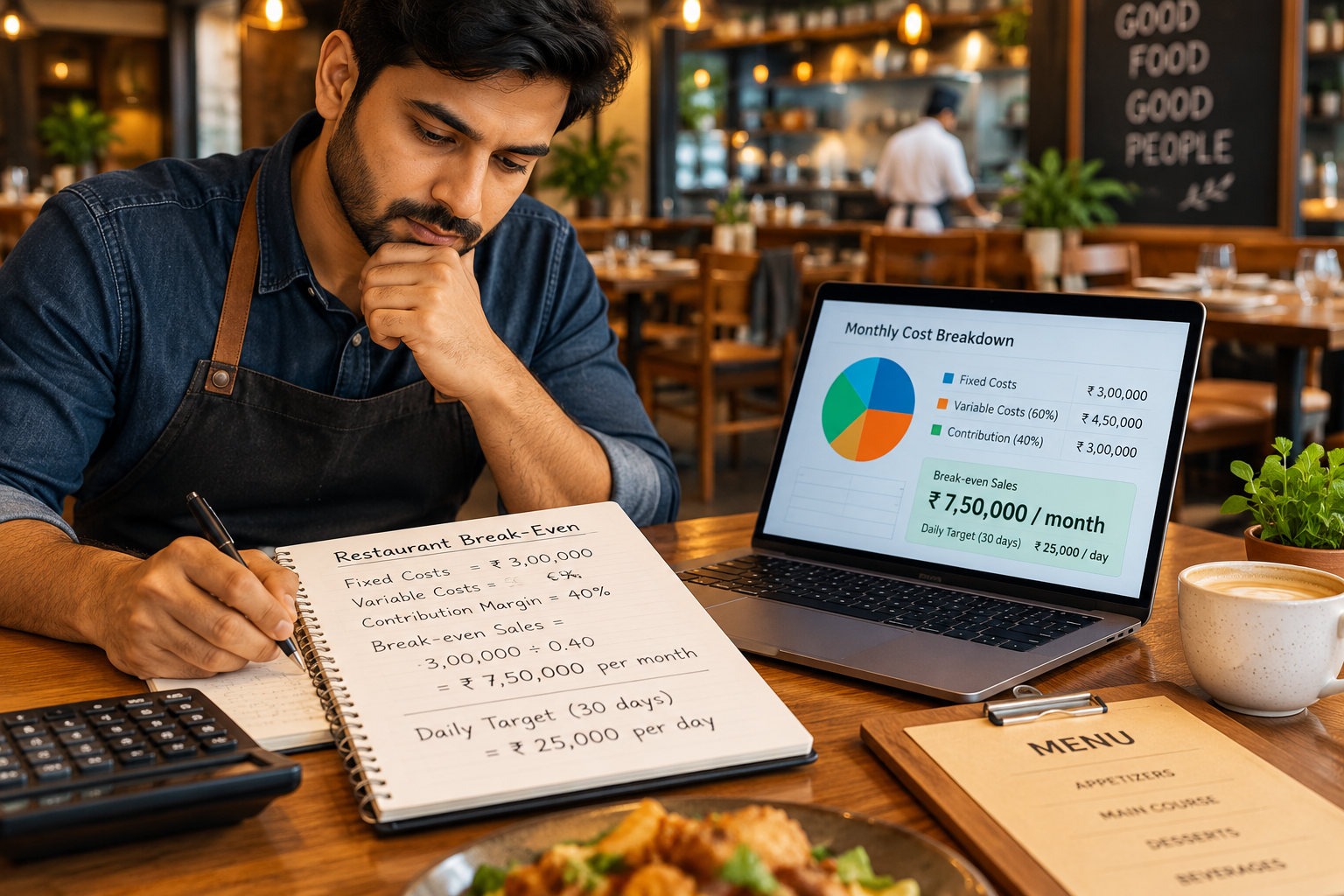
Break-even estimates the sales level at which contribution covers fixed costs. Use realistic numbers and separate costs that change with sales from costs that remain relatively fixed.
Illustrative example:
·Monthly fixed costs: ₹3,00,000
·Variable costs: 60% of sales
·Contribution margin: 40% of sales
·Break-even sales = ₹3,00,000 ÷ 0.40 = ₹7,50,000 per month
·At 30 operating days, this is approximately ₹25,000 in sales per day.
This is a simplified example, not a profit forecast. Include taxes where relevant, owner salary, loan repayments, depreciation, platform commissions, discounts, seasonality, and ramp-up time when preparing your full financial model.
8. Set up operations before launch
·Document recipes, portion sizes, prep methods, cleaning routines, and food-safety checks.
·Create supplier lists, reorder levels, stock counts, and wastage tracking.
·Train staff on service standards, billing, complaint handling, and hygiene.
·Test kitchen capacity and order timing during simulated peak periods.
·Set up POS, payment methods, invoicing, inventory records, and daily sales reporting.
·Define how customer feedback and low ratings will be reviewed and resolved.
9. Market your restaurant locally
Build visibility before opening and keep marketing focused on the customers you can realistically serve.
·Create and verify a Google Business Profile when eligible; keep the name, address, phone, hours, menu, and photos accurate.
·Publish a useful website or landing page with menu, location, opening hours, ordering options, and contact details.
·Use local SEO content naturally, such as cuisine, neighbourhood, and occasion terms where relevant.
·Post real food, kitchen, team, and customer-experience content on social platforms.
·Test paid ads with a clear budget and track calls, direction requests, bookings, orders, and cost per acquired customer.
·Use delivery platforms where they fit your model, but calculate commissions, discounts, packaging, and net contribution.
·Encourage genuine customer feedback without buying reviews or offering incentives that violate platform policies.
10. Use data to improve decisions
Review performance weekly rather than relying on impressions or total sales alone. Useful metrics include:
·Orders and revenue by daypart, channel, cuisine, and product.
·Average order value and contribution per order.
·Food cost, wastage, refunds, discounts, and platform commissions.
·Repeat-customer rate and customer acquisition cost.
·Table occupancy or kitchen capacity utilisation, depending on the model.
·Google Business Profile actions, website calls, direction requests, and qualified leads.
Common mistakes to avoid
·Choosing a location based only on rent or footfall without validating customer fit.
·Overbuilding the menu before identifying the best-selling items.
·Underestimating working capital and pre-opening delays.
·Setting prices without accounting for all variable costs and channel commissions.
·Depending on one acquisition channel or one delivery platform.
·Treating Google Trends index values as actual search volumes.
·Expanding before unit economics, food quality, and operating processes are repeatable.
Restaurant launch checklist
☐ Target customer and restaurant model defined
☐ Local demand and competitor research completed
☐ Startup budget and working-capital reserve prepared
☐ Location and lease due diligence completed
☐ Applicable licences and registrations confirmed
☐ Menu, recipe costing, and selling prices tested
☐ Suppliers, staff, POS, and inventory processes ready
☐ Google Business Profile and website/listings prepared where eligible
☐ Launch campaign and measurement plan ready
☐ Daily sales, food cost, wastage, and customer-feedback reporting in place