Introduction: Is Exporting a Business Opportunity for Indian Entrepreneurs?
India’s export sector offers opportunities for manufacturers, traders, agricultural businesses, service providers and entrepreneurs who want to sell products internationally. However, starting an export business involves more than finding a foreign customer and dispatching goods. An exporter must identify the right product, research overseas demand, understand regulations, calculate logistics costs, negotiate payment terms and comply with customs requirements.
The Government of India’s How to Export: A Practical Guide, published under the Niryat Bandhu Scheme for 2023–24, outlines the main stages of this process, from business establishment and Importer Exporter Code (IEC) registration to product classification, market selection, export documentation, shipping and payment realisation.
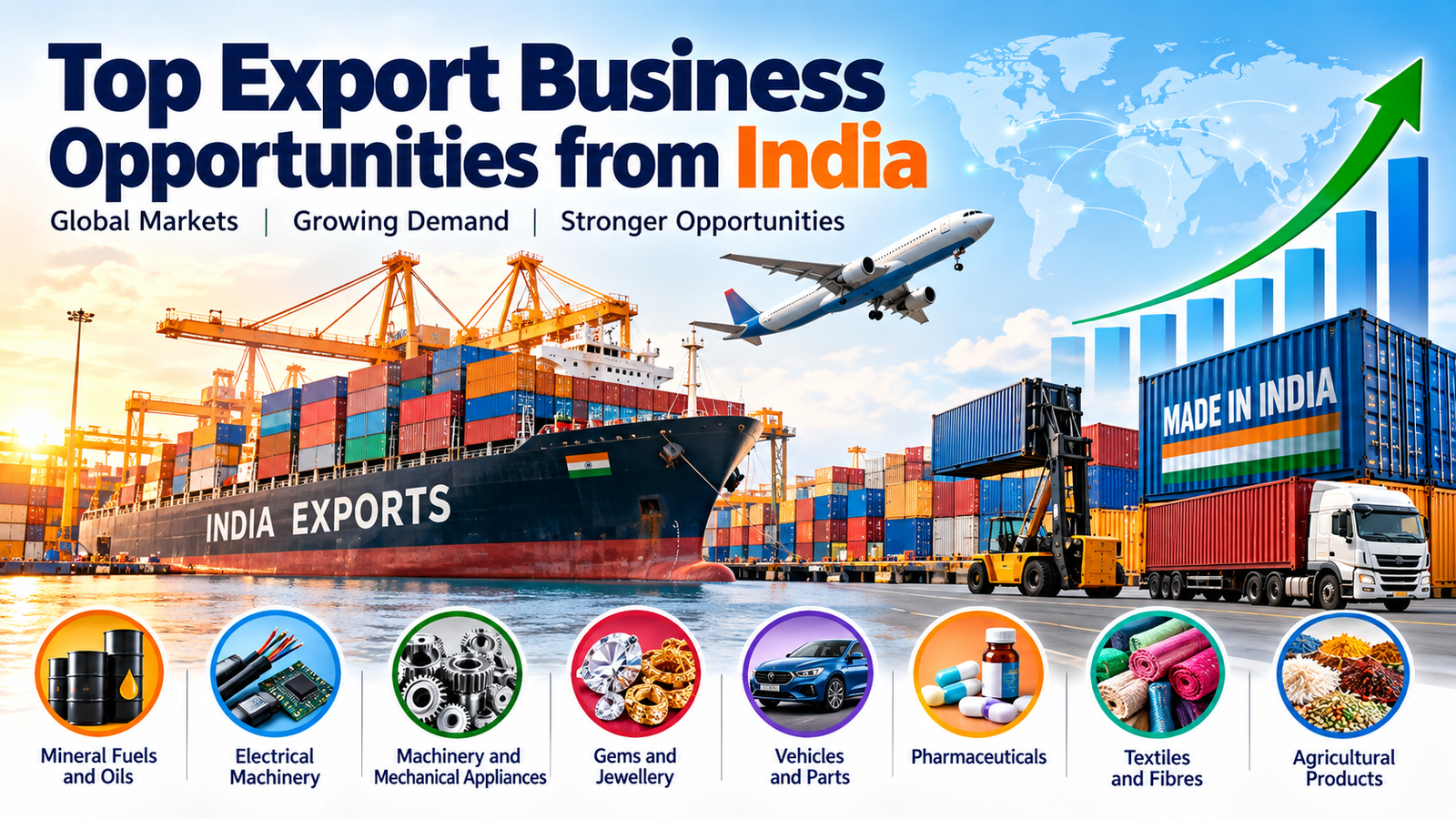
India’s more recent trade figures also demonstrate the scale of the opportunity. According to the Ministry of Commerce and Industry, total merchandise and services exports reached approximately US$825.25 billion in FY 2024–25, including US$437.70 billion in merchandise exports. Source: Ministry of Commerce and Industry annual report (see source links at the end).
A large national export market does not automatically make every product profitable. The opportunity lies in identifying products for which overseas buyers have sufficient demand, Indian suppliers can deliver consistent quality, and the exporter can earn an acceptable margin after all costs.
1. What Is an Export Business?
An export business involves selling goods or services from India to customers in another country. Depending on the business model, an exporter may manufacture products, purchase them from domestic suppliers, act as an intermediary between manufacturers and overseas buyers, or sell through international e-commerce channels.
Business model |
How it works |
Suitable for |
Manufacturer exporter |
Manufactures products and sells them internationally |
Factories and production businesses |
Merchant exporter |
Purchases products from manufacturers and exports them |
Traders and entrepreneurs with buyer-acquisition skills |
Third-party exporter |
Exports goods made by another producer under applicable documentation and compliance arrangements |
Trading businesses and sourcing companies |
E-commerce exporter |
Sells products to overseas customers through online channels |
Brands, artisans and small businesses |
Service exporter |
Supplies eligible services to overseas clients |
IT, consulting, design and professional service businesses |
The government guide discusses merchant and third-party exports, e-commerce, manufacturing and processing exports as distinct topics. The most appropriate model depends on available capital, product knowledge, supplier access and the entrepreneur’s ability to find customers.
Practical recommendation: Entrepreneurs who do not own a factory can investigate merchant exporting. This can reduce the need for manufacturing investment, although quality control, supplier reliability, working capital and export compliance remain important.
2. Which Products Should You Export From India?
Product selection is one of the most important decisions in an export business. The government guide explains that exporters should study export trends and check whether a product is freely exportable, restricted or prohibited. It also recommends selecting overseas markets after researching market size, competition, quality requirements, payment terms, freight expenses and other costs.
Product categories to investigate
Product category |
Examples |
Important factors to investigate |
Agricultural products |
Cereals, spices, seeds and processed agricultural products |
Seasonal supply, quality standards, sanitary requirements and shelf life |
Food processing |
Packaged foods, prepared food products and ingredients |
Food regulations, labelling, shelf life and destination-country approvals |
Textiles and apparel |
Cotton products, garments, fabrics and made-up textiles |
Specifications, sizing, consistency and buyer requirements |
Leather and footwear |
Leather articles, handbags and footwear |
Material specifications, product standards and destination-market rules |
Engineering products |
Metal articles, machinery and components |
Technical specifications, certifications and after-sales requirements |
Packaging and paper products |
Paperboard, printed products and packaging materials |
Customisation, printing quality, freight cost and order quantities |
Home and lifestyle products |
Furniture, decorative articles and manufactured goods |
Design differentiation, breakage risk and shipping volume |
These are product categories to research, not a ranking of the most profitable exports. The guide does not establish that each category is currently profitable or has unmet demand in a particular country.
How to evaluate a product before investing
·Is there measurable import demand in the target country?
·Are imports growing, stable or declining?
·How many suppliers are already serving the market?
·Can Indian suppliers meet required quality and delivery standards?
·What customs duties and regulatory requirements apply?
·What is the total landed cost after freight, insurance, duties and other charges?
·Can the business earn an adequate contribution margin?
·Can the product be supplied repeatedly rather than only once?
A high overseas selling price may still be unattractive if freight, compliance, returns or quality failures consume the margin.
3. How to Find Export Market Demand Using Trade Data
The government guide recommends using trade statistics, Export Promotion Councils, Indian Missions abroad and other market-research channels to assess potential markets. Entrepreneurs can also use the Government of India’s TradeStat database to examine exports and imports by commodity, country and year.
Step 1: Identify the product’s HS code
The Harmonized System (HS) classifies traded products. India’s ITC-HS system extends this classification to national requirements, commonly using eight-digit codes for customs and trade policy. The guide gives code 76069299 as an example of an eight-digit classification. Verify the current classification for the exact product, because materials, specifications and product uses can affect the code.
Step 2: Find the largest importing countries
·Total annual import value by destination country.
·Import growth over several years.
·India’s existing exports of that product.
·Major competing supplier countries.
·Changes in market share over time.
Step 3: Compare destination markets
Evaluation factor |
What to investigate |
Market size |
Total annual imports of the product |
Growth |
Change in import value over multiple years |
Competition |
Leading supplier countries and established brands |
Indian competitiveness |
India’s current export value and market share |
Logistics |
Freight, transit time and shipment reliability |
Regulation |
Product standards, certification and labelling |
Commercial feasibility |
Selling price, payment terms and landed cost |
Step 4: Calculate India’s market share
India’s market share in a destination = (India’s exports of the product to that country ÷ that country’s total imports of the product) × 100.
Illustrative example: if a country imports ₹500 crore of a product annually and imports from India account for ₹25 crore, India’s share is ₹25 crore ÷ ₹500 crore × 100 = 5%. This is an example calculation, not a reported trade statistic.
A small market share may indicate room to grow, but it does not prove unmet demand. The market may be competitive or Indian suppliers may face quality, price or regulatory barriers.
Step 5: Validate the opportunity with buyers
Trade data indicates what a country imports; it does not prove that a specific buyer will purchase your product. Contact importers, distributors, wholesalers or business customers and request feedback on specifications, target prices, minimum order quantities, certifications and delivery expectations.
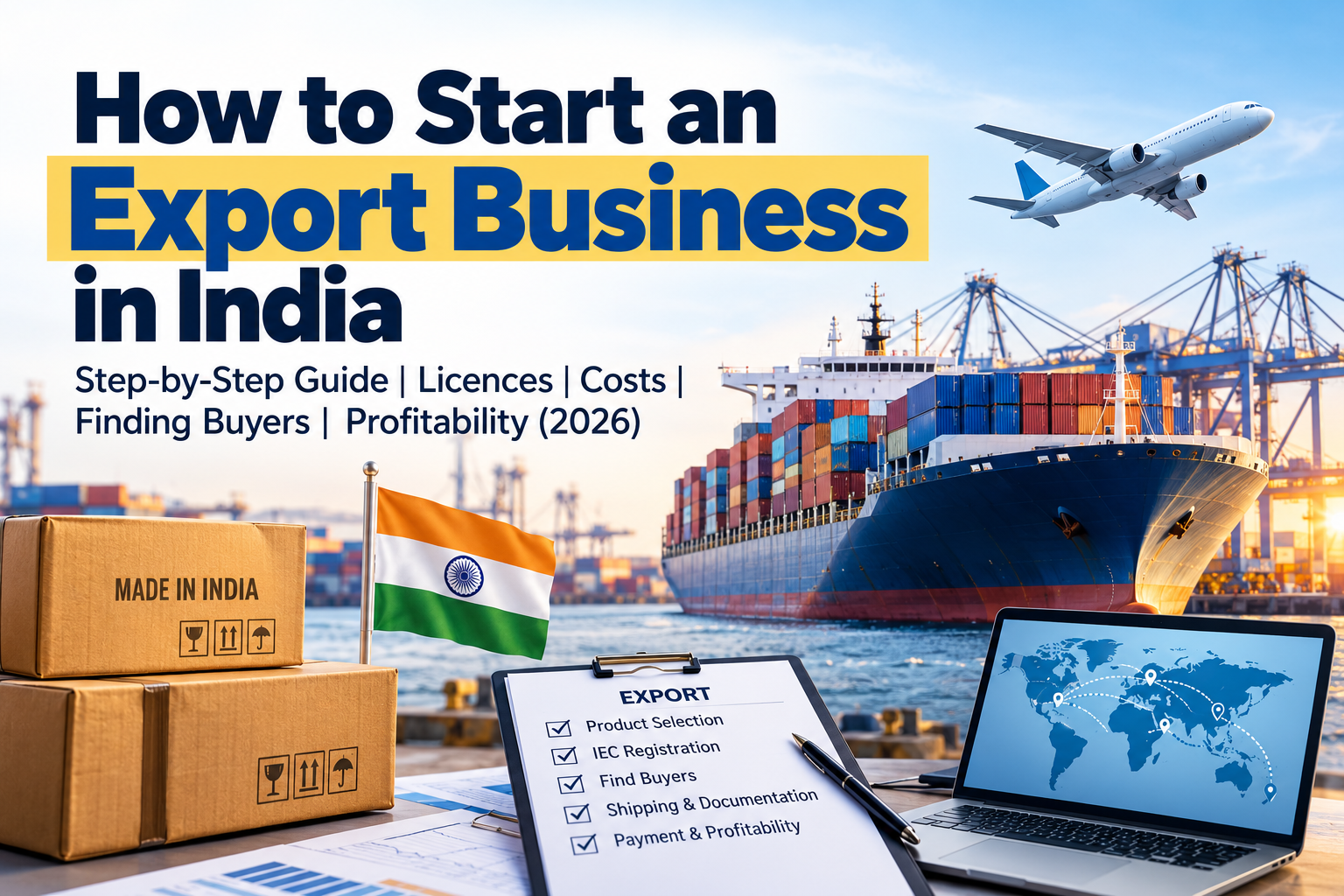
4. How to Register an Export Business in India
The government guide identifies business establishment, banking arrangements, PAN, IEC registration and product selection among the initial steps.
Step 1: Choose a business structure
Depending on your requirements, you may operate through a sole proprietorship, partnership, Limited Liability Partnership (LLP), One Person Company or private limited company. Consider liability, ownership, compliance costs, funding requirements and expansion plans. There is no universal requirement to establish a private limited company solely because you want to export.
Step 2: Obtain PAN and open a business bank account
Prepare the identity, address, business-registration and banking documents required by your selected bank. Confirm the bank’s current export-payment procedures and documentation requirements.
Step 3: Apply for an Importer Exporter Code
The Importer Exporter Code (IEC) is a key identifier for import and export activities. The guide explains that IEC is issued through the Directorate General of Foreign Trade (DGFT) and linked to the entity’s PAN. Check current eligibility, application procedures, fees, documents and annual IEC update requirements at https://www.dgft.gov.in/. Do not rely on historical fees or procedures without checking the current portal.
Step 4: Check whether additional registrations are needed
Some products and business models require registrations, licences or certificates beyond IEC. Agricultural products, food, pharmaceuticals, chemicals and other regulated goods may be subject to additional requirements. The guide also discusses Registration-Cum-Membership Certificates (RCMC); confirm whether one is required for your product, scheme or intended export activity.
Step 5: Verify export policy and restrictions
Check the current ITC-HS classification and export policy before accepting an order. Products may be freely exportable, restricted, prohibited or subject to designated State Trading Enterprise arrangements. Restricted products may require authorisation.
5. How to Find International Buyers
The government guide identifies trade fairs, buyer-seller meetings, exhibitions, B2B portals, web research, Export Promotion Councils, Indian Missions abroad and overseas chambers of commerce as potential sources of buyers.
Build a buyer-acquisition system
·Define your ideal buyer by product, country, customer type, order size and certification requirements.
·Build a verified prospect database with company name, website, business contact details, product fit and evidence of relevant activity.
·Prepare an export catalogue with photos, specifications, minimum order quantity, indicative price, lead time, packaging, genuine certifications and payment/shipping terms.
·Contact buyers with a relevant offer, concise introduction and clear next step.
·Track outreach, responses, sample requests, quotations, objections and expected order values in a CRM or spreadsheet.
·Send samples where appropriate, after checking shipping, documentation and regulatory conditions.
6. How to Calculate Export Pricing and Profitability
A common mistake is confusing the selling price with profit. A quotation must account for the full cost of fulfilling the order.
Cost component |
Illustrative amount |
Product purchase or manufacturing cost |
₹1,00,000 |
Domestic transport and handling |
₹5,000 |
Packaging and labelling |
₹8,000 |
Documentation and inspection allowance |
₹2,000 |
Freight and insurance allowance |
₹20,000 |
Other order-specific expenses |
₹5,000 |
Illustrative total cost |
₹1,40,000 |
These figures are hypothetical and are included only to demonstrate the calculation. They are not market quotations.
If total export revenue is ₹1,75,000, contribution before overheads and other excluded costs = ₹1,75,000 − ₹1,40,000 = ₹35,000.
Illustrative contribution margin = ₹35,000 ÷ ₹1,75,000 × 100 = 20%. This is not necessarily net profit. Account for excluded costs, applicable taxes, financing costs, overheads, bad debts and other expenses.
Contribution versus net profit
·Revenue: money earned from the sale.
·Direct order costs: costs attributable to fulfilling the order.
·Contribution: revenue less the relevant variable and order-specific costs.
·Net profit: the amount remaining after all applicable business expenses and charges.
Estimate break-even
If monthly fixed operating costs are ₹60,000 and contribution margin is 20%, break-even revenue = fixed costs ÷ contribution margin = ₹60,000 ÷ 0.20 = ₹3,00,000 per month. This simplified example assumes a stable contribution margin and excludes complications such as taxes, financing costs and changes in product mix.
7. Understand Incoterms Before Quoting Buyers
Incoterms define important responsibilities between buyers and sellers, including delivery obligations, cost allocation and transfer of risk under the selected rule. The appropriate term depends on shipment type, buyer requirements and negotiating position.
Term |
General purpose |
EXW |
Places substantial collection and delivery responsibilities on the buyer under the agreed arrangement. |
FCA |
Defines delivery to a carrier or other nominated party at the agreed place. |
FOB |
Used for qualifying sea or inland-waterway shipments, with specified delivery and risk-transfer conditions. |
CIF |
Used for qualifying sea or inland-waterway shipments and includes seller-arranged cost, insurance and freight to the named destination port. |
DAP |
Defines delivery at the named destination, ready for unloading, with specified buyer and seller responsibilities. |
DDP |
Generally places extensive delivery and import-clearance responsibilities on the seller, subject to the agreed terms and applicable law. |
These are simplified descriptions, not substitutes for the complete official rules. Specify the relevant Incoterm, named place or port and applicable version in the contract. Calculate costs and confirm you can fulfil the obligations.
8. Export Documentation: Which Documents Do You Need?
The guide explains that requirements vary by product and destination. Typical documents may include:
Document |
Purpose |
Pro forma invoice |
Communicates proposed product, price, delivery and payment terms. |
Export order or purchase order |
Records the buyer’s order and commercial requirements. |
Commercial invoice |
Records goods sold and transaction value. |
Packing list |
Describes packages, quantities, weights and packing details. |
Shipping bill or bill of export |
Supports the applicable customs export-clearance process. |
Bill of lading or airway bill |
Records carriage of goods by sea or air, as applicable. |
Certificate of origin |
Certifies goods’ origin for relevant commercial or regulatory purposes. |
Inspection or quality certificate |
Provides evidence of inspection or compliance where required. |
Letter of credit documents |
Supports presentation under an applicable letter of credit. |
BRC/e-BRC records |
Provides evidence of export-payment realisation through the applicable process. |
Not every shipment requires every document. Requirements depend on product, destination, transport method, customs procedure, buyer contract and applicable rules. Confirm the checklist with your freight forwarder, customs broker, bank and relevant regulatory authority.
9. Export Logistics: How Do Goods Reach the Buyer?
The guide discusses freight forwarders, containerised and non-containerised cargo, packaging, logistics and cold-chain requirements.
·Confirm the buyer’s order and delivery requirements.
·Procure or manufacture the goods.
·Complete quality checks and required inspections.
·Prepare export-compliant packaging and labelling.
·Obtain freight quotations and select the transport arrangement.
·Complete customs declarations and clearance.
·Dispatch goods and obtain the relevant transport document.
·Submit required documents to the bank or other parties involved in settlement.
·Track payment realisation and complete applicable post-shipment compliance.
FCL versus LCL
Full container load (FCL) generally applies when a shipment uses an entire container under the agreed arrangement. Less than container load (LCL) allows cargo to share container capacity with other shipments. Compare total charges, handling, destination fees, transit time and shipment volume rather than only the headline freight rate.
Why packaging matters
Export packaging must protect goods against damage, moisture, leakage, theft and handling during international transit. Fragile, perishable, bulky and temperature-sensitive goods may require specialised packaging or transport.
10. How to Manage Export Payment Risks
A purchase order does not guarantee payment. The guide discusses advance payments, letters of credit, documentary collection and Export Credit Guarantee Corporation (ECGC) risk protection.
·Advance payment: reduces the exporter’s payment exposure, subject to agreed terms.
·Letter of credit: a bank undertakes to pay against a compliant presentation under the credit’s terms.
·Documentary collection: banks handle specified documents and payment or acceptance instructions but generally do not provide the same payment guarantee as a letter of credit.
·Trade credit with appropriate protection: may be considered for established buyers after assessing credit exposure and available insurance or guarantees.
The right approach depends on transaction size, buyer credibility, bargaining power and financing costs. Confirm eligibility, interest, collateral, documentation and repayment conditions with your bank or financing institution.
11. Government Support and Export Promotion Schemes
The guide includes chapters on export promotion schemes, the Export Promotion Capital Goods (EPCG) Scheme, Advance Authorisation and incentives. These mechanisms may help eligible businesses manage certain import duties or export-related costs, but they are not automatic subsidies for every exporter.
·Verify whether your product and business are eligible.
·Check whether the transaction and destination qualify.
·Understand export obligations, value-addition rules and other conditions.
·Confirm documentation and reporting requirements.
·Review current DGFT notifications and scheme-specific procedures before including benefits in financial projections.
12. Common Mistakes New Exporters Should Avoid
·Choosing a product without checking actual demand.
·Ignoring full landed cost, including freight, insurance, packaging, handling, compliance and financing.
·Using an incorrect HS code.
·Accepting orders without assessing buyer payment risk.
·Neglecting quality control and destination-market standards.
·Assuming every export qualifies for incentives.
·Scaling before testing suppliers, packaging, freight, documentation and payment collection.
13. A Practical 30-Day Export Business Validation Plan
This is a proposed validation schedule, not a government-mandated timeline.
Period |
Main activities |
Desired output |
Days 1–5 |
Shortlist products, research trade data and verify initial policy requirements |
Two or three promising product candidates |
Days 6–10 |
Compare destination markets, competitors, logistics and standards |
One priority product-market combination |
Days 11–15 |
Identify suppliers, request quotations and assess quality and capacity |
Supplier shortlist and preliminary cost sheet |
Days 16–20 |
Build catalogue, identify buyers and begin targeted outreach |
Qualified prospect list and initial buyer feedback |
Days 21–25 |
Obtain freight quotations, review documentation and negotiate sample or pilot orders |
Preliminary quotation and shipment plan |
Days 26–30 |
Review buyer interest, contribution margin, compliance and working capital |
Go/no-go decision for the first order |
What counts as successful validation?
·Buyers are interested in the specific product.
·Some buyers have confirmed their requirements.
·Suppliers can meet the required specifications.
·The delivered price is competitive.
·The order remains profitable after realistic costs.
·Compliance and payment risks can be managed.
·The business has sufficient working capital to fulfil the order.
If these conditions are not met, revise the product, destination, supplier or business model before committing significant capital.
Conclusion: Build an Export Business Around Evidence, Not Assumptions
Starting an export business in India requires product research, compliance, buyer acquisition, cost management and reliable execution. The government’s How to Export practical guide provides a foundation for understanding the process. Entrepreneurs can strengthen that foundation by combining official trade statistics with direct buyer validation, supplier quotations and realistic profitability calculations.
Start with one product, investigate a small number of destination markets, validate demand, calculate complete order economics and test the operational process with a manageable transaction. The central principle is simple: identify a commercially viable product-market combination before investing heavily in inventory, manufacturing capacity or international marketing.
Editorial note: The supplied practical guide is a 2023–24 publication. Historical procedures, fees, scheme conditions and statistics should not be presented as current without verification. Example costs and break-even calculations in this article are illustrative, not observed market data or guaranteed business outcomes.