1. What Is a Paper Bag Manufacturing Business?
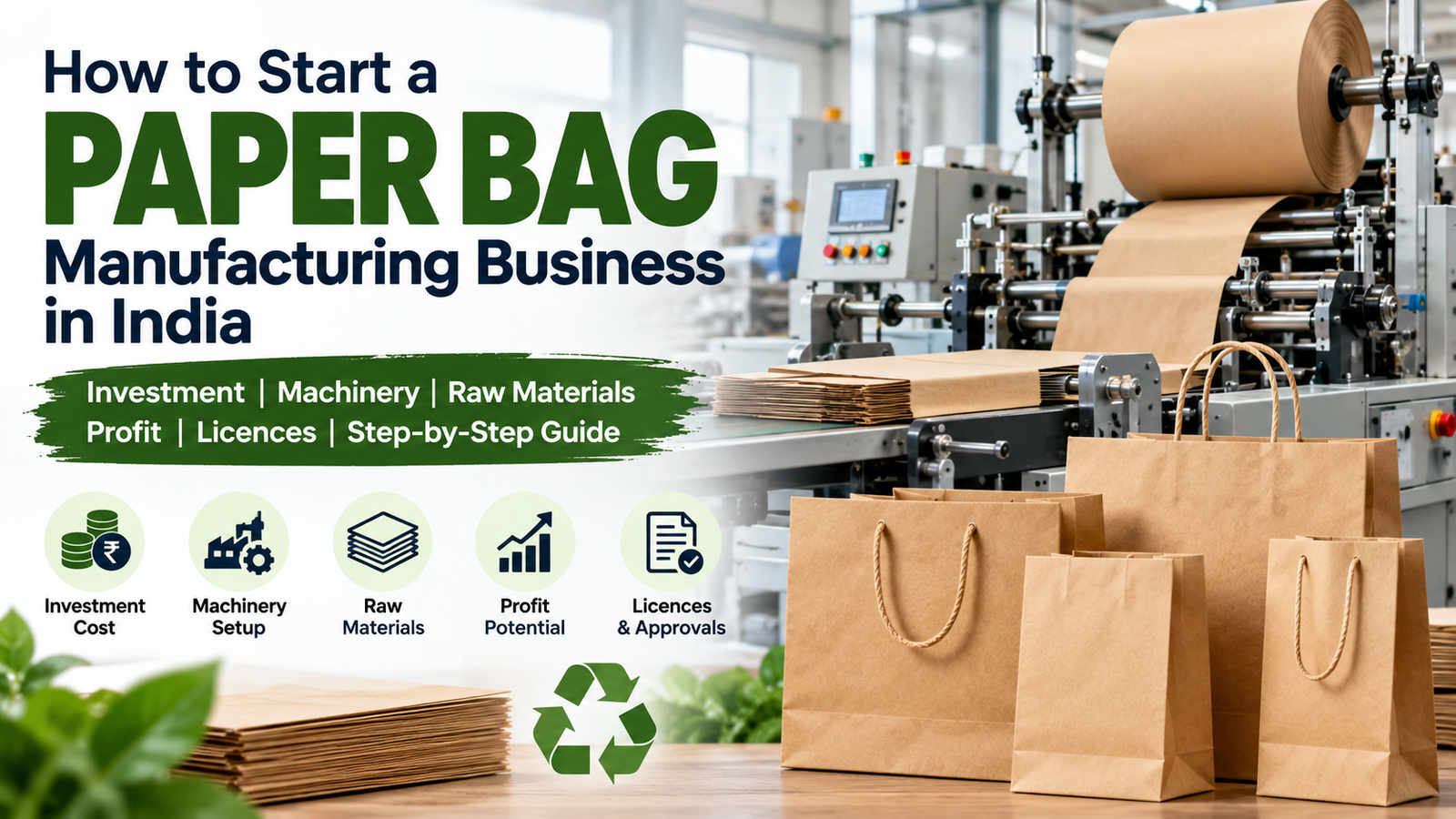
A paper bag unit generally purchases paper rolls or sheets and converts them into finished bags. A paper mill, by contrast, manufactures paper itself from pulp or recovered fibre. This guide focuses on paper bag manufacturing and conversion, not the construction of a full paper mill.
Product type |
Typical use |
Potential buyers |
Kraft shopping bags |
Retail purchases and takeaway orders |
Retail shops, supermarkets, boutiques |
Flat paper bags |
Small items, bakery products and lightweight goods |
Bakeries, pharmacies, food outlets |
SOS / square-bottom bags |
Groceries, takeaway and general retail |
Grocery stores, cafés, restaurants |
Twisted-handle paper bags |
Branded shopping and premium retail |
Clothing, footwear, gift and cosmetics stores |
Custom printed paper bags |
Brand promotion and packaging |
Businesses, agencies, event suppliers |
2. Investment Required: Small Unit vs Industrial Project
The available reports show a wide range of project sizes. The ₹10 lakh small-unit report does not provide a consistently stated daily capacity in the summary, so it should not be compared on a cost-per-bag basis with the EIRI industrial profiles.
Project model |
Reported capacity |
Land / building |
Machinery |
Working capital |
Total project cost |
Small paper bag unit (supplied report) |
Not consistently specified in report summary |
Not separately stated in summary |
₹5.50 lakh including machinery/equipment |
₹4.00 lakh |
₹10.00 lakh |
EIRI paper bag project |
10,000 bags/day |
₹1.18 crore |
₹32.98 lakh |
₹9.32 lakh (1 month) |
₹1.71 crore |
EIRI paper bag project |
100,000 bags/day |
₹1.14 crore |
₹25.00 lakh |
₹1.62 crore (2 months) |
₹3.10 crore |
EIRI paper bag project profile |
144,000 bags/day |
₹1.89 crore |
₹1.50 crore |
₹69.60 lakh (1 month) |
₹4.28 crore |
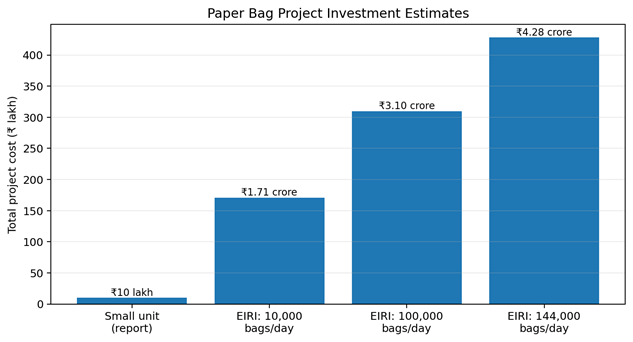
Graph 1. Reported total investment estimates. The projects differ in their specifications and assumptions.
Treat all estimates as project-report figures, not current quotations. Land, civil work, machinery scope, printing equipment, installation, tax, financing and working-capital assumptions may differ. Obtain a current supplier quotation and prepare a project-specific estimate before investing.
3. Small Unit: Detailed Project Cost
Cost component |
Amount |
Share of total |
Machinery and equipment |
₹5,50,000 |
55.0% |
Other fixed assets |
₹45,000 |
4.5% |
Preliminary / pre-operative expenses |
₹5,000 |
0.5% |
Working-capital limit |
₹4,00,000 |
40.0% |
Total |
₹10,00,000 |
100% |
4. Machinery Required for Paper Bag Production
Machine / equipment |
Function |
What to check before buying |
Paper bag-making machine |
Forms bag body and bottom |
Output speed, bag dimensions, GSM range and changeover time |
Paper slitting / cutting machine |
Prepares paper to required width and size |
Cutting accuracy, roll width and waste rate |
Printing machine |
Prints logos, colours and product details |
Number of colours, print quality and setup cost |
Handle-making / handle-fitting equipment |
Makes or attaches handles |
Handle type, strength and attachment method |
Gluing equipment |
Bonds seams and bottom folds |
Adhesive compatibility and bond strength |
Die-cutting equipment |
Cuts shaped handles or custom features |
Tooling cost and product mix |
Quality-control tools |
Checks dimensions, weight and strength |
Repeatability and testing needs |
Packing equipment |
Bundles and prepares finished bags for dispatch |
Batch size and packing method |
Not every unit needs every machine. Some automatic machines combine multiple stages. Select equipment based on the bag styles and customer specifications you intend to serve.
5. Raw Materials Required
Material |
Purpose |
Important specifications |
Kraft paper rolls or sheets |
Main bag body |
GSM, colour, width, moisture, tear strength and consistency |
Glue / adhesive |
Bonds seams and bottom |
Compatibility with paper and drying time |
Printing ink |
Branding and product information |
Print quality and suitability for intended use |
Paper rope / handles |
Handles for selected bag styles |
Load capacity and attachment quality |
Packaging materials |
Protects finished bags during storage and delivery |
Moisture protection and bundling |
6. Raw-Material Calculation from the Supplied Report
Raw material |
Quantity/month |
Rate shown in report |
Calculated amount |
Recycled kraft paper, 40 GSM and 60 GSM |
13 MT |
₹22,000/MT |
₹2,86,000 |
Glue |
250 kg |
₹15/kg |
₹3,750 |
Consumables |
Not specified |
Not specified |
₹1,250 |
Source-data issue: the supplied report states ₹2,75,000 for 13 MT of kraft paper at ₹22,000/MT. The arithmetic is ₹2,86,000. Its listed raw-material total therefore does not reconcile. Verify the supplier rate, quantity and monthly working-capital calculation before relying on the report.
7. Paper Bag Manufacturing Process
1.Paper procurement: choose paper grade, GSM, width and strength according to the bag specification.
2.Slitting and feeding: prepare the paper roll or sheets for the selected machine.
3.Printing: print the customer’s logo or design if the order requires branding.
4.Forming and folding: form the bag body and bottom using the machine settings.
5.Gluing and handle fitting: bond the seams and bottom; attach handles where required.
6.Quality inspection: check dimensions, glue bonding, print quality and load performance.
7.Bundling and dispatch: pack finished bags and deliver them according to the purchase order.
8. Production Capacity and Sales Projections
The supplied project report lists 200 MT of paper bags at ₹29,000 per MT, which calculates to ₹58 lakh in annual sales. It also provides the following gross-receipts table by capacity utilisation:
Capacity utilisation |
Gross receipts stated in report |
50% |
₹58.00 lakh |
55% |
₹60.90 lakh |
60% |
₹63.80 lakh |
65% |
₹66.70 lakh |
70% |
₹69.60 lakh |
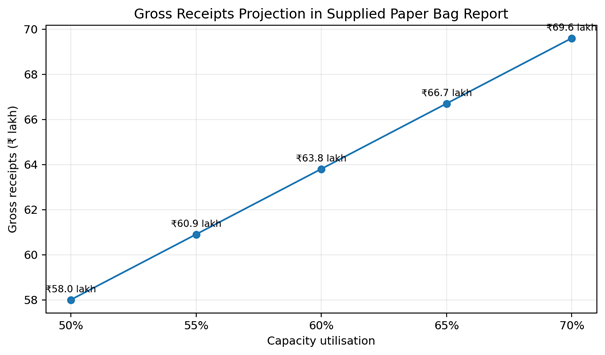
Graph 2. Gross receipts by capacity utilisation, as shown in the supplied report.
Important reconciliation note: the report’s ₹58 lakh annual sales assumption for 200 MT does not clearly align with the separate table that lists ₹58 lakh at 50% utilisation. The figures may use different assumptions. Reconcile the production, utilisation, selling-price and sales tables before treating this as a financial forecast.
9. How to Estimate Revenue and Profit
Annual saleable output = saleable bags per day × operating days per year.
Revenue = quantity actually sold × average selling price per bag.
Contribution = sales revenue − variable costs.
Operating profit = contribution − fixed operating expenses.
Cost / financial line |
Items to include |
Revenue |
Bags sold, average realised selling price and customer discounts |
Variable production costs |
Paper, glue, ink, handles, packaging, variable labour and waste |
Fixed operating costs |
Rent, fixed salaries, insurance and other fixed overheads |
Other costs |
Power, maintenance, transport, finance costs and depreciation |
Net profit |
Profit after relevant expenses and applicable taxes |
Break-even example
Break-even sales = fixed costs ÷ contribution margin ratio. If annual fixed costs are ₹12 lakh and contribution margin is 30%, illustrative break-even sales are ₹40 lakh. This example explains the formula and is not a forecast from the supplied report.
10. How to Find Customers
·Retail shops, supermarkets and grocery stores.
·Bakeries, sweet shops, cafés and restaurants.
·Clothing, footwear, cosmetics and gift retailers.
·Packaging wholesalers and printing companies.
·E-commerce brands and businesses needing custom printed bags.
·Event organisers and corporate gifting suppliers.
Before investing, ask potential customers for bag dimensions, GSM, handle type, printing requirements, monthly quantity, target price, delivery schedule and payment terms. Repeat business and realistic payment terms are essential for managing working capital.
11. Registrations and Compliance
Registration / approval |
What to verify |
Business constitution and PAN |
Choose a suitable legal structure and tax identity. |
Udyam registration |
Register as an MSME if eligible through the official portal. |
GST registration |
Applicability under current GST rules. |
Local trade / factory approvals |
Requirements based on premises, workforce and state rules. |
Fire and electrical safety |
Requirements for the building and installed machinery. |
Labour compliance |
Registrations and obligations applicable to the establishment. |
Pollution Control Board consent |
Check with the relevant state authority based on process and location. |
Official Udyam portal: https://udyamregistration.gov.in/
PMEGP revised guidelines: https://www.kviconline.gov.in/pmegpeportal/dashboard/notification/Revised_PMEGP_Scheme_Guidelines_07122023_compressed.pdf
Government support depends on current scheme rules, applicant eligibility and approval. Do not assume a subsidy will be sanctioned until eligibility and the application process have been verified.
12. Step-by-Step Plan to Start
- Select the product range and target customer segment.
- Validate demand and obtain indicative or confirmed buyer orders.
- Define bag dimensions, paper GSM, printing and handle specifications.
- Compare machinery quotations and service support from multiple suppliers.
- Calculate investment, monthly raw materials, working capital and cash flow.
- Check premises, power, safety and applicable approvals.
- Arrange finance using a consistent project report and realistic assumptions.
- Install and test the machine; measure actual speed, waste and quality.
- Start
production with customer orders and monitor margins, collections and rejects
Conclusion
A paper bag manufacturing business should be built around a defined product range, validated customer demand and a reliable cost model. The supplied report offers a ₹10 lakh small-unit example, while EIRI profiles show much larger industrial projects. Before investing, obtain current quotations, verify the production capacity and reconcile the source report’s raw-material and sales assumptions.
Sources and References
·EIRI paper bag project profile (144,000 bags/day): https://www.eiriindia.org/project-profile-handbook-paper-bag-unit-cap-formulation-53
·EIRI paper bags manufacturing project: https://www.eiriindia.org/detailed-project-report-on-paper-bags-manufacturing
·EIRI paper bag production project (10,000 bags/day): https://www.eiriindia.org/detailed-project-report-on-paper-bags-production-rate-nos-day
·Udyam Registration: https://udyamregistration.gov.in/
·PMEGP revised scheme guidelines: https://www.kviconline.gov.in/pmegpeportal/dashboard/notification/Revised_PMEGP_Scheme_Guidelines_07122023_compressed.pdf
Paper Bag Making (PDF).