Executive summary
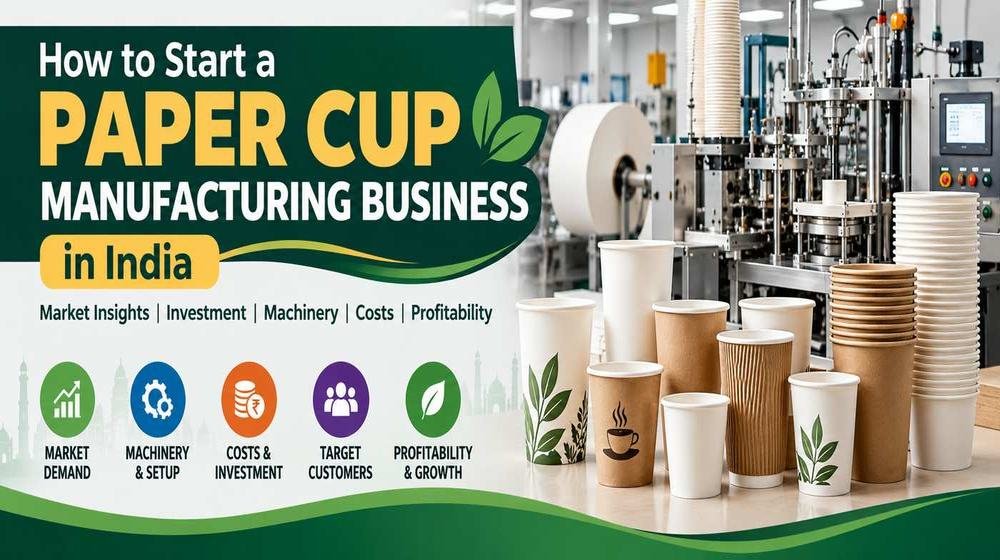
A paper cup manufacturing business can serve tea and coffee vendors, cafés, quick-service restaurants (QSRs), corporate cafeterias, caterers, hospitals, education campuses and packaging distributors. The opportunity is real, but a machine purchase alone does not make the business profitable: repeat orders, raw-material control, cup quality, credit management and distribution economics matter just as much.
IMARC estimates that India’s paper-cup market reached 23.76 billion cups in 2025 and projects 29.66 billion cups by 2034, equivalent to a reported CAGR of 2.28%. These are third-party market-research estimates, not audited government statistics. Supplier listings show automatic machines in the broad ₹6.5–₹8.9 lakh range for selected examples, but specifications and tax treatment differ. A practical project budget must also include installation, moulds, electrical work, premises, inventory, packaging, testing and working capital.
This guide distinguishes reported market data, observed supplier-listing prices and illustrative financial calculations. Treat the figures as a starting point for due diligence—not a guarantee of demand, profit, subsidy or payback.
1. Understand the market before investing
Paper cups are used across takeaway beverages, foodservice, offices, events and institutional catering. Demand is not uniform: customers buy different sizes, paper grades, coatings, printing options and quantities. The best initial strategy is usually to choose a narrow product range and a defined customer segment, prove repeat demand, then add variants.
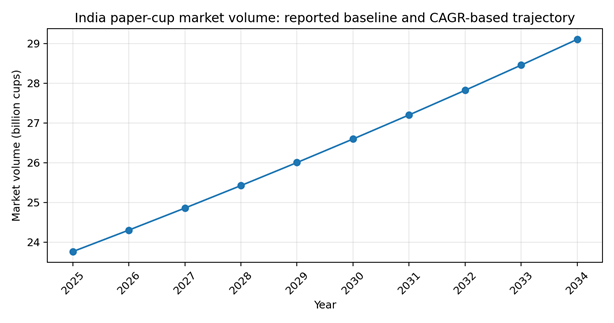
Figure 1. The 2025 baseline and 2026–2034 trajectory calculated from IMARC’s reported 23.76-billion-unit baseline and 2.28% CAGR. The intermediate years are calculated, not separately reported market observations; the final value is approximately 29.1 billion using the CAGR arithmetic, so the source’s stated 29.66-billion 2034 forecast should be treated as the published forecast rather than forcing the calculated line to match it.
Why the chart may not land exactly on the published 2034 forecast: published base values, rounded CAGR and forecast endpoints can differ because of rounding or model revisions. For decisions, quote the source’s headline figures and label the plotted intermediate values as illustrative.
2. Which customer segments should you target?
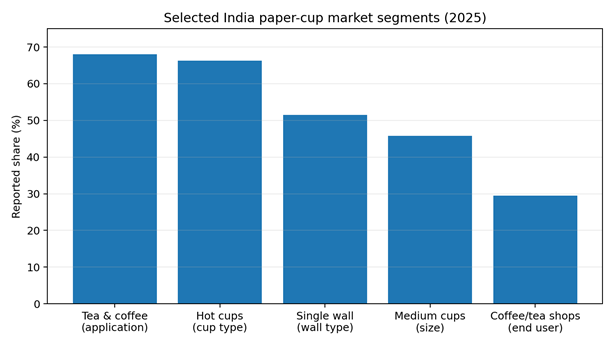
Figure 2. Selected segment shares reported by IMARC for 2025. These bars describe different dimensions of the market—application, cup type, wall type, size and end user—so they are not mutually exclusive and should not be added together.
Buyer segment |
What they value |
Recommended sales approach |
Tea/coffee stalls and independent cafés |
Low landed cost, reliable stock, common sizes |
Local distributor route; small sample orders; frequent replenishment |
Café/QSR chains |
Consistent dimensions, print quality, leak resistance, supply continuity |
Vendor onboarding, product testing, forecast and written specifications |
Corporate cafeterias and caterers |
Bulk availability, delivery reliability, credit terms |
Institutional procurement, monthly contracts, scheduled deliveries |
Wholesalers and packaging dealers |
Competitive carton price, availability, dependable margins |
Price list, territory terms, credit limits and clear return policy |
Events, hospitals and education |
Peak-volume supply and hygiene documentation |
Tender/procurement checks and seasonal demand planning |
3. Select your product and manufacturing model
Decide these items before requesting machinery quotations:
·Cup sizes: for example, 65–90 ml tea cups, 100–150 ml cups and larger beverage sizes. Choose based on signed buyer requirements, not assumptions.
·Wall construction: single-wall cups are usually simpler and more cost-focused; double-wall or ripple-wall products need additional equipment/processes and have different economics.
·Printing: plain cups reduce setup complexity; branded cups can improve differentiation but require artwork approval, print-quality controls and minimum order planning.
·Paper/coating: specify board GSM, cup dimensions, food-contact suitability, barrier coating and bottom-reel compatibility. GSM alone does not guarantee strength or leak resistance.
·Manufacturing scope: buying pre-printed/pre-cut cup blanks can reduce upfront equipment needs; printing and die-cutting in-house can increase control but also adds machinery, space, skill and working capital.
4. Paper cup machine price and capacity
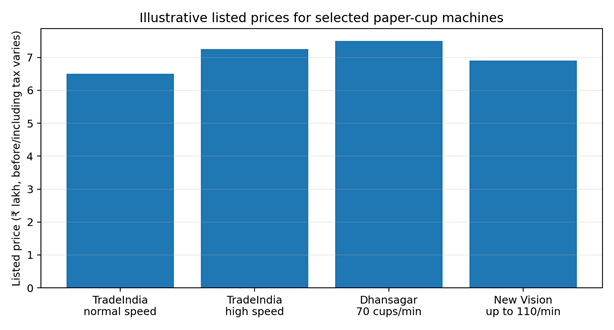
Figure 3. Selected online supplier/marketplace listing examples. These are not like-for-like quotations: some prices may exclude GST, and capacity, moulds, installation, warranty and machine configuration differ.
Listing example |
Displayed price |
Displayed specification |
What to verify |
TradeIndia normal-speed listing |
About ₹6.50 lakh |
Generic normal-speed machine |
Exact output, included moulds, GST, installation and warranty |
TradeIndia high-speed listing |
About ₹7.25 lakh |
Generic high-speed machine |
Saleable cups/minute for your cup size and paper stock |
Dhansagar Machinery |
₹7.50 lakh + 18% GST = ₹8.85 lakh |
70 cups/minute listing |
Trial run, output after rejects, electrical load and service |
New Vision Machines |
₹6.90 lakh before GST per listing |
Up to 110 cups/minute |
Whether quoted configuration matches your chosen size and line requirements |
Do not choose a machine based only on the advertised cups-per-minute figure. Ask the supplier to run a witnessed trial using the exact cup size and raw material you plan to purchase. Record good cups per hour, rejects, downtime, electricity consumption and changeover time.
Machine purchase checklist:
·Cup size range and mould/changeover cost.
·Rated versus saleable output, including rejection rate.
·Paper blank dimensions, bottom reel specification and coating compatibility.
·Connected load, voltage/phase, compressor and auxiliary equipment requirements.
·GST, freight, unloading, installation, operator training, warranty and spare-parts availability.
·Written service-response commitments and at least one reference customer.
5. Raw materials and quality control
Typical inputs include PE-coated or other barrier-coated cup-stock paper, printed cup blanks, bottom paper reels, inks where applicable, outer packaging and labels. Actual material requirements vary by cup size, design, paperboard grade and supplier process.
Observed supplier listing |
Indicative listed price |
Caveat |
135 GSM printed PE-coated reels |
₹70/kg |
Listing for a specified cup-stock product; confirm MOQ, GST and freight |
150 GSM PE-coated printed blanks |
₹80/kg |
Supplier listing; specification and cup size matter |
180 GSM material for 6 oz cups |
About ₹98/kg |
Supplier listing; confirm grade/coating and delivered price |
PE-coated cup-stock roll, 130–250 GSM |
₹90/kg before GST; ₹106.20/kg with 18% GST |
Trade-directory listing; confirm current stock and food-contact documentation |
These are online listing benchmarks observed during research, not a national price index or guaranteed delivered prices. Ask for written quotes from at least three suppliers. Compare delivered cost per kilogram, grammage, coating, print, minimum order quantity, batch consistency, lead time, payment terms and rejection/return policy.
Set up a quality-control checklist for every incoming batch and production run:
·Paper GSM and dimensions match the approved specification.
·Cup rim is even; side seam and bottom seal are secure.
·No visible pinholes, delamination, odour or ink transfer.
·Leak test using the intended beverage temperature and holding time.
·Count accuracy, carton strength, label/batch traceability and rejection log.
·Retain approved samples and supplier certificates/specifications.
6. How much investment is needed?
There is no single reliable startup cost for every unit. A basic setup buying ready-to-form blanks can be cheaper than a facility that also prints, die-cuts and runs multiple cup formats. One 2026 secondary guide describes broad paper cup/plate project costs of roughly ₹8–30 lakh; this is a planning reference, not a quotation or a guarantee. The chart below is an illustrative allocation, not an estimate for every factory.
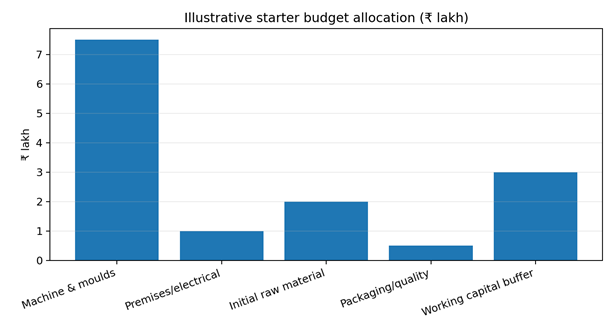
Figure 4. Example allocation totalling ₹14 lakh: machine/moulds ₹7.5 lakh, premises/electrical ₹1 lakh, initial raw material ₹2 lakh, packaging/quality ₹0.5 lakh and working-capital buffer ₹3 lakh. The amounts are illustrative and exclude any additional printing/die-cutting line, major civil work, financing cost or unexpected setup expense.
Cost head |
Budget it for |
Machine and moulds |
Forming machine, compatible moulds, commissioning, spare parts |
Premises and utilities |
Deposit/rent, power connection, wiring, safety equipment, storage and ventilation |
Raw materials |
Cup-stock paper, bottom reels, printed blanks, ink/coatings as relevant |
Labour and training |
Operators, helpers, supervisor, training and statutory employment costs |
Packaging and dispatch |
Inner sleeves, cartons, labels, pallets, local freight and handling |
Working capital |
Inventory, customer credit, supplier advances, wages and utilities during ramp-up |
Compliance and administration |
Registrations, professional fees, testing, insurance, accounting and documentation |
7. Illustrative unit economics: calculate before you buy
A transparent calculation is more useful than a generic claim such as “20–35% profit margin.” The example below uses a prior planning model for one carton of 3,000 cups. It is not a national benchmark, a verified quote or a recommended selling price. Replace every assumption with your actual invoice, material consumption and customer quote before investing.
Per carton of 3,000 cups |
Illustrative amount |
List selling price |
₹2,400.00 |
Discount assumption (5%) |
−₹120.00 |
Returns/refunds assumption (1% of discounted sales) |
−₹22.80 |
Net revenue |
₹2,257.20 |
Product/manufacturing cost assumption |
₹1,770.00 |
Packaging |
₹90.00 |
Delivery |
₹80.00 |
Other variable cost |
₹10.00 |
Payment fee + commission (2.5% of net revenue) |
₹56.43 |
Total variable cost |
₹2,006.43 |
Contribution per carton |
₹250.77 |
Contribution margin on net revenue |
11.1% |
This example assumes monthly fixed costs of ₹82,000: rent ₹20,000, salaries ₹45,000, marketing ₹5,000 and other fixed expenses ₹12,000. At contribution of ₹250.77 per carton, mathematical break-even is approximately 327 cartons per month (about 981,000 cups). At exactly 327 cartons, the model is effectively at zero profit. This excludes any cost not included in the assumptions, such as financing, depreciation, taxes, major maintenance or additional selling costs.
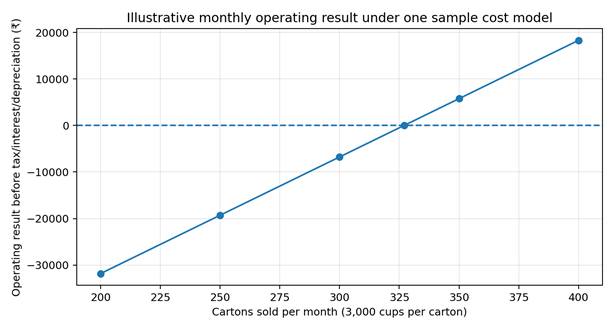
Figure 5. Monthly operating result under the example assumptions. This graph shows the sensitivity to volume, not a forecast. At 400 cartons, the model yields about ₹18,308/month before tax, interest, depreciation and omitted costs; at 300 cartons it loses about ₹6,769/month.
Critical check: the model’s ₹1,770 product cost per 3,000-cup carton equals ₹0.59 per cup. If paper consumption is 13.5–15.6 kg per carton, raw material alone at ₹80/kg would be about ₹1,080–₹1,248; at ₹118/kg it would be about ₹1,593–₹1,841, before other production costs and wastage. This means actual cup weight, bottom paper, material price and waste must be reconciled carefully. Do not double-count packaging or labour if already included in the product-cost line.
8. Estimate production capacity realistically
A machine rated at 70 cups/minute could theoretically produce 33,600 cups in an 8-hour shift (70 × 60 × 8), before breaks, changeovers, downtime and rejects. At 80% effective utilisation, that becomes 26,880 good cups per shift. Use measured saleable output—not the nameplate speed—for costing and sales commitments.
Illustrative calculation |
Result |
Rated speed |
70 cups/minute |
Theoretical output in 8 hours |
33,600 cups |
Output at 80% effective utilisation |
26,880 cups |
Output at 80% utilisation over 25 working days |
672,000 cups/month |
This is a simple capacity illustration, not a supplier guarantee. The 80% utilisation assumption is hypothetical. A different cup size, paper stock, operator skill or maintenance profile can change the result substantially.
9. Registrations, compliance and environmental claims
Exact requirements depend on the state, premises, workforce, installed capacity, product and customer type. Confirm applicability with the relevant local authority, industrial-area operator, accountant and compliance professional before commercial production.
·Choose a legal structure and obtain PAN/bank account and applicable tax registrations.
·Check local trade/factory permissions, land-use/zoning, fire and electrical safety, labour obligations and pollution-control consent requirements for the site and process.
·Consider Udyam registration through the official government portal. The portal states that Udyam registration is free and paperless; avoid unofficial paid lookalike websites.
·For food-contact packaging, verify current FSSAI Packaging Regulations and applicable standards/documentation with the material supplier and your buyer. A cup manufacturer is not automatically the same as a food business operator; confirm which licence/registration applies to your specific activity.
·Check current Central/State Pollution Control Board requirements and rules on plastic waste, coatings and packaging. Do not market PE-lined paper cups as “plastic-free,” “biodegradable” or “compostable” unless the exact product and claim are properly substantiated and compliant.
·If applying for a loan or scheme such as PMEGP, check the current official guidelines, eligibility, activity classification and application route. Never include a subsidy in your base-case funding plan until written eligibility and approval are confirmed.
Official and primary reference pages are listed in the sources section at the end.
10. Build a practical go-to-market plan
1.Interview 25–40 prospective buyers in one local cluster. Record current cup size, daily/weekly consumption, delivered price, supplier issues, payment terms and switching criteria.
2.Obtain written interest or trial orders before finalising machine capacity. A verbal statement that a buyer “may purchase” is not contracted demand.
3.Prepare three standard SKUs first—for example, a high-volume small tea cup, a medium hot beverage cup and one customised SKU only if buyers justify it.
4.Offer samples and document leak, rim, stacking and transport tests. Collect feedback against a signed specification.
5.Build a route-to-market mix: direct key accounts for volume and feedback, plus two or more distributors for geographic reach. Set customer credit limits.
6.Create a price calculator with raw material per cup, wastage, labour, electricity, packaging, freight, commission, returns, credit cost and contribution.
7.Track weekly: orders, repeat-order rate, saleable cups/hour, rejection rate, raw-material yield, on-time delivery, receivable days, contribution per carton and cash balance.
11. Common mistakes to avoid
·Buying a machine before validating local buyer demand and price points.
·Using market-size estimates as if they were the number of customers available to one factory.
·Confusing rated machine output with saleable output across a full month.
·Using supplier listing prices without confirming GST, freight, MOQ, grade and specification.
·Underestimating working capital when wholesalers or institutions request credit.
·Offering too many sizes and printed designs before process control is stable.
·Claiming large profit margins or short payback periods without showing the calculation and all excluded costs.
·Assuming that paper-based means automatically plastic-free, compostable or environmentally superior in every disposal system.
12. Conclusion: is paper cup manufacturing a good business?
It can be viable for an operator that secures repeat demand, controls material usage and quality, and distributes efficiently. Published market research indicates a large Indian market, but market growth alone does not prove that a new unit will win profitable orders. Before investing, validate at least three machine quotations, three raw-material quotations, a detailed bill of materials, a buyer pipeline and a cash-flow model with conservative utilisation.
A sound decision rule is simple: prove the contribution per carton, calculate break-even from fixed costs, then demonstrate that realistic repeat orders can exceed break-even with a safety margin. If the plan works only at full machine capacity or assumes unverified customer volumes, revise it before committing capital.
Sources and methodology
Market-size data and segment shares below come from IMARC’s public market summary. Machine and raw-material prices are supplier/marketplace listing examples, not verified transactions or a national average. Financial scenarios are calculated from the explicitly stated assumptions in this article. Intermediate market trajectory points and capacity calculations are derived arithmetic, not separately published observations.
IMARC Group, India paper cups market (market volume and segment shares; accessed 18 Oct 2026): https://www.imarcgroup.com/indian-paper-cups-market
TradeIndia, automatic paper cup machine listing examples (prices updated on page): https://www.tradeindia.com/manufacturers/automatic-paper-cup-machine.html
Dhansagar Machinery, 70 cups/minute listing (₹7.5 lakh + GST example): https://www.tradeindia.com/products/fully-automatic-paper-cup-making-machine-c10344619.html
New Vision Machines, automatic high-speed machine listing: https://www.newvisionmachines.com/shop/automatic-paper-cup-making-machine
Tirupati Paper Products, paper cup raw-material listing: https://www.tirupatipaperproducts.com/paper-cup-raw-material.html
Devishree Printopack, paper cup raw-material listing: https://www.devishree.in/paper-cup-raw-material.html
Viraj Industries / TradeIndia, PE-coated cup-stock roll listing: https://www.tradeindia.com/products/pe-coated-cup-stock-paper-roll-10370632.html
Official Udyam Registration Portal: https://udyamregistration.gov.in/
FSSAI official notifications and food law portal: https://www.fssai.gov.in/notifications.php
KVIC PMEGP official portal and scheme guidelines: https://www.kviconline.gov.in/pmegpeportal/
IIFL secondary project-cost reference (published 19 June 2026): https://www.iifl.com/blogs/gold-loan/how-to-start-a-paper-cup-plate-unit-business
Disclaimer: This is a general business-planning article, not legal, tax, engineering or investment advice. Confirm current rules and costs with official authorities and qualified professionals. All financial illustrations are pre-tax unless stated otherwise.