Executive Summary
India’s services sector contributed approximately 56.4% of the country’s Gross Value Added (GVA) in FY2025–26. Services exports reached an estimated US$418.31 billion, up 7.94% year over year, according to IBEF’s May 2026 report. These figures demonstrate the scale of the services economy, but a large market does not automatically guarantee high profits for a new entrant.
Based on the report’s growth indicators and an assessment of potential business models, B2B AI automation and specialised business software emerge as attractive opportunities for entrepreneurs seeking recurring revenue with relatively low initial infrastructure requirements. Healthcare technology, fintech infrastructure, specialised IT services, market intelligence and export-oriented professional services also merit consideration.
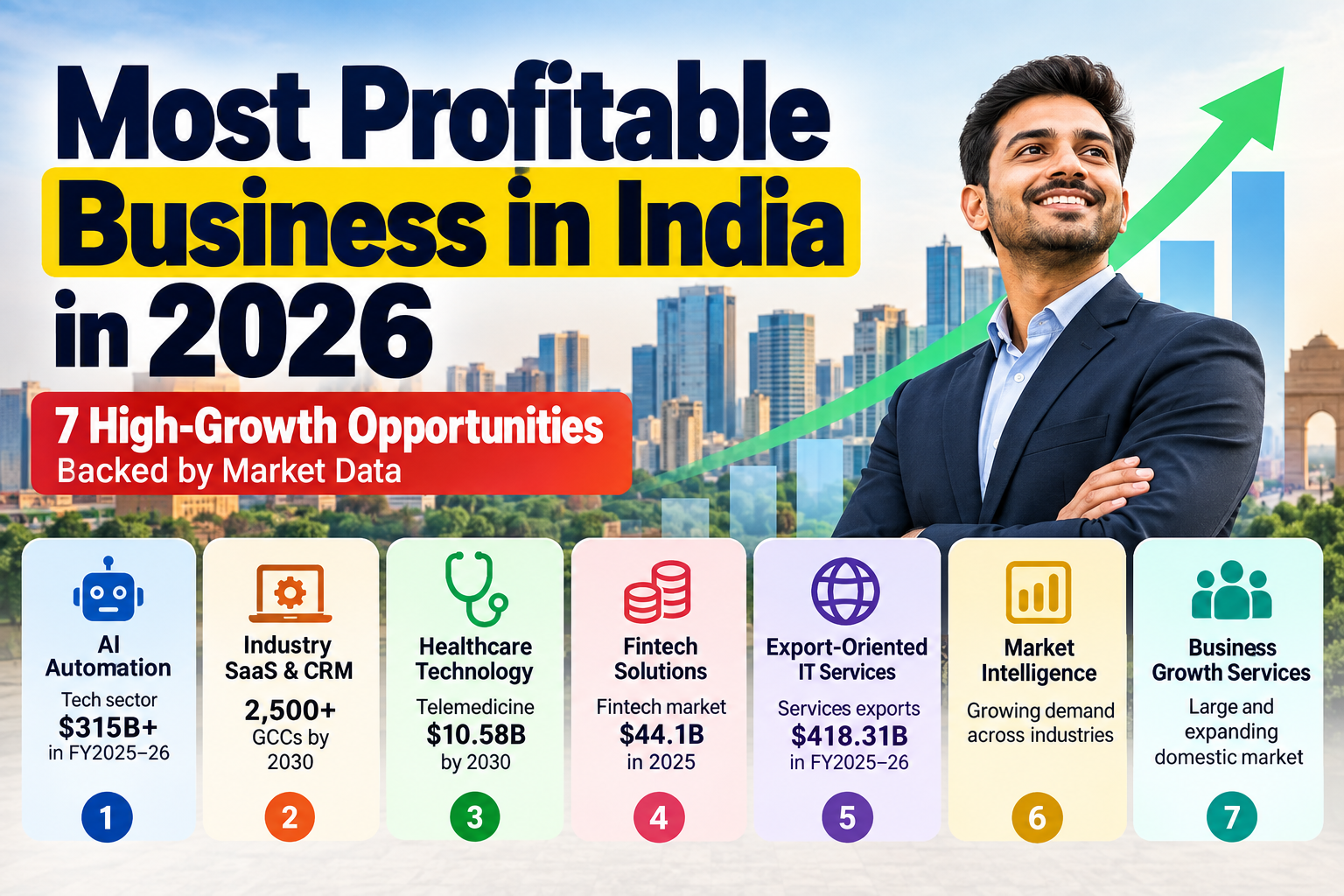
The Seven Business Opportunities at a Glance
Rank |
Business opportunity |
Supporting report indicator |
Revenue model |
1 |
B2B AI automation and workflow software |
Technology sector projected to exceed US$315B in FY2025–26 |
Setup fees + subscriptions |
2 |
Industry-specific SaaS and CRM |
More than 2,500 GCCs projected by 2030 |
Monthly/annual subscriptions |
3 |
Healthcare technology services |
Telemedicine projected at US$10.58B by 2030 |
Subscriptions + service contracts |
4 |
Fintech and financial workflow solutions |
Indian fintech valued at US$44.1B in 2025 |
SaaS, licensing, transaction fees |
5 |
Export-oriented IT and professional services |
Services exports estimated at US$418.31B in FY2025–26 |
Project fees + retainers |
6 |
B2B market intelligence and data services |
Growing technology and professional-services ecosystem |
Paid reports + subscriptions |
7 |
Business growth and lead-management services |
Large and expanding domestic services economy |
Retainers + defined performance fees |
Note: This is an opportunity ranking, not a verified ranking by net profit. Market indicators are from IBEF; business models and rankings are analytical assessments.
1. B2B AI Automation: A Strong Candidate for a Low-Infrastructure Business
Businesses need to reduce manual work, improve response times and increase operational efficiency. AI automation can support enquiry management, lead qualification, CRM updates, reporting and other repetitive processes. IBEF estimates India’s technology sector will exceed US$315 billion in FY2025–26 and highlights the growing importance of higher-value technology activities.
Potential services
·Automated enquiry capture and lead qualification.
·CRM updates and lead-routing workflows.
·WhatsApp and email follow-up systems.
·Invoice processing and document extraction.
·Management dashboards and automated reporting.
·Customer-support workflows with human escalation.
Revenue can combine implementation fees, recurring maintenance, software subscriptions and integration work. The business must account for software costs, ongoing support, integration effort and customer churn.
Verdict: A strong opportunity for entrepreneurs who can solve measurable operational problems without major physical infrastructure.
2. Industry-Specific SaaS: Build Software for One Industry
A specialised product can serve workflows that general-purpose software handles poorly. Examples include CRM and order management for manufacturers, multi-location operations software for franchise networks, lead-management tools for real estate, clinic management systems and inventory tools for wholesalers.
IBEF projects more than 2,500 Global Capability Centres (GCCs) in India by 2030, employing approximately 2.8–2.9 million professionals. This signals growth in technology capabilities but does not directly establish the addressable market for small-business SaaS.
Once developed, software can sometimes serve additional customers at a lower incremental cost than manual service delivery. However, product development, onboarding, support, sales, infrastructure and maintenance remain significant costs.
Verdict: Attractive for founders who validate a narrow problem and can retain paying customers.
3. Healthcare Technology: A High-Growth Sector
IBEF reports an Indian telemedicine market of US$3.64 billion in 2025, projected to reach US$10.58 billion in 2030. Based on these endpoints, the implied annualised growth rate is approximately 23.8%, assuming the projection is achieved. This is calculated from the reported values, not a separately reported CAGR.
Potential business models
·Clinic appointment and scheduling software.
·Patient communication and follow-up systems.
·Healthcare billing and administrative automation.
·Medical practice management software.
·Healthcare analytics and reporting.
Healthcare technology requires careful attention to data privacy, cybersecurity, applicable regulation and clinical responsibilities. Verdict: A promising long-term opportunity for founders who understand healthcare workflows and compliance.
4. Fintech Infrastructure: Technology for Financial Operations
The report values India’s fintech industry at US$44.1 billion in 2025 and projects a 16.6% CAGR through 2030. It also projects digital payment volumes to increase from 206 billion transactions in FY2024–25 to 617 billion in FY2029–30. These indicators describe a growing ecosystem, not guaranteed market share for a new entrant.
Potential offerings
·Payment reconciliation for SMEs.
·Automated financial reporting.
·Invoice and receivables management.
·Expense-management systems.
·Accounting workflow integrations.
·Compliance and documentation software.
Verdict: Attractive for founders with financial-process knowledge, technical capabilities and an understanding of relevant regulation.
5. Export-Oriented IT and Professional Services
India’s services exports reached an estimated US$418.31 billion in FY2025–26, compared with US$387.55 billion in FY2024–25, according to IBEF. Potential export services include software development, business analytics, engineering and research support, specialised consulting, technical documentation and business-process automation.
Exporting can provide access to international customers without a physical presence in every market, but success depends on expertise, reliability, communication, pricing and delivery quality. Verdict: Suitable for entrepreneurs with demonstrable skills and the ability to win international contracts.
6. B2B Market Intelligence and Data Services
Businesses need reliable information to identify markets, assess competitors, locate suppliers and understand demand. Possible products include industry reports, import-export analysis, supplier databases, geographic market analysis, competitor monitoring and subscription dashboards.
IBEF supports the wider services and technology growth thesis, but it does not quantify the Indian market for commercial market-intelligence products. Demand and willingness to pay must be validated independently. A business could start with paid research projects and gradually introduce standardised reports or subscriptions.
7. Business Growth and Lead-Management Services
A business growth service can combine customer acquisition strategy, lead tracking, conversion optimisation, CRM implementation and reporting. Potential customers include manufacturers, professional-service firms, clinics and franchise networks. Revenue can come from implementation, monthly services, software access and clearly defined performance-based work.
The main challenge is proving incremental business value rather than merely reporting activity. Verdict: An attractive starting point for entrepreneurs with business-development, analytics and technology skills, and a potential route to SaaS.
How to Choose the Most Profitable Opportunity
Factor |
What to investigate |
Customer demand |
Are businesses actively seeking a solution? |
Willingness to pay |
Will customers pay enough to support a viable business? |
Customer acquisition |
How much does it cost to win a paying customer? |
Gross margin |
What remains after direct delivery costs? |
Recurring revenue |
Can customers renew monthly or annually? |
Capital requirement |
How much investment is needed before revenue begins? |
Competition |
What alternatives already serve the customer? |
Scalability |
Can the business grow without costs rising at the same rate as revenue? |
Compliance |
Are licences, privacy safeguards or industry approvals required? |
Illustrative Profitability Example
Consider a hypothetical B2B automation business with 20 customers paying ₹15,000 per month. The figures below are assumptions for illustration, not IBEF data, industry benchmarks or a forecast.
Metric |
Monthly amount |
Customers |
20 |
Monthly fee per customer |
₹15,000 |
Total monthly revenue |
₹3,00,000 |
Direct delivery and software costs |
₹90,000 |
Gross profit |
₹2,10,000 |
Other operating expenses |
₹1,20,000 |
Operating profit before tax |
₹90,000 |
Operating margin |
30% |
The example excludes financing costs, taxes and any founder compensation not already included in operating expenses. It illustrates that profitability depends on revenue, delivery costs and operating expenses—not merely total market size.
A Practical Launch Plan
1.Choose one industry and identify a costly, repetitive problem.
2.Interview potential customers and test willingness to pay.
3.Sell an initial service or implementation before building a complete product.
4.Measure customer acquisition cost, delivery cost, retention and operating margin.
5.Standardise the workflow and convert repeatable components into software.
6.Expand only after the business model demonstrates sustainable economics.
Conclusion
India’s services sector provides a substantial opportunity landscape. For an entrepreneur seeking recurring revenue and limited physical infrastructure, B2B automation or a specialised SaaS product deserves serious consideration. The best approach is to solve one expensive problem, validate willingness to pay, measure unit economics and only then scale.
AnalytixChamp Magazine perspective: The strongest opportunity is not simply to launch an AI company. It is to build a business that uses technology to solve a specific, expensive problem—and then turn the proven solution into a repeatable product.
Source and Methodology Note
Primary source: India Brand Equity Foundation (IBEF), Services Sector Report, May 2026 (28 pages). Figures in this article are attributed to the report where stated. The business ranking, strategic interpretations and illustrative financial model are analytical assessments, not findings published by IBEF. Forecasts are not guaranteed outcomes and should be verified against the latest primary sources before investment or publication.