Executive Summary
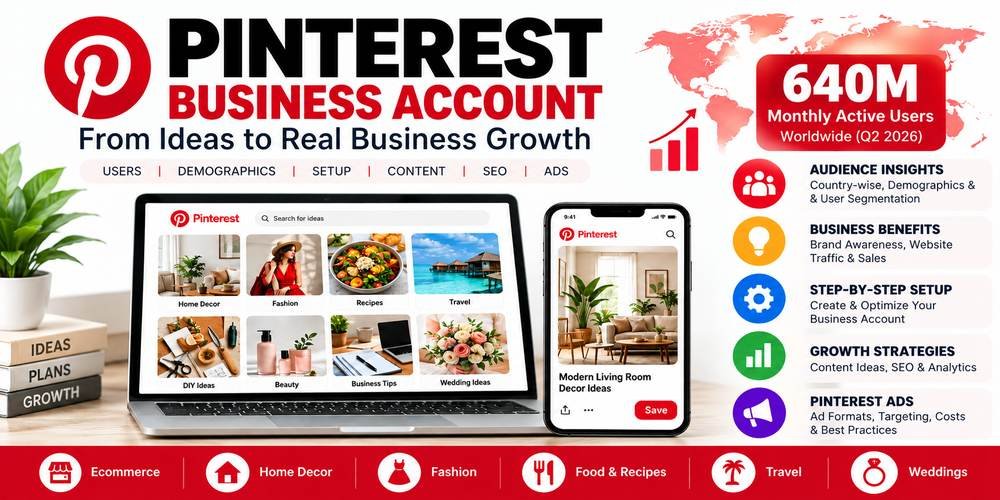
Pinterest is a visual discovery and planning platform. People use it to explore ideas, save inspiration, research products and plan future activities. Businesses can use Pins to build awareness, send qualified traffic to websites, showcase products and support lead generation or sales.
Pinterest reported 640 million monthly active users worldwide in Q2 2026, according to the figures discussed in this report. Global scale is not the same as local demand: businesses should validate country, audience, topic and conversion opportunity before committing budget.
This document consolidates the discussion into a practical guide: platform purpose, user statistics, country-level opportunities, demographic and interest segmentation, business fit, account setup, content planning, Pinterest SEO, advertising, measurement, a 30-day action plan and FAQs.
Important Data Note
Country-level monthly active user counts, age shares, gender shares and audience reach were not verified as a single comparable official dataset in the information available for this report. Country rows and demographic groups are therefore qualitative planning segments, not measured rankings or percentages. Advertising reach is distinct from monthly active users. Verify current figures in Pinterest investor reports, Pinterest Trends, Pinterest Analytics and the advertising tools available for the relevant market before publishing quantitative claims.
1. What Is Pinterest?
Pinterest is a visual discovery platform where people discover, save and organise images, videos and ideas in collections called boards. It combines search, recommendations and visual content. Common use cases include home décor, fashion, beauty, food, weddings, travel, DIY, crafts, education and product discovery.
Why People Use Pinterest
Inspiration: explore ideas for products, spaces, outfits, recipes and projects.
Planning: organise weddings, home renovations, travel, celebrations and purchases.
Learning: find tutorials, checklists, recipes, visual explainers and how-to content.
Product discovery: discover brands, compare styles and explore possible purchases.
Saving: collect useful ideas in boards to revisit later.
How Pinterest Can Help a Business
- Brand awareness among people exploring a relevant category.
- Referral traffic to articles, product pages, service pages, portfolios and landing pages.
- Product discovery through visual demonstrations, product imagery and catalogues where eligible.
- Lead generation when useful Pins link to a relevant landing page.
- Content repurposing: convert existing articles, guides and research into visual assets.
- Measurement through Pinterest Analytics and website analytics.
2. Users and Platform Statistics
Metric |
Figure / interpretation |
How to use it |
Worldwide monthly active users |
640 million reported for Q2 2026 in the discussion |
Indicates global platform scale; does not show the size of an individual country's audience. |
Year-over-year user growth |
11% reported for Q2 2026 in the discussion |
A platform-level growth indicator, not a promise of business performance. |
Quarterly revenue |
$1.18 billion reported for Q2 2026 in the discussion |
Company financial metric; not a direct measure of advertiser ROI. |
India monthly active users |
No reliable, current official figure verified for this document |
Do not invent a number; use available audience estimates and validate campaign performance. |
Advertising audience / reach |
Separate measurement from monthly active users |
Use only with the source, date and methodology clearly labelled. |
Before republishing statistics, confirm the relevant quarter and figures in Pinterest Investor Relations. Do not combine different quarters or compare advertising reach with monthly active users as if they were the same metric.
3. Country-wise Audience Opportunity
The following table is a qualitative market-planning framework, not a ranking by verified current users. It suggests where a business might test Pinterest based on the nature of the market and visual category fit.
Country / market |
Potential category opportunities |
Suggested approach |
Validation needed |
United States |
Home décor, fashion, beauty, recipes, ecommerce |
Product Pins, seasonal campaigns, shopping-oriented creative |
Current audience reach, CPM/CPC and conversion data |
Brazil |
Fashion, beauty, food, lifestyle |
Portuguese-language Pins and local seasonal topics |
Local demand and language performance |
Mexico |
Home design, fashion, weddings, food |
Spanish-language content and relevant occasions |
Country-specific reach and landing-page fit |
United Kingdom |
Interiors, fashion, travel, gifting |
Editorial guides, product collections and shopping content |
Campaign economics and competition |
Canada |
Lifestyle, home décor, fashion, DIY |
Seasonal content and product-led Pins |
Audience size and regional demand |
France |
Fashion, interiors, beauty, food |
French-language creative and visual storytelling |
Language quality and category demand |
Germany |
DIY, home improvement, furniture, lifestyle |
German-language guides and product comparisons |
Search demand and acquisition costs |
India |
Fashion, weddings, food, interiors, beauty |
English and relevant regional-language creative; test topic by topic |
Available ad onboarding, reach estimates and conversions |
Australia |
Home, lifestyle, outdoor, travel |
Seasonal campaigns and practical guides |
Regional audience and performance |
Japan |
Design, fashion, crafts, food, interiors |
Japanese-language content and locally adapted visuals |
Cultural relevance and audience demand |
Country selection checklist: serviceable market, audience demand, language, shipping or service coverage, purchasing power, advertising availability, landing-page experience, taxes and fulfilment, and expected acquisition cost.
4. Demographic Segmentation
Age and life-stage segments help organise creative tests. The age bands below are planning categories; they are not claims about Pinterest's actual user distribution.
Segment |
Potential interests |
Content examples |
Possible business fit |
18–24 |
Fashion, beauty, education, lifestyle |
Outfit ideas, tutorials, budget guides |
Affordable ecommerce, beauty, digital products |
25–34 |
Home design, travel, fashion, weddings |
Buying guides, room makeovers, planning checklists |
Furniture, fashion, travel, wedding services |
35–44 |
Family lifestyle, interiors, cooking, organisation |
Practical guides, product comparisons, recipes |
Home products, family services, food brands |
45–54 |
Home improvement, gardening, cooking, travel |
DIY tutorials, renovation ideas, how-to guides |
Home improvement, gardening, travel |
55+ |
Hobbies, crafts, recipes, gardening, home inspiration |
Step-by-step guides and hobby collections |
Hobby products, lifestyle and home businesses |
Life stage |
Newly married, parents, homeowners, renters, movers |
Wedding planning, nurseries, storage, renovation ideas |
Wedding services, furniture, storage, household products |
Gender-related segments |
Interests vary by person and category |
Inclusive creative based on actual audience signals |
Segment only when permitted and supported by evidence |
Use available analytics and compliant ad targeting to determine which groups are actually reachable and valuable. Do not infer a user's interests or buying behaviour from age or gender alone.
5. Interest-Based Segmentation
Interest segment |
Search/content themes |
Example Pin |
Potential products/services |
Home décor |
Interior design, furniture, room layouts |
10 Modern Living Room Ideas |
Furniture, accessories, interior design |
Fashion |
Outfits, styling, seasonal trends |
Capsule Wardrobe for Work |
Clothing, shoes, accessories |
Beauty |
Skincare, makeup, haircare |
Everyday Makeup Routine |
Cosmetics and skincare |
Food |
Recipes, meal planning, baking |
Easy Vegetarian Dinner Ideas |
Food products, kitchenware, publishers |
Weddings |
Dresses, venues, flowers, invitations |
Elegant Wedding Décor Ideas |
Planners, venues, bridalwear |
Travel |
Destinations, itineraries, packing |
Three-Day Jaipur Travel Guide |
Hotels, tours, travel services |
DIY and crafts |
Handmade projects, repairs, craft ideas |
DIY Home Décor Under ₹1,000 |
Craft supplies, tools, workshops |
Fitness and wellness |
Exercise ideas, healthy routines |
Beginner Home Workout Plan |
Fitness equipment, coaching, content |
Education and business |
Templates, infographics, tutorials |
Small Business Marketing Checklist |
Courses, software, consulting |
B2B and manufacturing |
Materials, product applications, industrial design |
Types of Industrial Packaging |
Manufacturers, suppliers, technical content |
6. Purchase-Intent Segmentation
Audience group |
Behavioural signal |
Objective |
Recommended content |
Inspiration seekers |
Explore ideas and save Pins |
Awareness |
Inspiring visuals, trend collections, educational content |
Active planners |
Search for projects or upcoming events |
Consideration |
Checklists, comparisons, detailed guides |
Product researchers |
Explore products, styles or features |
Website visits |
Product Pins, demonstrations, comparisons |
High-intent visitors |
Visit product or pricing pages |
Conversion |
Relevant landing pages and eligible retargeting |
Previous customers |
Purchased or engaged previously, where tracking permits |
Repeat purchase |
New collections, complementary products, seasonal ideas |
These are conceptual segments for planning. Available audience targeting depends on current platform features, market availability, privacy requirements and account eligibility.
7. Which Businesses Should Use Pinterest?
Business type |
Suitability |
Content strategy |
Priority |
Fashion and apparel |
Very high |
Outfit inspiration, styling, seasonal collections |
High |
Home décor and furniture |
Very high |
Room designs, product showcases, makeovers |
High |
Beauty and skincare |
High |
Routines, tutorials, product education |
High |
Wedding and event services |
High |
Portfolios, mood boards, planning guides |
High |
Food and recipe publishers |
High |
Recipes, food photography, meal plans |
High |
Travel and hospitality |
High |
Destination guides, itineraries, hotel visuals |
High |
Ecommerce |
High when products are visually compelling |
Product Pins and shopping content |
High |
Digital marketing and education |
Medium to high |
Templates, diagrams, tutorials |
Test |
SaaS businesses |
Depends on visual use cases |
Workflow diagrams, templates, educational guides |
Test |
Manufacturing and B2B |
Selective |
Product applications, materials guides, technical graphics |
Test demand |
Local laundry / dry cleaning |
Secondary channel |
Garment-care guides, fabric tips, seasonal clothing care |
Prioritise local search first |
A local service that depends on immediate proximity-based demand may get more direct value from Google Business Profile and local search. Pinterest can be a secondary channel for educational or visually useful content.
8. How to Create a Pinterest Business Account
1.Open Pinterest at https://www.pinterest.com/ and select the sign-up or business-account option.
2.Enter the required account details and use a secure email address your business can retain access to.
3.Add your business name, website, category, logo and a concise description.
4.Create focused boards using clear names relevant to the content you plan to publish.
5.Create original Pins with useful titles, descriptions and relevant destination URLs.
6.Claim your website where supported and configure suitable website analytics and conversion tracking.
7.Review Pinterest Analytics and improve the profile and content based on evidence.
Official account setup guide: https://help.pinterest.com/en/business/article/get-a-business-account
Profile Launch Checklist
·Business name matches the website and other brand properties.
·Recognisable logo and profile image are uploaded.
·Description clearly explains the business and its subject area.
·Website is added and claimed where available.
·Boards are focused, relevant and clearly named.
·Initial set of useful Pins is ready.
·Analytics and conversion tracking have been checked.
9. Content Formats to Publish
Content format |
Purpose |
Example |
Destination |
Before-and-after |
Show a transformation |
Small living room makeover |
Project page or service page |
Infographics/checklists |
Teach and earn saves |
10 things to check before buying a sofa |
Detailed article |
Product showcases |
Explain product features and use cases |
Minimalist skincare essentials |
Product detail page |
Tutorials/how-to |
Solve a problem step by step |
Organise a small kitchen in five steps |
Tutorial or blog |
Seasonal content |
Meet occasion-related demand |
Diwali home decoration ideas |
Relevant category or guide |
Templates/mood boards |
Help users plan or create |
Modern brand colour palette ideas |
Resource or lead page |
Video demonstrations |
Show products or processes in action |
Room transformation walkthrough |
Product or project page |
Comparisons |
Help people evaluate choices |
Product A vs Product B |
Comparison or buying guide |
Example Seven-Day Content Calendar
Day |
Format |
Example |
Monday |
Educational infographic |
7 tips for choosing the right product |
Tuesday |
Product showcase |
Features, uses and styling ideas |
Wednesday |
Tutorial |
How to solve a common customer problem |
Thursday |
Comparison |
Product A vs Product B |
Friday |
Before-and-after |
Customer transformation or project |
Saturday |
Seasonal inspiration |
Ideas for an upcoming occasion |
Sunday |
Blog promotion |
Visual summary linking to a detailed article |
10. Organic Growth Strategy
Keyword Research
Use Pinterest search suggestions, Pinterest Trends and relevant audience data to identify how people describe topics. For home décor, examples include small living room design ideas, modern bedroom décor, budget-friendly home makeover and space-saving storage.
Creative Quality
·Use high-quality images and clear subject matter.
·Consider a 2:3 vertical ratio, such as 1,000 × 1,500 pixels, for standard image Pins; check current format specifications.
·Use readable text overlays only when they add clarity.
·Keep branding visible but unobtrusive and design for mobile.
·Make sure the Pin accurately represents the linked destination.
Boards and Consistency
Create focused boards around themes rather than unrelated collections. Start with a publishing schedule the team can sustain. A test cadence of a few original Pins per day may suit a resourced team, but it is not an official ranking requirement or a guarantee of growth.
Destination Pages
·Link a product Pin to the relevant product page.
·Link a recipe Pin to the full recipe.
·Link an infographic to the in-depth article.
·Link a portfolio Pin to the relevant project or service page.
·Avoid sending every Pin to the homepage when a more specific page exists.
Measure and Iterate
Review impressions, saves, Pin clicks, outbound clicks, engagement rate, website sessions and conversions. High impressions with few outbound clicks may indicate a weak message or mismatched creative. High clicks with few conversions may indicate a landing-page, offer or audience issue.
11. Pinterest SEO
8.Find relevant phrases using Pinterest search suggestions and Trends.
9.Write descriptive Pin titles that state the topic clearly.
10.Write helpful descriptions and include relevant phrases naturally.
11.Save Pins to the most relevant boards.
12.Make the destination page relevant, fast, mobile-friendly and useful.
13.Ensure the visual, title, description and landing page match.
14.Review performance and develop new creative around topics that produce valuable traffic.
Pinterest SEO and Google SEO are not identical. Pinterest can support discovery and referral traffic, but a Pin does not automatically improve Google rankings. Optimise the website independently for search intent, content quality, technical accessibility and conversion.
12. Pinterest Ads
Pinterest Ads allow eligible advertisers to pay to distribute content to relevant audiences. Campaign setup and format availability vary by market and account.
Common Ad Formats
Format |
Typical use |
Creative idea |
Promoted image Pins |
Awareness, product discovery, traffic |
Single strong image with a clear message |
Video Ads |
Demonstration and storytelling |
Product-in-use or transformation video |
Carousel Ads |
Product ranges and comparisons |
Multiple swipeable images |
Collections Ads |
Ecommerce and related products |
Main lifestyle creative with supporting product imagery |
Idea and other interactive formats |
Tutorials and inspiration |
Multi-step educational creative, where available |
India Advertising Availability
The discussion referenced Pinterest's official help documentation listing India as a market served through an advertising partner. Before planning a campaign, confirm the current onboarding process, billing, targeting options, minimum spend and available formats with Pinterest's official India advertising page: https://business.pinterest.com/en-in/advertise/. The partner and account setup process may change.
Advertising Cost Metrics
Metric |
Formula |
Meaning |
CPM |
Ad spend ÷ impressions × 1,000 |
Cost per thousand impressions |
CPC |
Ad spend ÷ clicks |
Average cost per click |
CTR |
Clicks ÷ impressions × 100 |
Click-through rate |
Conversion rate |
Conversions ÷ clicks × 100 |
Share of clicks that convert |
Cost per lead |
Ad spend ÷ leads |
Average cost for each lead |
ROAS |
Attributed revenue ÷ ad spend |
Revenue attributed per unit of ad spend |
Illustrative Campaign Example
Metric |
Hypothetical result |
Ad spend |
₹15,000 |
Impressions |
150,000 |
Clicks |
3,000 |
Conversions |
60 |
Attributed revenue |
₹60,000 |
CPC |
₹5 |
CTR |
2% |
Cost per conversion |
₹250 |
ROAS |
4× |
These values are illustrative calculations, not industry benchmarks or a forecast. Revenue attributed to ads is not profit; account for product costs, fulfilment, taxes, discounts and other expenses.
Practical Ad Testing
·Choose one clear campaign objective.
·Test two or three materially different creative concepts.
·Send each ad to a relevant landing page.
·Track conversions using suitable analytics and supported Pinterest measurement tools.
·Judge performance by qualified leads, purchases and costs—not impressions alone.
·Increase spend only when results and margins justify it.
13. Measurement and Analytics
Funnel stage |
Metrics |
What to learn |
Discovery |
Impressions, reach |
Whether the content is being surfaced |
Engagement |
Saves, Pin clicks, interactions |
Whether the content is useful or compelling |
Website traffic |
Outbound clicks, engaged sessions |
Whether the Pin attracts relevant visitors |
Business outcomes |
Leads, purchases, revenue, profit |
Whether Pinterest contributes to business results |
Paid efficiency |
CPC, CPL, CPA, ROAS |
Whether campaigns meet commercial targets |
Use UTM parameters on website links to identify Pinterest traffic in Google Analytics 4. Example: https://example.com/products/sofa/?utm_source=pinterest&utm_medium=organic_social&utm_campaign=home_decor. Use a consistent naming convention and distinguish paid campaigns with an appropriate medium such as paid_social.
Suggested Monthly Report
·Number of original Pins published.
·Impressions, saves and outbound clicks.
·Engaged website sessions from Pinterest.
·Leads and purchases attributable to Pinterest.
·Conversion rate and revenue attributed.
·Advertising spend, cost per acquisition and ROAS where applicable.
·Best-performing topics, creatives, boards and landing pages.
14. Thirty-Day Action Plan
Week |
Focus |
Tasks |
Week 1 |
Setup and research |
Create business profile; research 20–30 phrases; create 5–8 focused boards; prepare first 10 Pins. |
Week 2 |
Publish and test |
Publish consistently; test product, tutorial and infographic formats; add relevant links; record baseline metrics. |
Week 3 |
Improve content |
Identify promising topics; create distinct variations; improve titles and landing pages; check tracking. |
Week 4 |
Measure and decide |
Review platform and website analytics; compare qualified traffic; calculate leads, purchases and costs; decide next tests. |
16. Conclusion
Pinterest can be a useful discovery and referral channel for businesses with visual products, searchable inspiration or educational content. The strongest approach is to define the target market, validate audience demand, publish original Pins consistently, link to relevant pages and measure leads, purchases and profitability. Treat country and demographic tables as planning frameworks unless backed by current, comparable audience data.
Editorial note: Statistics and ad availability change. Recheck official sources before publication. This document deliberately avoids inventing precise country user counts, age shares, gender shares or advertising benchmarks where comparable current evidence was not verified.
Treat the first 30 days as an initial experiment, not a definitive verdict. Some Pins may take longer to produce results. Decide whether to continue based on audience fit and commercial outcomes.