Introduction: Is India’s skill-development market ready for a new business model?
India’s skill-development sector is changing as employers respond to artificial intelligence, automation, digital transformation and evolving customer expectations. Students, job seekers and working professionals need practical skills that help them secure employment, improve performance and progress in their careers.
This creates an opportunity for training businesses—but not necessarily for another institute offering generic courses. A more promising model is to build training around three questions: which skills employers struggle to find, which learners need those skills, and whether the provider can demonstrate that the training improves capability or employment outcomes.
Three sources help frame the opportunity: NITI Aayog’s Reimagining Skilling for Viksit Bharat@2047, private market-research publisher’s India soft-skills training market estimate, and the Press Information Bureau’s Empowering India’s Skill Ecosystem backgrounder. These sources measure different things, so their figures should not be treated as directly comparable.
1. What does the data say about India’s skilling opportunity?
NITI Aayog: skilling as a lifelong journey
NITI Aayog’s August 2026 report, Reimagining Skilling for Viksit Bharat@2047, frames skilling as a lifelong process connecting education, employment and career progression. It highlights the need for more flexible learning pathways, stronger employer engagement, apprenticeship opportunities, informed career guidance and recognition of learning outcomes.
Government data snapshot: scale and programme reach
The report’s central message is that expanding access to courses is not enough. Learners also need reliable information, practical exposure, relevant credentials and pathways into work. For training providers, this suggests an opportunity to help learners choose skills, practise them, demonstrate competence and connect with employers.
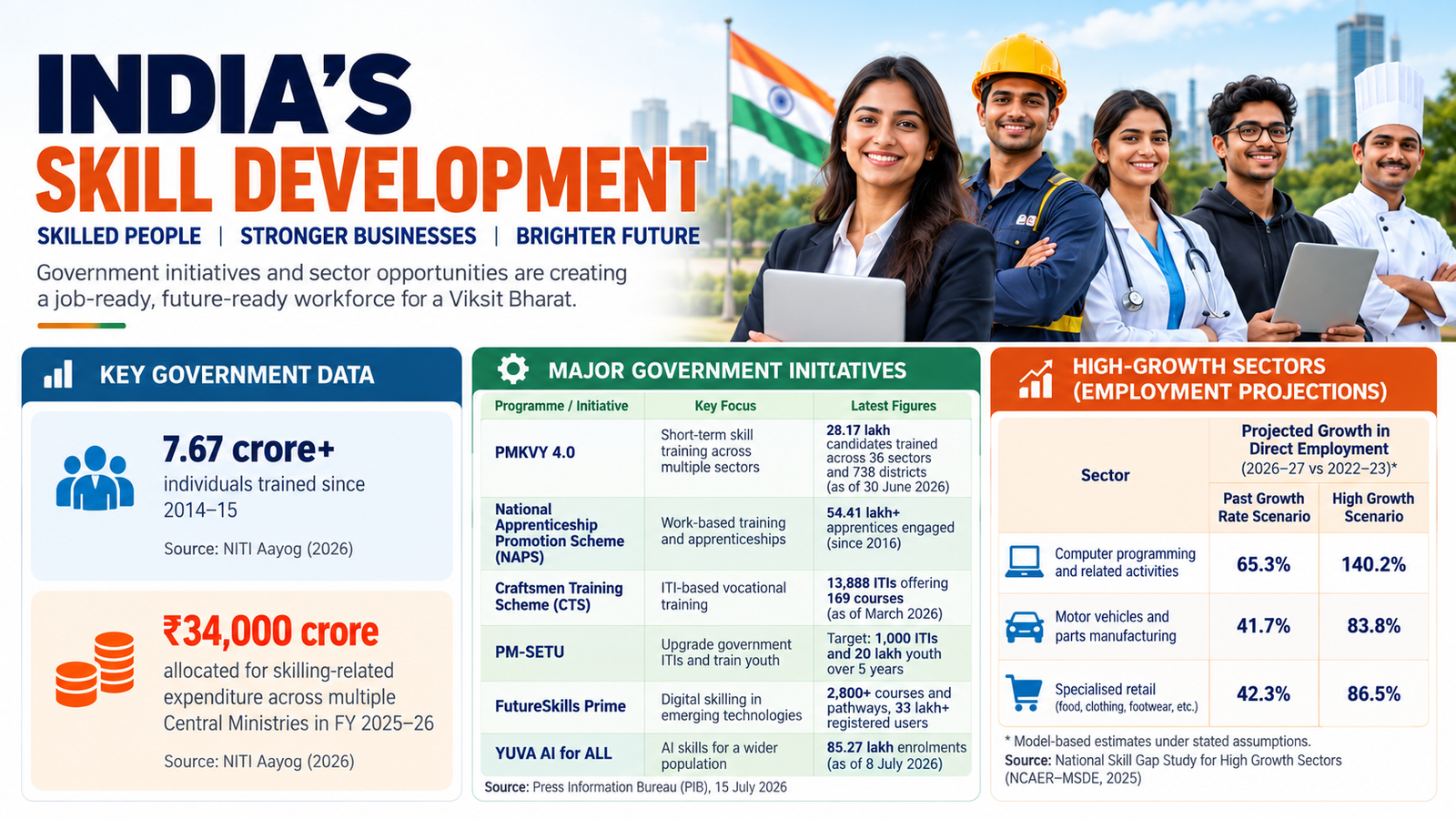
Indicator |
Reported figure |
How to interpret it |
People formally skilled since 2014–15 |
7.67 crore |
NITI Aayog report figure; cumulative programme-related reach, not a count of currently employed skilled workers. |
Skilling-related allocation across key Central Ministries, FY 2025–26 |
₹34,000 crore |
Budget allocation across multiple ministries; not private training-market revenue. |
Population segments considered in the NITI Aayog framework |
Approximately 60 crore citizens |
Five learner/worker segments across schooling, tertiary education, work, NEET youth and women. |
Source: https://www.niti.gov.in/node/2397
PIB: government programmes are expanding training access
The Press Information Bureau’s 15 July 2026 backgrounder, Empowering India’s Skill Ecosystem, describes initiatives spanning school education, vocational training, apprenticeships, workforce reskilling and emerging technologies.
Programme |
Figure reported by PIB |
PMKVY 4.0 |
28.17 lakh candidates trained across 36 sectors and 738 districts as of 30 June 2026 |
National Apprenticeship Promotion Scheme |
More than 54.41 lakh apprentices engaged since 2016 |
Craftsmen Training Scheme |
13,888 ITIs offering 169 courses as of March 2026 |
PM-SETU |
Target to upgrade 1,000 government ITIs and train 20 lakh youth over five years |
FutureSkills Prime |
More than 2,800 courses and pathways and 33 lakh-plus registered users |
YUVA AI for ALL |
85.27 lakh enrolments as of 8 July 2026 |
Selected government programme indicators
These figures describe individual programmes and their reach. They are not counts of unique people across the whole skilling ecosystem and should not be added together to estimate the number of skilled workers in India. They do show the breadth of the ecosystem and potential areas for complementary employer-specific training, assessments, communication skills and career support.
Programme / indicator |
Figure reported |
Reference date / scope |
PMKVY 4.0 |
28.17 lakh candidates trained |
As of 30 June 2026; 36 sectors and 738 districts |
PMKVY 4.0 recent training |
21.91 lakh candidates trained |
1 April 2024 to 31 March 2026 |
Customised courses / future-skill roles |
68 courses / 189 job roles |
PMKVY 4.0 |
Institutions implementing PMKVY 4.0 |
More than 16,900, including 6,800+ Skill Hubs |
Nationwide |
National Apprenticeship Promotion Scheme |
54.41 lakh+ apprentices engaged |
Since 2016 |
Craftsmen Training Scheme |
13,888 ITIs; 169 courses |
As of March 2026 |
FutureSkills Prime |
2,800+ courses/pathways; 33 lakh+ registered users |
PIB backgrounder figure |
YUVA AI for ALL |
85.27 lakh enrolments |
As of 8 July 2026 |
Source: https://www.pib.gov.in/PressReleasePage.aspx?PRID=2284941®=3&lang=1
2. What government data can—and cannot—tell us about market size
The government sources reviewed for this article do not provide a directly comparable, official national market-size estimate for the commercial soft-skills training industry. Government programme figures show the reach of particular initiatives; the National Skill Gap Study identifies selected sectoral skill needs and modelled employment projections. Neither should be treated as total private-market revenue.
A responsible government-data-led article should therefore avoid assigning a national revenue figure to the soft-skills training market unless an official source defines and publishes that measure. Instead, use programme reach and sectoral evidence to identify where training may be needed, then validate commercial demand locally.
For a business decision, estimate a serviceable market from reachable employers or learners, realistic purchase frequency and a validated price. This local estimate is a business model, not an official national market statistic.
3. What this growth could mean for a training business
Three business implications stand out. First, corporate customers may provide recurring revenue through onboarding, customer service, sales and management programmes. Second, blended learning can combine digital lessons with live coaching and practical exercises. Third, specialist training may be easier to position than a generic soft-skills course.
·Customer-service communication for retail and hospitality teams.
·Business English and writing for client-facing professionals.
·Presentation and stakeholder communication for technical teams.
·Leadership and feedback skills for first-time managers.
·Interview readiness and workplace communication for graduates.
4. The real problem: training does not automatically create employability
Training has value when learners can apply what they have learned. A course called Business Communication could go beyond lectures and require learners to write a professional email, handle a simulated customer complaint, deliver a short presentation, participate in a team discussion and improve their work after feedback.
Providers can compare baseline and end-of-course performance using consistent rubrics. This gives learners evidence of progress and employers a more useful signal than attendance alone. A certificate may be useful, but it should not be confused with a guarantee of employment.
5. Seven business opportunities in skill development
Industry-specific soft-skills training
Design separate programmes for retail, hospitality, IT services, sales, healthcare administration, manufacturing supervisors and customer-support teams. Revenue can come from workshops, annual learning contracts and refresher programmes.
Job-readiness programmes for graduates
Combine professional communication, interview practice, CV improvement, digital collaboration and role-specific exercises. Track assessment gains and verified employment outcomes.
Corporate communication and leadership training
Offer programmes in business writing, presentations, feedback, conflict management, sales conversations and first-time management. Sell measurable business outcomes rather than course hours alone.
Regional-language employability training
Teach foundational employability skills in languages learners are comfortable with, alongside the additional workplace-language skills required for their target roles. Validate demand in one language and one job category first.
AI-assisted communication coaching
Use AI to support repeated practice in interview answers, writing and customer conversations. Treat automated feedback as a learning aid, protect personal data and retain human review for high-stakes decisions.
Apprenticeship and employer-connect services
Help employers prepare candidates, coordinate practical learning and gather supervisor feedback. Clearly define the service and verify current programme requirements before claiming formal scheme participation.
Skill-gap assessment and workforce analytics
Assess job tasks, employee capability and manager feedback before recommending training. Provide follow-up measurement and dashboards while protecting employee privacy.
6. What the National Skill Gap Study reveals about technical training
The attached National Skill Gap Study for High Growth Sectors, prepared by the National Council of Applied Economic Research with the Ministry of Skill Development and Entrepreneurship, examines selected areas including agriculture, animal husbandry, textile weaving, motor-vehicle manufacturing and related activities, renewable power generation, specialised retail and computer programming.
The study combines quantitative analysis with stakeholder interviews; its executive summary reports 191 stakeholder interviews across the seven selected sectors. It identifies roles such as data engineering, technical business analysis, data security, CNC operation, automotive software development, solar installation and operations and maintenance.
Its 2026–27 employment projections are model-based scenarios, not confirmed future hiring figures. For example, under the report’s past-growth-rate scenario, direct jobs in computer programming activities were projected to rise by 65.3% compared with the 2022–23 input-output baseline. The report cautions that input-output analysis assumes technology remains constant, so results need to be considered alongside industry feedback and technological change.
Selected NCAER–MSDE employment projections for 2026–27
Note: Percentages are the report’s projected change in direct jobs for 2026–27 compared with its 2022–23 input-output-analysis baseline, under two different growth scenarios. These are model-based projections, not observed job growth or guaranteed vacancies.
Examples of sector-specific training opportunities
Business implication: technical training can be paired with communication, teamwork, documentation and problem-solving skills. The relevant combination depends on the actual role and employer.
Sector in study |
Roles / skills identified in report |
Possible training focus |
Agriculture |
Drone operators, agri-advisors, GIS specialists, farm machinery technicians |
Equipment operation, field data, safety and customer communication |
Animal husbandry |
Veterinary technician assistants, dairy technologists, refrigeration mechanics |
Practical technical skills, hygiene and maintenance |
Textiles |
Handloom and powerloom weavers and assistants |
Machine/process skills, quality and production practices |
Automotive |
CNC operators, tool-and-die roles, vehicle software, embedded systems, automotive cybersecurity |
Technical competence, diagnostics, documentation and teamwork |
Renewable energy |
Solar installers, PV installers, O&M technicians, site surveyors |
Installation, electrical safety, maintenance and field reporting |
Retail and related services |
Sales/customer service, e-commerce marketing, merchandising, logistics |
Customer conversations, digital tools and operations |
Computer programming |
Data engineering, technical business analysis, data security and domain analysis |
Programming/data skills, problem-solving and technical communication |
Selected sub-sector |
Scenario 1: past growth rates |
Scenario 2: IMF growth projections |
Growing cereals, pulses and oilseeds |
+11.7% |
+16.6% |
Raising cattle and buffaloes |
+24.9% |
+16.5% |
Weaving of textiles |
−11.6% |
−22.4% |
Motor vehicles and related activities |
+41.7% |
+104.1% |
Solar and other non-conventional power generation |
+22.4% |
+30.1% |
Specialised retail and vehicle repair-related grouping |
+42.3% |
+47.5% |
Computer programming activities |
+65.3% |
+59.6% |
7. How to build a skill-training business using data
1.Choose one customer segment and one skill problem. Avoid launching a large catalogue of unrelated courses at the start.
2.Interview 20–30 employers as an initial discovery exercise. This is a proposed validation target, not a statistically representative sample.
3.Ask which roles are difficult to recruit for, which capabilities new hires lack, what training employers already buy and what evidence would justify payment.
4.Validate learner demand through job listings, search data, colleges, employer interviews and paid pilots. Interest alone is not proof of paying demand.
5.Run a short pilot with a baseline assessment, practical exercises, instructor feedback and a repeat assessment.
6.Track enrolments, attendance, completion, assessment changes, verified placement outcomes, employer satisfaction, repeat contracts and contribution margin.
8. Estimate the market without overstating demand
Government programme figures do not show how much revenue is available in a particular city or niche. Build a local serviceable market estimate from the customers you can realistically reach.
Illustrative B2B example: if 20 companies buy an annual training package priced at ₹1,50,000, annual revenue would be 20 × ₹1,50,000 = ₹30,00,000. This is an example calculation, not a market forecast; it excludes costs, taxes, renewals and acquisition time.
Demand validation dashboard: suggested metrics
Useful measures to track:
Metric |
Definition / calculation |
Why it matters |
Qualified employer leads |
Employers with a confirmed skill need, decision-maker and next step |
Separates genuine B2B demand from general interest |
Paid pilot conversion |
Paid pilots ÷ qualified proposals |
Tests willingness to pay |
Course completion rate |
Learners completing ÷ learners enrolled |
Measures engagement and delivery fit |
Assessment improvement |
Post-training score minus baseline score using the same rubric |
Tracks learning progress |
Repeat contract rate |
Customers renewing or buying again ÷ eligible customers |
Signals ongoing customer value |
Contribution margin |
Revenue minus direct delivery costs |
Shows whether the offer can be commercially sustainable |
·Search impressions and relevant enquiries: awareness and interest.
·Qualified employer leads: potential B2B demand.
·Paid pilot bookings: willingness to pay.
·Attendance and completion: engagement.
·Pre- and post-training results: learning effectiveness.
·Repeat contracts: customer value and retention.
·Revenue and contribution margin: commercial sustainability.
9. International lesson: connect training with real work
A broadly useful lesson from international vocational and workforce-development approaches is to connect learning with actual tasks, employer expectations and opportunities to practise. Indian providers can adapt this through employer-reviewed curricula, workplace simulations, apprenticeships where appropriate, competency-based assessment and continued learning as job requirements change. Local wages, employer practices, learner affordability and qualification requirements still need to be considered.
10. Government programmes and partnership opportunities
The PIB backgrounder discusses programmes and initiatives such as PMKVY, apprenticeship promotion, ITIs, PM-SETU and FutureSkills Prime. These can help a business understand the wider ecosystem, but eligibility and partnership conditions differ. Verify current guidelines, accreditation requirements, procurement processes and approved-provider conditions before assuming access to funding or formal participation.
A private training business can also operate commercially by selling specialist programmes directly to employers or learners. Its economics should be validated using real customers, delivery costs and repeat purchase behaviour.
11. Challenges and risks
Competition
Generic courses compete with established training brands, independent trainers, EdTech platforms and internal corporate learning teams.
Measuring results
Use consistent practical assessments instead of relying only on satisfaction surveys. Be cautious about attributing every workplace change solely to training.
Trainer quality
Facilitators need to observe behaviour, give constructive feedback and adapt to different learners. Quality controls are essential when scaling.
Affordability and access
Consider flexible schedules, modular programmes and employer-sponsored options where appropriate.
Technology and privacy
Explain AI limitations, obtain appropriate consent, protect learner information and avoid automated scores as the sole basis for high-stakes hiring decisions.
Employment claims
Do not promise jobs, salaries or promotions without support. Publish verifiable outcomes and explain how they were measured.
Conclusion: connect skills with outcomes
India’s skill-development opportunity is broader than the growth of one training category. Government programme figures show the breadth of skilling activity, NITI Aayog identifies structural barriers and reform priorities, and private market-research publisher estimates growth in the soft-skills training market. These sources measure different things and should be interpreted separately.
For entrepreneurs, the practical path is to start with a specific customer, a clearly defined skill gap and a measurable outcome. Validate willingness to pay, build employer relationships, measure learning and commercial performance, and expand only when delivery quality and unit economics support it.